AI jargon turns up in team meetings, product pages, vendor emails and job posts, and most people nod along without a clear definition in mind. This AI terms glossary explains 47 terms in plain English, grouped by topic so each concept builds on the one before it. Every entry starts with a short definition, adds a business example, and ends with a limit or a practical note.
The list covers the AI terms for beginners that come up first, such as machine learning and prompt, and the newer ones from 2025 and 2026, such as agentic AI, MCP and vibe coding. You can read it from top to bottom or jump to the term you need. It was last updated in October 2026, so model names and limits may change. Check each provider before you rely on a number.
Most confusion about AI comes from vocabulary, not from the technology itself. Once the words are clear, product pages, contracts and tool comparisons become much easier to read.
How to Use This AI Terms Glossary
The glossary is ordered from simple to advanced. Core concepts come first, then how language models work, then prompts, then accuracy and safety, then agents and newer terms, and finally the AI terms for business and deployment. Every entry can be read alone, so you do not need to follow the order.
If you only need a fast answer, use the quick reference table below. If a definition still feels abstract, read the example in the entry, because each one ties the term to an everyday task such as writing an email or answering a support ticket. Different vendors sometimes use different AI terminology for the same thing, so where a term has a common second name it is listed in the entry. For a university view of the same vocabulary, the MIT Sloan glossary is a short and well cited companion.
Quick Reference: The AI Terms You Will See Most
These ten terms appear in nearly every AI glossary and in most vendor documentation. Learn them first and the AI terms everyone should know will feel familiar.
| Term | Plain-English meaning |
|---|---|
| LLM | A model trained on large amounts of text to read and write language |
| Prompt | The instruction you give an AI tool |
| Token | A small piece of text the model reads and counts |
| Context window | How much text the model can hold at once |
| Hallucination | A confident answer that is wrong or invented |
| Fine-tuning | Extra training on your own examples |
| RAG | Looking up documents before answering |
| Temperature | A setting that controls how predictable the answer is |
| Agentic AI | AI that plans and takes steps toward a goal |
| AI governance | Rules for how a company uses AI |
Core AI Concepts
This first group of the generative AI glossary covers the base ideas. Every other term in the list builds on these eight.

Artificial Intelligence (AI)
Artificial intelligence (AI) refers to software that performs tasks which normally need human judgment, such as reading text, recognizing images or making a prediction. Most AI used in business today is narrow, which means it is built for one kind of task. A spam filter is AI, but it cannot write a report.
Machine Learning (ML)
Machine learning (ML) is a way of building software that learns patterns from examples instead of following hand written rules. A model sees thousands of past orders, for instance, and learns which ones tend to be returned. The quality of the result depends heavily on the quality and amount of the examples it learns from.
Deep Learning
Deep learning is a type of machine learning that uses neural networks with many layers. It powers image recognition, speech to text and the language models behind chat tools. It usually needs a lot of data and computing power, which is why training these systems is expensive and mostly done by large companies.
Neural Network
A neural network is a system of connected nodes, loosely modeled on the brain, that passes numbers from one layer to the next and adjusts them during training. Each connection has a weight that shows how much it matters. Nobody sets these weights by hand, which is why the inner workings are hard to explain.
Algorithm
An algorithm is a set of step by step instructions a computer follows to solve a problem or reach a result. A recipe is a simple comparison. In AI, the algorithm describes how a model learns, while the model is what you get after the learning is finished.
Model
A model is the trained result of a learning process, a file of numbers that turns an input into an output. GPT, Claude and Gemini are all models. When a tool says it runs on a certain model, it means that file is doing the work behind the interface.
Generative AI
Generative AI refers to models that create new content, such as text, images, audio, video or code, based on patterns learned from existing data. ChatGPT and Midjourney are common examples. It is useful for first drafts and ideas, but the output still needs a human check. Our guide to generative AI for business shows where it fits in daily work.
Artificial General Intelligence (AGI)
Artificial general intelligence (AGI) describes a system that could learn and perform any intellectual task a person can. It does not exist today. Current tools are strong in some areas and weak in others, so treat any product that claims to be AGI with caution.
How Language Models Work
Language models sit behind most of the AI tools people use at work. These nine AI terms explain what they are made of and what happens when you press send.
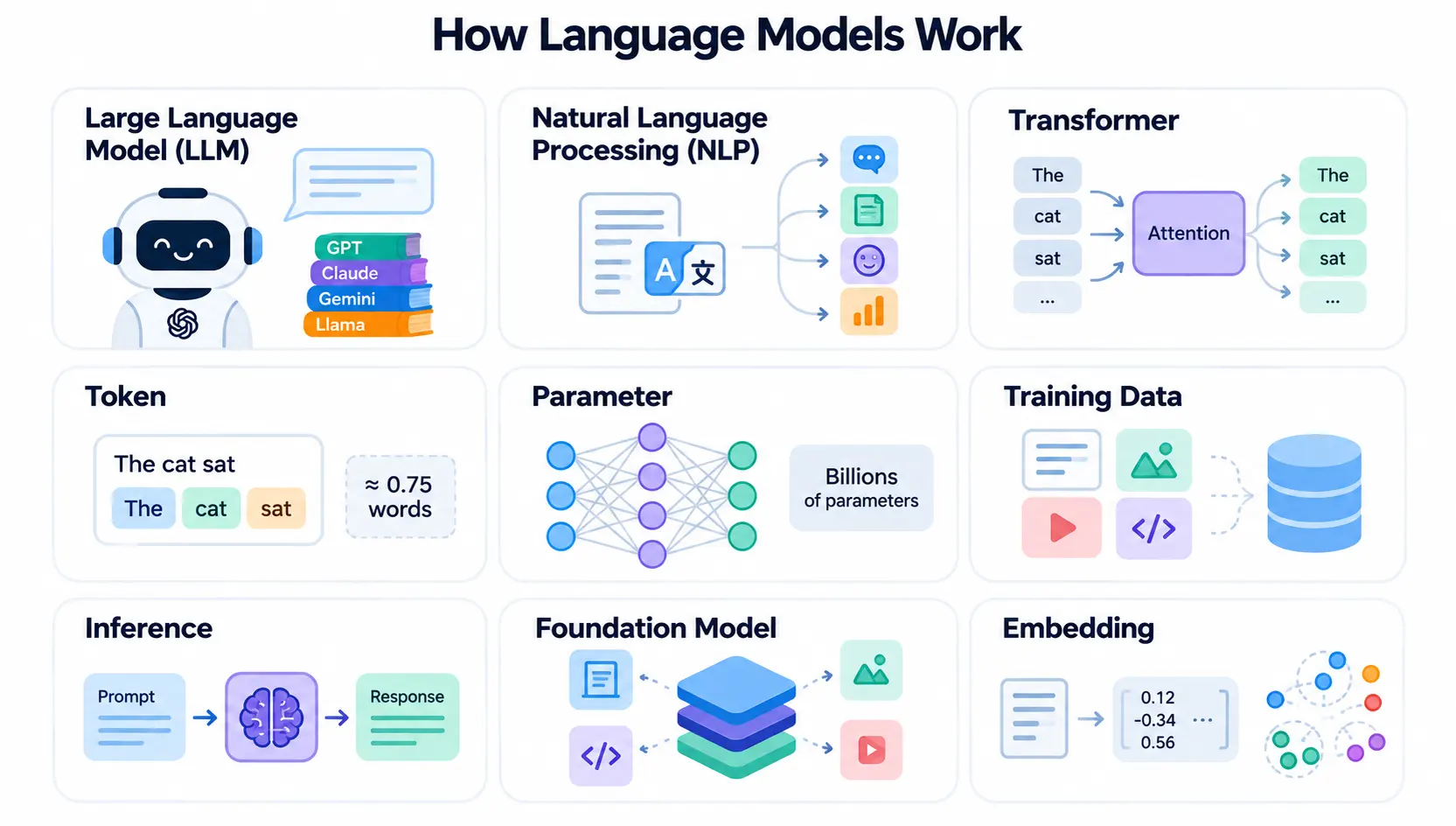
Think of this part of the AI glossary as the plain English view of the engine.
Large Language Model (LLM)
A large language model (LLM) is a model trained on huge amounts of text so it can predict the next word and, by doing that again and again, write full answers. Examples include GPT, Claude, Gemini and Llama. An LLM does not look up facts the way a search engine does, which is why it can sound sure and still be wrong.
Natural Language Processing (NLP)
Natural language processing (NLP) is the field of AI that deals with human language, covering tasks such as translation, summarization, sentiment analysis and chat. Before LLMs, NLP tools were built for one task each. Today a single language model can handle most of them in one tool.
Transformer
A transformer is the model design behind almost every modern language model. It uses a method called attention to weigh which words in a passage matter most to each other, so it can follow meaning across long text. The T in GPT stands for transformer.
Token
A token is a small piece of text, often a word or part of a word, that a model reads and counts. In English, one token is roughly three quarters of a word. Most paid AI tools bill by tokens, so longer prompts and answers cost more. The guide on how much AI tools cost shows how these charges add up.
Parameter
A parameter is one of the numbers inside a model that is adjusted during training. Large models have billions of them. More parameters often mean more capacity, but not always better results, because training data and design also matter. Parameters are not the same thing as tokens, which are pieces of text.
Training Data
Training data is the collection of text, images or other examples a model learns from. It shapes what the model knows and which mistakes it makes. If the data is outdated or one sided, the answers will be too, so ask vendors what their model was trained on, especially for sensitive work.
Inference
Inference is the moment a trained model produces an answer from your input. Training happens once and costs a lot, while inference happens every time someone sends a prompt. Speed and price per request both depend on how heavy the model is at this stage.
Foundation Model
A foundation model is a large model trained on broad data that can be adapted to many tasks, such as writing, summarizing or coding. Companies build products on top of it instead of training their own from scratch. Most chat tools you use are products built on a foundation model.
Embedding
An embedding is a list of numbers that represents the meaning of a word, sentence or image. Texts with similar meaning get similar numbers, so a system can find related documents even when they share no words. Embeddings are what make semantic search and many company chatbots work.
Prompts and Controls
These eight terms describe what you type into an AI tool and the settings that change the result. They matter most if you use AI every day.
Prompt
A prompt is the instruction, question or text you give an AI tool to get an answer. It can be one line or several pages with background, examples and a format. A clear prompt usually produces a clear answer, and a vague one produces a vague answer.
Prompt Engineering
Prompt engineering is the practice of writing and testing prompts so a model gives useful and consistent results. It covers wording, examples, structure and format. Teams often keep a shared library of tested prompts for tasks such as emails and reports. Our guide to prompt engineering for business explains the methods step by step.
System Prompt
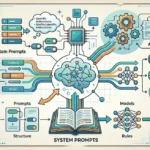
A system prompt is a set of standing instructions that tells the model how to behave in every conversation, for example its tone, its role and what it must refuse. Users usually do not see it. A prompt is what you type, while a system prompt is what the tool builder sets in advance.
Context Window
The context window is the amount of text a model can hold at once, counted in tokens. It includes your prompt, earlier messages and the answer. When a conversation passes the limit, the model loses the oldest parts. Larger windows let you upload long reports, though quality can still drop with very long input.
Temperature
Temperature is a setting that controls how predictable the output is. A low value gives focused and repeatable answers, which suits data extraction. A high value gives more varied and creative wording, which suits brainstorming. Most chat tools set it for you, but developer tools let you change it.
Zero-Shot and Few-Shot Prompting
Zero-shot prompting means asking the model to do a task with no examples. Few-shot prompting means adding a small number of examples to the prompt so the model copies the pattern. For instance, show three product descriptions in your style before asking for a fourth. Few-shot usually gives more consistent results.
Chain-of-Thought Prompting
Chain-of-thought prompting asks the model to work through a problem step by step before it gives a final answer. A line such as think through this step by step can improve results on math, logic and planning. Newer reasoning models do part of this on their own.
Fine-Tuning
Fine-tuning is extra training of an existing model on your own examples so it learns a specific style, format or subject. A law firm might fine-tune on its contracts. It costs more and takes longer than prompting, and it does not update when facts change, which is where RAG is often the better choice.
Accuracy, Safety, and Ethics
AI tools make mistakes, and some of those mistakes carry legal or reputation risk. These nine terms are the ones that come up in every risk review.
Hallucination
A hallucination is an answer that sounds confident but is false or invented, such as a fake source, a wrong date or a made up statistic. It happens because a language model predicts likely words and does not check facts. Always verify names, numbers and quotes before you publish or send anything.
Grounding
Grounding means connecting a model answer to a trusted source, such as your documents or a verified database, so it relies on real information instead of memory. Grounded tools can show the passage they used. This lowers the chance of a wrong answer but does not remove it.
Retrieval-Augmented Generation (RAG)
Retrieval-augmented generation (RAG) is a method where the system first searches your documents for relevant passages and then gives them to the model along with your question. It keeps answers current without retraining. Many company help bots and internal search tools use RAG.
Bias
Bias in AI refers to results that unfairly favor or disadvantage certain groups or views. It usually comes from training data that reflects past patterns or gaps. In hiring or lending, biased output can create legal and reputation risk, so test tools on varied cases and keep a person involved in final decisions.
Guardrails
Guardrails are rules, filters and checks placed around a model to keep its output safe and on topic. They can block private data, stop harmful requests or force a set format. A support bot, for example, may be limited to answering questions about your own products.
Prompt Injection
Prompt injection is an attack where hidden or malicious text in a web page, file or message tells the model to ignore its rules. An AI assistant that reads email could be tricked into leaking information. Limit what tools can access and treat any outside text the model reads as untrusted.
Sycophancy
Sycophancy is the tendency of a model to agree with the user or flatter them instead of giving an honest answer. If you state a wrong belief, the model may confirm it. Ask for counterarguments and risks explicitly, and do not treat agreement from a chatbot as proof.
Explainability
Explainability is the ability to show why an AI system produced a certain result in terms a person can follow. It is also called interpretability. Simple models are easier to explain than deep neural networks, and regulated fields such as finance often require a clear reason for each decision.
Human in the Loop (HITL)
Human in the loop (HITL) means a person reviews, approves or corrects AI output before it takes effect. It is common in legal, medical, financial and customer facing work. The model does the first pass and the person owns the final decision.
Agents and Newer AI Terms
Most of the words in this group came into wide use in 2025 and 2026. They appear in product launches and job descriptions, so they are worth knowing even if you do not use the tools yet.
Agentic AI
Agentic AI refers to systems that plan toward a goal, choose steps, use tools and act with limited human input, instead of only answering a single question. An AI agent might read a support ticket, check an order and send a reply. You can read more in our guide to AI agents for business.
Reasoning Model
A reasoning model is a language model built to work through a problem in several steps before it answers, often using extra computing time. It is stronger on math, code and planning than a standard model. It is also slower and costs more per answer, so use it only when the task needs it.
Multimodal AI
Multimodal AI can work with more than one type of input or output, such as text, images, audio and video. You can upload a chart and ask for a summary, or speak a question and get a written answer. Not every model supports every format, so check the product page.
Model Context Protocol (MCP)
The Model Context Protocol (MCP) is an open standard that lets AI tools connect to outside apps and data, such as a calendar, a database or a file store, in a common way. Think of it as a shared plug. It saves developers from building a separate connection for each tool, but each connection still needs permission controls.
Deep Research
Deep research is a mode in some AI tools where the model searches many sources, reads them and writes a long report with citations, often over several minutes. It saves time on background work. Check the cited sources yourself, because summaries can misstate what a page says.
Vibe Coding
Vibe coding means describing the software you want in plain language and letting an AI write the code, with the person guiding by results rather than reading every line. It is fast for prototypes and small tools. Code for customers or sensitive data still needs review by someone who can read it.
Small Language Model (SLM)
A small language model (SLM) is a language model with far fewer parameters than a large one. It runs faster, costs less and can work on a phone or a company server. It is weaker on broad knowledge, but for a narrow task such as sorting support tickets it is often enough.
AI Terms for Business and Deployment
The last group of this AI glossary covers the AI terms for business that appear in contracts, security reviews and vendor demos.
AI Governance
AI governance is the set of policies, roles and checks a company uses to control how AI is chosen, used and monitored. It covers data privacy, accuracy, bias, security and who is accountable. The NIST AI Risk Management Framework is a widely used reference. For data questions, see our guide to AI data privacy for business.
API
An API (application programming interface) is a way for one piece of software to talk to another. Companies use an AI API to add a model to their own app, website or workflow without building the model. Usage is usually billed by tokens, and the API key must be kept private.
Latency
Latency is the delay between sending a request and receiving the answer. It matters for chatbots, voice assistants and anything a customer waits on. Bigger models and reasoning modes usually have higher latency, so a faster model is often the better pick for live support.
Vector Database
A vector database stores embeddings so a system can quickly find text, images or records with similar meaning. It is the storage layer behind most RAG tools. If your company search finds a policy even when you use different words than the document, a vector database is likely involved.
Open-Weight Model
An open-weight model is a model whose trained weights are published, so companies can download it, run it on their own servers and adjust it. This is not always the same as open source, because the training data and code may stay closed and a license may limit use. It gives more control over privacy, but you must manage the hosting yourself.
AI Workflow Automation
AI workflow automation uses AI to carry out repeated steps across apps, such as sorting emails, filling in a CRM or drafting a reply for approval. It differs from older rule based automation because the AI can handle messy text. See our guide to AI marketing automation for examples.
AI Terms People Often Confuse
Some AI terminology sounds alike and gets mixed up, even in vendor pitches. This part of the AI glossary puts six common pairs side by side.
| Pair | The difference |
|---|---|
| AI, machine learning and deep learning | AI is the broad field. Machine learning is a way to build AI from data. Deep learning is a type of machine learning that uses neural networks with many layers. |
| LLM and chatbot | An LLM is the model. A chatbot is the app you talk to, which may use an LLM plus rules and company data. |
| Prompt and system prompt | A prompt is what the user types. A system prompt is the standing instruction set by the builder. |
| Fine-tuning and RAG | Fine-tuning changes the model through extra training. RAG leaves the model as it is and gives it documents at answer time. |
| Token and parameter | A token is a piece of text the model processes. A parameter is a number stored inside the model. |
| Open source and open weight | Open source shares code, and often data, under an open license. Open weight shares only the trained model files. |
A chatbot is the part customers actually see, and many companies build one on top of an LLM. If you plan to use one for support, read our guide on AI customer service before you compare vendors.
How to Start Using These AI Terms at Work
Knowing the vocabulary is useful only when it changes a decision. When a vendor says its tool uses RAG, ask which documents it searches and who can see them. When a demo mentions agents, ask what actions the agent can take without approval. When a price list mentions tokens, ask for a cost per typical task. Clear questions are the fastest way to cut through AI jargon.
A good first step is to pick one task, such as summarizing meeting notes or drafting replies, and test it with two or three tools. Write down the prompt, the model, the settings and the result so you can compare them later. Add a human check wherever a wrong answer could cost money or trust. Share this AI glossary with your team so everyone uses the same words in meetings and reviews, which makes tool comparisons and policy talks much faster.
For a wider view of how these tools fit into daily work, read our guide to AI in the workplace, and keep this page open while you do.
Frequently Asked Questions
What is an AI terms glossary used for?
An AI terms glossary is a reference list that explains AI vocabulary in plain English. People use it to follow product pages, compare tools, write clearer prompts and talk to vendors without guessing what a word means.
What is the difference between AI, machine learning, and deep learning?
AI is the broad goal of making software perform tasks that need human judgment. Machine learning is one way to reach that goal by learning from data. Deep learning is a type of machine learning built on neural networks with many layers, and it powers most current language and image tools.
What is the difference between fine-tuning and RAG?
Fine-tuning trains the model further on your examples, so it changes how the model writes or behaves. RAG keeps the model unchanged and gives it relevant documents at the moment of the question. Use fine-tuning for style and format, and RAG when facts change often or must come from your own files.
What is the difference between an LLM and a chatbot?
An LLM is the trained model that produces language. A chatbot is the product built around it, with a chat window, a system prompt, rules and sometimes access to company data. One LLM can power many different chatbots.
What is a context window in simple terms?
The context window is the amount of text a model can handle in one conversation, including your prompt, earlier messages and its answer. It is counted in tokens. Once the limit is reached, older parts are dropped, so long chats can lose early details.
What does it mean when an AI hallucinates, and can it be fixed?
A hallucination is a confident answer that is false or invented. It can be reduced but not removed. Grounding, RAG, clear prompts and a human review step all lower the risk, so check every fact, name and number that matters before you use it.
What is the difference between a token and a parameter?
A token is a piece of text the model reads or writes, and it is what most tools use to measure cost and limits. A parameter is a number inside the model that was set during training. Tokens describe your usage, while parameters describe the size of the model.
What are AI agents?
AI agents are systems built on language models that can plan steps, use tools such as email or a calendar and carry out a task with limited supervision. A simple chatbot answers one question at a time, while an agent works toward a goal. Set clear permissions and keep a person in the loop for important actions.
What does model-agnostic mean in AI tools?
A model-agnostic tool lets you choose or switch between several models, such as GPT, Claude and Gemini, instead of locking you into one. This is useful when prices, quality or privacy needs change, because you can move without rebuilding your workflow.
Which AI terms should beginners learn first?
Start with prompt, LLM, token, context window, hallucination and RAG, because they explain most of what you see in everyday tools. Then try them in practice with our how-to on using AI in business.