Two people open the same AI tool on the same Monday morning. One gets a generic paragraph that needs an hour of rewriting. The other gets a usable draft in two minutes. The tool is identical, so the only difference is the instruction. That gap is where prompt engineering for business lives, and it is the reason some teams save hours every week while others abandon the tool after a month.
This guide explains what prompt engineering means in plain language, which frameworks cover most work tasks, and how a weak prompt turns into a strong one. It also covers techniques such as few-shot and chain-of-thought, copy-ready examples for every department, a method for building a shared prompt library, and the risks every team should plan for. Nobody needs to code to follow any of it.
Key Takeaways
- Prompt engineering for business is a non-technical communication skill. It is closer to writing a good brief than to programming.
- Most business prompts need three things: context, a clear task, and a defined format.
- In prompt engineering the first answer is a draft, and follow-up prompts add most of the quality.
- Being vague is the most common prompt engineering mistake. Asking for too much in one prompt is the second.
- A shared prompt library gives the whole team the same level of results, and good prompt templates make that library easy to reuse.
- Every figure, quote, and claim needs a human check before it leaves the company.
What Is Prompt Engineering for Business?
Prompt engineering for business is the practice of writing clear, structured instructions so that AI tools such as ChatGPT, Claude, and Gemini return work you can actually use. Prompt engineering is a plain-language skill. You do not need to write code, and you do not need a technical degree.
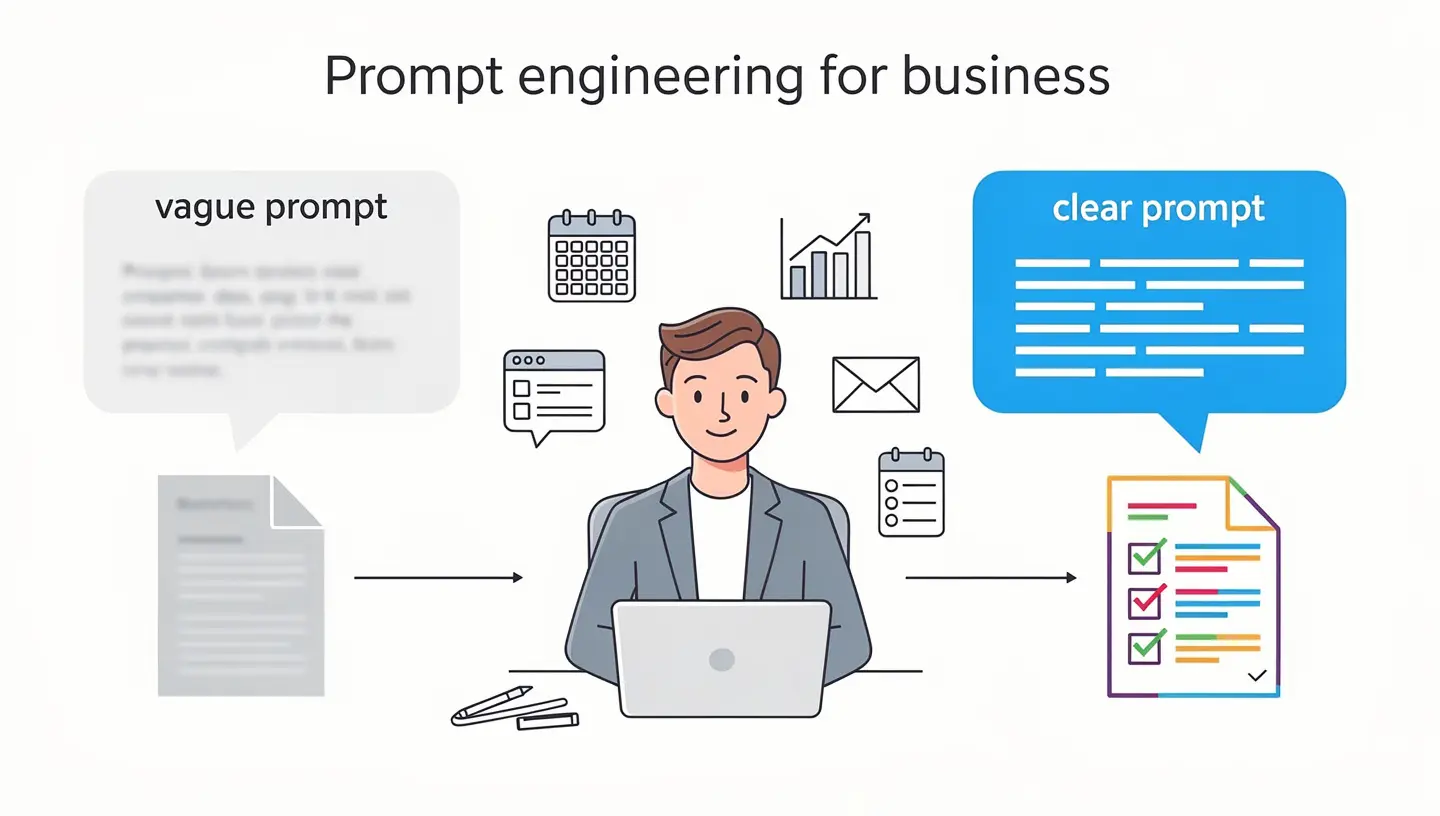
The word engineering in prompt engineering sounds heavier than the job really is. In practice, you describe a task well enough that a very fast but very literal assistant can finish it. A request such as “write something about our new product” gets a shrug from a human coworker, and the AI answers it the same way, with a generic paragraph. A request such as “write a 150-word LinkedIn post that announces our scheduling feature to small clinic owners in a warm, confident tone” gets a real draft.
A business prompt also differs from a casual question in one more way. It is a reusable asset. When a prompt produces a good result once, the team can save it, adjust a few details, and use it again for the next campaign, the next report, or the next customer reply. That repeatability matters most when several people share the same tool and everyone expects the same quality. Prompt engineering sits on top of large language models, a term explained in the AI terms glossary.
Why Prompt Engineering Matters for Companies Right Now
According to a McKinsey survey, 71 percent of organizations now use generative AI regularly in at least one business function. So the question is no longer whether a company uses AI. The question is whether it gets consistent results from it. That is why prompt engineering has moved from a developer curiosity to a daily office skill.
Almost every employee has tried an AI chatbot. Far fewer know how to get reliable output from one. Casual users treat the tool like a search engine and receive shallow answers. Skilled users treat it like a capable assistant and receive first drafts, summaries, and plans they can build on. A manager who prompts well can produce a project plan in ten minutes, while a colleague who does not may spend an hour and still start from a blank page.
The gap also shows up in cost. Every vague prompt creates rework, and rework eats the time AI was supposed to save. Good AI prompt engineering cuts the number of retries, keeps tone and format steady, and makes results easier to check. Prompt engineering is also the cheapest improvement on the table, since it needs no new software and no extra budget. Teams that want the wider picture can start with the guide to generative AI for business.
What Good Prompts Change in Daily Work
The benefits of prompt engineering show up in small, repeated tasks more than in big projects.
- Consistency: the same request gives similar quality no matter who sends it.
- Personalization: one brief can become versions for different segments, regions, or customers.
- Faster internal work: status notes, meeting summaries, and policy drafts take minutes.
- Fewer off-brand or biased answers: rules in the prompt, such as tone limits and bias checks, catch problems early.
- Easier scaling: a tested prompt can move from one team to every department.
The Anatomy of a Good Business Prompt
Most prompt engineering for business comes down to a short checklist. A prompt that covers the checklist is usually good enough, and a prompt that skips it drifts away from what you needed.
The Context, Task, Format Framework
The simplest prompt engineering framework has three parts. Context is the background: who you are, who the audience is, and what has already happened. Task is the single job you want done, stated in plain words. Format is the shape of the answer, such as length, structure, or a table.
Here is a short example. “We are a five-person accounting firm. A client asked to delay a quarterly filing. Write a reply that agrees to a one-week extension but makes clear that the final deadline cannot move. Keep it under 120 words and professional.” That prompt covers all three parts, and it produces a usable draft on the first try.
Adding Role, Constraints, and Output Rules
Longer frameworks add more pieces. A fuller structure, often written as role, task, context, content, constraints, output, and evaluation, helps when a task repeats or when the answer feeds another process.
- Role tells the model which expert to imitate, such as a senior B2B copywriter or a careful contracts paralegal.
- Constraints set the rules: tone, word limit, terms to avoid, and the sources it may use.
- Output defines fields, headings, or a table.
- Evaluation states how a good answer will be judged.
The role line costs almost nothing. Five words such as “act as an experienced sales manager” often shift the whole answer, because the model picks vocabulary and priorities that fit the role.
RTF and CREATE for Quick and Complex Work
Two shorter labels show up in most prompt engineering training material. RTF covers role, task, and format, and it fits quick jobs. CREATE covers character, request, examples, adjustments, type, and extras, and it suits detailed work where precision matters. The table compares the options.
| Framework | Parts | Best for |
|---|---|---|
| Context, Task, Format | Background, one job, shape of the answer | Almost every everyday prompt |
| RTF | Role, Task, Format | Fast jobs such as emails, summaries, and simple drafts |
| CREATE | Character, Request, Examples, Adjustments, Type, Extras | Detailed analysis or compliance-sensitive work |
| CRAFT | Context, Role, Action, Format, Tone | Content that must match a brand voice |
| CARE | Context, Ask, Rules, Examples | Replies and reports that follow a fixed pattern |
| Seven-part structure | Role, Task, Context, Content, Constraints, Output, Evaluation | Repeated tasks and prompts that feed other systems |
Pick one prompt engineering framework and stay with it long enough to learn its rhythm. Switching every week stops the habit from forming. Most teams settle on RTF for daily work and move to CREATE when the stakes rise.
CRAFT and CARE: Two More Frameworks Worth Knowing
CRAFT stands for context, role, action, format, and tone. It is RTF with two extra parts, which makes it a good fit for content that has to sound a certain way, such as customer emails or blog posts. A short CRAFT prompt might read: “Context: we sell project software to small agencies. Role: senior copywriter. Action: write a 100-word reply to a prospect who asked about pricing. Format: three short paragraphs. Tone: friendly and direct.”
CARE stands for context, ask, rules, and examples. It puts the weight on rules and examples, so it works well when the answer must follow a pattern. “Context: we answer billing questions for a gym chain. Ask: write a reply to a member who was charged twice. Rules: apologize once, never promise a refund date, keep it under 90 words. Example: [paste a past reply].” The five-part version used in many guides, with context, role, task, format, and examples, is nearly the same thing. All of these prompt engineering frameworks cover the same ground with different labels, so the best choice is the one your team will actually remember.
Four Types of Business Prompts
Prompts also differ by purpose. An instructional prompt gives a direct order, such as “summarize this memo in five bullets”. A scenario-based prompt sets up a situation first, for example “you are the operations lead and a supplier has just missed a deadline; draft the message to the supplier and the update to your director”. A conversational prompt starts a back-and-forth, where you refine the answer through follow-up questions. A stylistic prompt controls voice, such as “write this as a calm, plain-spoken note to a long-term customer”. Strong prompt engineering for business often mixes two types, for example a scenario with a style instruction.
Weak Prompt vs Strong Prompt: Side-by-Side Examples
The fastest way to see how prompt engineering works is to compare two prompts for the same job. The table below gives five prompt engineering examples built from common requests. Each strong version adds only what the AI genuinely needed, so it is not longer for the sake of length.
| Task | Weak prompt | Strong prompt | What it adds |
|---|---|---|---|
| Customer reply | Reply to this complaint. | A customer says her order arrived nine days late. Write a 70-word reply that apologizes once, gives the new delivery date, and offers a 10 percent discount code. Keep the tone warm and calm. | Situation, length, tone |
| Report summary | Summarize this report. | Summarize the attached Q3 sales report in four bullets for the regional director. Cover the biggest drop, the main reason, and one action. Maximum 20 words per bullet. | Audience and focus |
| Meeting notes | Clean up these notes. | Sort these meeting notes into decisions, action items with owners, and open questions. Use bullet points and no more than five per group. | Output format |
| Job ad | Write a job description. | Write a job description for a part-time bookkeeper at a ten-person logistics firm. Plain language, 250 words, three must-have skills, no gendered wording. | Context and limits |
| Product text | Describe this product. | Write a product description for a stainless steel water bottle aimed at office workers. Three short paragraphs, 100 words maximum, simple language, lead with the benefit. | Audience and structure |
The weak version saves about fifteen seconds of typing and costs about fifteen minutes of rewriting. The strong version reverses that trade. For email work in particular, the how-to on writing marketing emails with AI shows the same logic applied to campaigns.
Core Prompt Engineering Techniques for Business Teams
Beyond the basic frameworks, a few named prompt engineering techniques help with harder tasks. Nobody needs all of them every day. Knowing they exist widens what you can ask for.
Zero-Shot and Few-Shot Prompting
Zero-shot prompting means asking for the task with no examples. It works for common requests such as summarizing a paragraph or drafting a standard email. Few-shot prompting means showing the model two or three examples of the output you want before the real request. If you paste two past replies in your brand voice and then ask for a third, the model copies tone and structure far better than it would from a description. Quality beats quantity here, since a few strong examples teach more than a long list of average ones.
Chain-of-Thought and Step-by-Step Reasoning
Chain-of-thought prompting asks the model to reason through steps before it gives a final answer. A line such as “work through this step by step, then give the final number” helps with calculations, eligibility checks, and comparisons. The method comes from a 2022 research paper, Chain-of-Thought Prompting Elicits Reasoning in Large Language Models, which showed that worked reasoning steps improved results on arithmetic and logic tasks.
Newer models often reason internally, so test whether the extra line still helps on the tool you use. Pairing it with a check, such as “now verify the working and correct any error”, catches mistakes from the first pass.
Role Prompting and Personas
Role prompting tells the model to answer as a specific professional, for example a UK tax adviser or a plain-English editor. Be precise about domain and seniority. “Act as an expert” is vague, while “act as a finance analyst preparing a month-end variance note for the finance director” gives the model something to work with.
Prompt Chaining and Structured Output
Prompt chaining splits a large task into smaller prompts, where each answer feeds the next. A content workflow might use one prompt for an outline, a second for each section, and a third for editing tone and length. Each step stays focused, so the result is cleaner than one giant request.
Structured output asks for an exact shape: a table with four columns, a list with fixed fields, or a JSON object when the answer goes into another system. Models follow explicit formatting reliably, which saves manual cleanup later.
Iterative Refinement and Meta Prompting
Iterative refinement treats the first answer as a draft. Read it, say what is wrong, and ask again. “Too formal, cut it in half, and lead with the number” works better than rewriting the whole prompt. Meta prompting goes one level up. You ask the model to critique your prompt, list the missing context, or suggest a sharper version. Over time this builds prompting skill across the whole team.
Constraint-Based Prompting
In prompt engineering, constraints tell the model what to leave out as well as what to include. Useful constraints are a word limit, a list of banned phrases, a rule to use only the attached sources, a required reading level, and a fixed number of options. “Give three options, each under 40 words, and do not mention price” produces cleaner output than an open request, and it makes the answer easier to compare and check.
System Prompts and Custom Instructions
A system prompt is a standing instruction that applies to every conversation. Many tools let you save one, for example through custom instructions in ChatGPT or project instructions in Claude. Use it for what never changes: your company, your tone, the rules for sources, and the default format. Then each daily prompt only needs the task. This keeps results steady across a team and cuts repeated typing.
Critique and Self-Review Prompts
A useful prompt engineering move is to ask the model to review its own work, or yours. “Read the draft above as a skeptical finance director. List the three weakest claims and what evidence would fix them” often finds problems before a person does. A second useful move is a checklist prompt: “check the draft against these five criteria and mark each pass or fail”. The model can miss its own errors, so treat this as an extra filter, not as a replacement for human review.
Multi-Perspective and Scenario Prompts
For planning, prompt engineering means asking for the same issue from several viewpoints: the customer, the finance team, and a regulator. For decisions, ask for scenarios, such as best case, worst case, and most likely case, with the assumptions behind each. Executives also use familiar business frameworks inside prompts, for example SWOT or PEST analysis, so the answer follows a structure the board already knows.
Follow-Up Prompting: Treat It as a Conversation
In prompt engineering, a strong prompt is only the start of the work. After the first answer, follow up with short corrections such as “shorter”, “add a number”, “make the second point the lead”, or “explain this to a new hire”. Each round costs a few seconds and often improves the result more than a long first prompt would have.
Tree-of-Thought and Self-Consistency
Two advanced prompt engineering methods go beyond a single line of reasoning. Tree-of-thought prompting asks the model to explore several paths and compare them before choosing one. Self-consistency runs the same question several times and keeps the answer that appears most often. They help with hard analysis and planning, but they cost more time, so most business tasks do not need them.
Prompt Engineering Examples by Department
Prompt engineering use cases look different in each function, but the pattern stays the same: role, context, task, format, and limits. Applying prompt engineering for business in a department means picking the tasks that repeat most often and writing one strong prompt for each. The examples below can be copied and adjusted.
Marketing and Content
Marketing teams repeat similar work every week, which makes prompt engineering pay off early for them. A strong prompt names audience, tone, channel, and goal. “Create five LinkedIn post ideas for operations managers who care about scheduling software. Each needs a hook, one short insight, and a closing question. Keep the tone professional with a slight edge.” One extra line, such as “avoid the words innovative and best-in-class”, saves hours of editing across a campaign. The guide to AI content creation covers the wider workflow.
Sales and Outreach
Sales reps use prompt engineering for first-touch emails, call preparation, and clean summaries of messy notes. “Act as an account executive for a payroll software company. Draft a first email to the CFO of a 200-person firm, 120 words, with one metric from this case study and one question as the call to action.” A real metric keeps the email specific. Prompt engineering for marketing and sales shares one rule: include only claims you can prove.
Customer Support
Prompt engineering for support needs the right tone and accurate content. “You are a support specialist. Acknowledge the problem, give one troubleshooting step, and keep the reply under 80 words” holds up far better than “reply to this complaint”. Feeding the model two or three resolved tickets teaches your house style in one pass. The setup is covered in more detail in the guide to AI customer service.
HR and Recruitment
HR teams use prompt engineering for job descriptions, interview question sets, and policy summaries. One guardrail helps a lot: “do not factor in name, gender, or age when comparing candidates”. Review every shortlist by hand, since the prompt supports the process and does not replace the decision.
Finance and Operations
Finance teams use prompt engineering for variance explanations, vendor comparisons, and first-pass contract reading. “From the pasted contract, list payment terms, renewal clauses, and any automatic extension. Return a table and quote the clause number.” Operations teams use the same approach for supplier updates, checklists, and weekly status notes. Always ask for source references, so a person can verify the numbers.
Product and Research
Product managers apply prompt engineering by pasting in 200 support tickets and asking for the five most frequent complaints, ranked by count. Researchers ask for a competitor comparison in a fixed table. The prompt keeps the answer tied to what customers actually said, rather than the loudest recent opinion.
Operations and Procurement
Operations teams use prompt engineering for process documents and vendor decisions. “Turn these rough notes into a numbered standard operating procedure with owners and a checklist” saves hours. For vendors: “Compare these three proposals in a table. Score each from 1 to 5 on price, delivery time, support, and risk, weight price at 40 percent, and explain each score in one line.” Ask the model to show its scoring, so the team can challenge it.
Legal and Compliance
Legal and compliance teams use prompt engineering to summarize contracts, compare clauses, and explain regulations in plain language. “Summarize the termination and liability clauses in the pasted contract in plain English, quote the clause numbers, and add a note on anything unusual.” Add a disclaimer line to the output and always have a qualified person review it, since the model is not a lawyer.
Meetings, Executive Briefs, and Project Planning
Prompt engineering also helps around meetings. Before one, ask for an agenda and five questions the other side is likely to ask. After it, ask for decisions, owners, and deadlines. For executives, a prompt that turns a long report into a one-page brief with a clear recommendation saves the most time. For projects, ask for a 90-day plan with milestones, risks, and open questions, then edit the plan with the team. A RAID log, covering risks, assumptions, issues, and dependencies, is a good format to request.
Data Analysis and Weekly Reporting
For data work, prompt engineering means giving the model real numbers. Paste a small table or attach a file and ask for exactly what you need. “Compare budget and actual for each line item, calculate the variance, and name the likely driver of the three largest gaps. Return a table.” Check the arithmetic by hand on at least two lines. For weekly reports, save a template with fixed headings, so each week only the data changes.
Prompt Engineering for Business Analysts and Executives
Analysts and executives use the same prompt engineering framework but lean harder on structure and checking, because the output feeds a decision. The best prompt engineering tips for this group are simple. Paste in real data instead of describing it. State the question and the exact table you want back. Ask the model to show its reasoning, so the logic can be checked before anyone trusts the result.
For AI decision-making, ask for options, risks, and a recommendation in separate sections, and ask the model to list the assumptions it made. “Analyze our Q3 sales by region. Name the top three revenue opportunities and the top three risks. Write an executive summary of 200 words with one recommendation” beats “analyze our Q3 sales” every time. Prompt engineering for executives is mostly about specificity. A leader who names the audience, the framework, and the output length gets a draft that is ready for a board pack, not a general essay.
Leaders can also ask the model to apply a known framework, such as SWOT or PEST analysis, to a market question, then ask for the biggest assumption behind each point. Ask for stakeholder views from the board, customers, and staff, and for a short list of questions the data cannot answer yet. That turns a general overview into material that can be challenged in a meeting.
How to Get AI to Write in Your Brand Voice
Brand voice is one of the most requested uses of prompt engineering for business, and it is easy to lose when many people use AI. The fix is a short voice guide that goes into every prompt.
- Collect three to five pieces of writing that sound like your brand.
- Ask the model to describe the voice: sentence length, word choice, level of formality, and what the writing avoids.
- Turn the answer into a voice block of five to eight rules.
- Add a list of banned words and phrases.
- Paste the voice block and one example at the start of each prompt, or save it as a system prompt.
- Test the output against a real piece and adjust the rules.
A voice block can be short: “Write in plain English. Use sentences under 20 words. Address the reader as you. Be direct and friendly, never pushy. Avoid jargon and exclamation marks.” Update this part of your prompt engineering setup when the brand changes, and keep one copy in the shared library.
How to Build a Prompt Library and Reusable Templates
A prompt library turns one good result into the default for the whole team. This is where prompt engineering shifts from a personal habit to a team process. Start small. When someone writes a prompt that works, they save it in a shared document with a short note on what it is for, who owns it, and which tool it was tested on. After a few weeks the team has a set of reliable prompt templates for the jobs it repeats.
- Pick three tasks the team repeats every week.
- Write one strong prompt for each, with role, context, task, format, and limits.
- Replace fixed details with brackets, such as [audience] and [word limit], so the template can be reused.
- Test each template on the tool your team actually uses, since results differ between models.
- Save the final version with an owner, a date, and a sample of good output.
- Review the library every quarter and remove prompts nobody uses.
For every saved prompt, record the title, the purpose, the tool and model it was tested on, the inputs it needs, an example of good output, the owner, and the date it was last tested. In prompt engineering, these fields make a prompt easy to find, easy to trust, and easy to retire when it stops working.
These prompt engineering best practices also protect brand voice. A template that includes tone rules and banned phrases keeps the style steady when several people produce content. A short workshop on the context, task, format structure brings most teams to a working level. The bigger picture of how AI changes daily work is covered in the guide to AI in the workplace.
How Teams Build Prompting Skills Together
Prompt engineering for business teams improves fastest when it is shared. Set aside twenty minutes in a regular meeting for people to show one prompt that worked and one that failed. Pair a confident user with a beginner on a real task. Name one or two prompt champions per department, who maintain that department part of the library and answer questions.
Short workshops on the context, task, format structure bring most teams to a working level in an afternoon. After that, prompt engineering practice on real tasks matters more than extra theory. Track a few numbers, such as how many prompts are in the library and how often they are reused, so progress is visible. People get better at prompt engineering faster when they review results against a rubric together, since it teaches the team what good output looks like.
How to Measure Prompt Quality and ROI
A library only helps if the prompts in it are good. Measuring prompt engineering results starts with a short rubric that makes the review consistent. Score each criterion from 0 to 2 and set a target, for example 8 out of 10, before a prompt is promoted into the shared library.
| Criterion | What to check |
|---|---|
| Accuracy | Facts match the supplied sources and nothing is invented |
| Relevance | The answer serves the stated audience and goal |
| Clarity | Short sentences, plain words, no ambiguity |
| Format | Structure and length match the request |
| Safety | No personal data and no policy or legal problems |
To measure prompt engineering ROI, track four numbers: minutes saved per task, the quality score from the rubric, the rework rate, and how many people reuse each prompt. A pilot with three use cases, ten users, and four weeks gives enough data for a one-page report. The how-to on AI ROI for business explains how to turn those numbers into a business case.
Common Prompt Engineering Mistakes in Business
The same prompt engineering mistakes appear in almost every team. Each has a quick fix.
- Being vague. “Improve this text” leaves too much open. Name the audience, the goal, and what better means.
- Skipping context. The model knows nothing about your company, customers, or tone. Add two or three sentences of background.
- Ignoring format. Without a format you get a wall of text. State the length, the structure, and how the output will be used.
- Cramming several tasks into one prompt. A full strategy, five email versions, and a budget in a single request means every part comes out weak. Split the work into steps.
- Accepting the first draft. Treat it as raw material and iterate.
- Trusting without checking. A wrong answer reads exactly as smoothly as a right one.
One more habit is worth dropping. Copying prompts between tools without testing them leads to surprises, since a prompt tuned for one model can behave differently in another.
Security, Privacy, and Accuracy Risks
Prompt engineering does not remove risk. Three areas need a plan before a team scales its use.
Hallucinations are confident answers that are wrong. Reduce them by attaching source material, telling the model to use only that material, asking for page or row references, and adding a self-check step at the end. Review anything a customer, regulator, or board will see.
A short safety prompt, which is a useful prompt engineering habit, can be added to any task: “Before you answer, list every claim you are not sure about, mark any figure you calculated yourself, and tell me what information is missing.” It will not catch every error, but it shows a reviewer where to look first. For sensitive topics, also ask for the sources behind each statement and check them yourself.
Data privacy needs clear rules. Never paste personal or confidential data into consumer chat tools. Use enterprise versions with clear data terms, anonymize inputs wherever possible, and check data residency under rules such as UK GDPR and EU GDPR. The guide to AI data privacy for business lists what to check with a vendor.
Prompt injection is an attack in which hidden text in a document, email, or web page overrides the original instructions. It matters for any business that lets AI read untrusted input. Keep a person in the loop for anything that triggers an action, and review outputs for bias before they reach customers.
Is Prompt Engineering Still Worth Learning?
The job title “prompt engineer” is fading, because the work is being absorbed into broader roles such as AI specialist, analyst, or marketing lead. Prompt engineering as a skill is going the opposite way. Prompt engineering jobs now often combine prompting with workflow design and checking, and the people who get hired can show a saved library of prompts with before and after results. That portfolio proves more than a certificate.
A prompt engineering career works best when prompting sits next to a second skill such as marketing, operations, or compliance. Prompt engineering tools, such as shared workspaces and prompt generators, speed up the writing, but they cannot decide what a good answer looks like for your own work. As models get better at reading plain language, clever phrasing matters less and judgment matters more.
ChatGPT, Claude, and Gemini: Do Prompts Transfer?
Mostly, yes. The basics of prompt engineering, meaning a specific task, useful context, one good example, and iteration, work in ChatGPT, Claude, and Gemini alike. The details differ. Claude tends to respond well to clearly tagged, structured instructions, while GPT and Gemini models often prefer concise schemas. Pick the tool your work already lives next to, test each template there, and adjust small things. The skill travels with you, even when the tool changes.
Where to Run Your Prompts: Tools and Platforms
Prompt engineering for business works in any chat-based AI tool, so the choice usually depends on where your team already works and which data rules apply. Features and plans change often, so check each provider before you decide.
| Tool type | Examples | Good for |
|---|---|---|
| Chat assistants | ChatGPT, Claude, Gemini | Drafting, analysis, summaries, and saved instructions |
| Office suite assistants | Microsoft Copilot in Word, Outlook, and Excel; Gemini in Google Workspace | Writing and analysis inside the documents your team already uses |
| Automation tools | Zapier, Make | Running a saved prompt on a schedule or when an event happens |
| Prompt storage | Shared documents, Notion, a team wiki | Keeping and versioning templates |
Start with one assistant and one shared document. Once the prompts are stable, you can connect them to automation.
When Better Prompts Stop Helping
A good prompt cannot give the model knowledge it does not have. If answers need your own documents, current data, or the ability to take actions, prompt engineering for business alone reaches a limit. Three options come next.
- Retrieval-augmented generation (RAG) searches your documents and passes the relevant passages to the model, so answers rest on your own files.
- Fine-tuning trains a model further on your examples. It suits a fixed style or format and does not keep up with changing facts.
- AI agents use tools to carry out multi-step tasks with limited supervision. The guide to AI agents for business explains when they make sense.
A simple rule works well: improve the prompt first, add RAG when the facts live in your documents, and consider fine-tuning only when prompts and RAG cannot hold a style or format. Even with agents, the instructions you give them are prompts, so the skills in this guide carry over.
Where to Start With Prompt Engineering for Business
Start with your next real task. Write down the background, the specific job, and the output you want. Run it, read the draft, and give one correction. Then save the prompt. Repeat that for three tasks this week and you have the start of a library. Prompt engineering rewards small, regular practice more than long courses.
Smaller companies can follow the same path. For a wider plan on rolling AI out across a company of any size, read the how-to on using AI in business.
Frequently Asked Questions
What is prompt engineering for business?
Prompt engineering for business is the skill of writing clear, structured instructions that get useful results from AI tools such as ChatGPT, Claude, and Gemini. It is a communication skill, not coding. Any professional can learn the basics in a few hours and improve through daily use.
Do I need technical skills for prompt engineering?
No. Prompt engineering is closer to briefing a colleague than to programming. If you can write a clear email that explains what you need, who it is for, and what the result should look like, you can write a strong prompt. Technical knowledge helps with advanced work such as automation, but it is not required for everyday business tasks.
What is the best prompt engineering framework for business prompts?
Context, Task, Format covers most everyday needs. RTF works for quick jobs, CRAFT suits content that must match a voice, CARE suits replies that follow a pattern, and CREATE suits detailed or compliance-sensitive work. The best framework is the one your team uses consistently, so choose one and stay with it for a few weeks before judging it.
How long should a business prompt be?
Long enough to include context, task, and format, and no longer. A well-ordered prompt of 100 to 200 words usually beats a rambling one of 500. Every line should give the model something it needs. Remove background that has no effect on the answer.
What is the difference between zero-shot and few-shot prompting?
Zero-shot prompting asks for a task with no examples. Few-shot prompting shows the model two or three examples first. Few-shot usually gets closer when the output needs a specific format or tone, because an example teaches more than a long description.
How do I reduce hallucinations in AI answers?
Attach the source material and tell the model to use only that material. Ask for page or row references, and add a final step where the model checks its own answer. Then spot-check key figures by hand before anything is shared outside the team.
Can the same prompt work in ChatGPT, Claude, and Gemini?
Mostly. The core moves of a clear task, context, an example, and follow-up edits transfer across all three. Small adjustments may be needed, so test each saved template on the tool your team actually uses before adding it to the shared library.
Which AI model is best for business prompt engineering?
There is no single best model. ChatGPT, Claude, and Gemini all handle business writing and analysis well, and their strengths shift with each release. Choose by task, data rules, and where your team already works, and test your saved prompts on the tool before you adopt it.
How do I get AI to write in my brand voice?
For prompt engineering and brand voice, create a short voice block with tone, sentence length, banned words, and one example. Paste it at the start of every prompt or save it as a system prompt. Test the result on a real piece, and update the rules when the output drifts.
Why does AI give generic answers to specific business questions?
In prompt engineering, generic answers usually come from generic prompts. When the prompt lacks the audience, the context, and the format, the model fills the gaps with the safest average. Add the background, the reader, an example, and the exact shape of the answer.
When should I fine-tune instead of improving prompts?
Improve the prompt first, since prompt engineering is cheaper and faster than training. Fine-tuning makes sense when you need a consistent style or format at scale and prompts with examples cannot deliver it. If answers must reflect changing facts, RAG is usually a better choice than fine-tuning.
Is it safe to use ChatGPT for business data?
It depends on the plan and the data. Consumer chat tools may store inputs, so do not paste personal or confidential data into them. Business plans offer clearer data terms, and anonymizing inputs helps further. Check the provider data policy and your own company rules first.
How can I get better at prompt engineering faster?
Prompt engineering improves with practice on real tasks. Save every prompt that works, and iterate on weak results instead of starting over. Share prompts with colleagues and review output against a simple rubric. Regular small practice beats a long course.
Are prompt engineering jobs still available?
Yes, but often under other titles such as AI specialist or content strategist. Roles that connect AI output to business results are the most secure. A portfolio of saved prompts with before and after results shows the skill better than a certificate.