Zhipu AI is a Chinese artificial intelligence company from Beijing that builds the GLM family of large language models. Outside China it works under the name Z.ai, so both names point to the same firm. The company started in 2019 as a spin-off from Tsinghua University, listed on the Hong Kong stock exchange in January 2026 and now sells its models through a chat app, a developer API and a coding subscription.
So what is Zhipu AI in practice? It is a lab that releases most of its models with open weights, charges far less per token than the large US providers and puts its main effort into coding and long agent tasks. The current flagship is GLM-5.3, released in August 2026.
This guide covers the company, the models, the products, the Z.ai pricing checked in October 2026 and the safety questions that come with using a Chinese provider. Prices and model names changed several times this year, so every number below carries a date or a source.
Zhipu AI quick facts
The table collects the basic data in one place, so you can check the company before reading the details.
| Item | Detail |
|---|---|
| Company name | Zhipu AI, international brand Z.ai, legal name Knowledge Atlas Technology Joint Stock Co. Ltd. |
| Founded | 2019, Beijing, spin-off from Tsinghua University |
| Founders | Tang Jie and Li Juanzi |
| CEO | Zhang Peng |
| Stock listing | Hong Kong, HKEX 2513, since 8 January 2026 |
| Main product line | GLM models, Z.ai chat, API, GLM Coding Plan |
| Current flagship | GLM-5.3 (August 2026) and GLM-5.3-Flash |
| Employees | 800 or more (2024 figure) |
| US status | On the US Entity List since January 2025 |
What is Zhipu AI?
The short answer to what is Zhipu AI: it is one of the so-called AI tigers of China, a group of well-funded startups that also includes Moonshot AI, MiniMax and Baichuan. The company is best known for the GLM models, which cover chat, coding, vision, video and agent tasks. Most of them can be downloaded and run on your own servers.
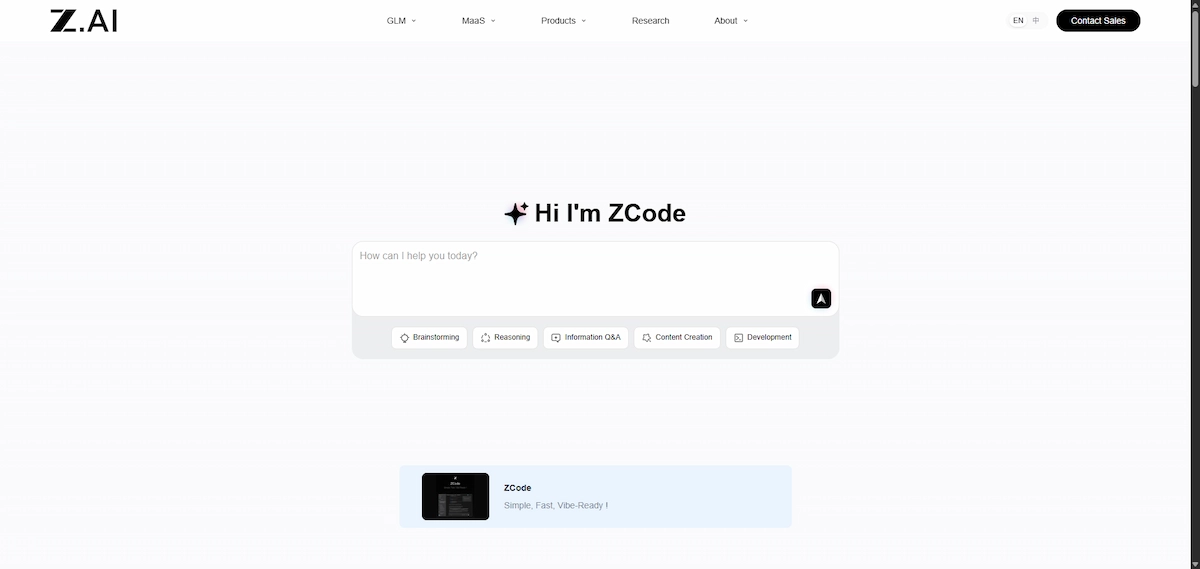
Zhipu makes money in three ways: a pay-per-token API, subscription plans for coding tools and on-premises deployments for large clients such as banks and state-owned firms. The enterprise side has been the largest source of revenue so far, while the developer products bring the international attention.
Is Zhipu AI the same as Z.ai?
Yes. Z.ai is the global brand of Zhipu AI, introduced in July 2025 around the release of GLM-4.5. Inside China the firm is still called Zhipu, written 智谱 in Chinese. The legal name changed to Knowledge Atlas Technology in 2025, and that is the name on the stock exchange filings.
The developer platform in China is called BigModel, while the international site is z.ai. The chat app, the API documentation and the model downloads on Hugging Face all sit under the Z.ai name, so for most readers the two names mean the same thing.
Who founded Zhipu AI?
Two professors from the computer science department at Tsinghua University, Tang Jie and Li Juanzi, started the company in 2019 on the base of the university Knowledge Engineering Group. Tang Jie remains the main scientific figure behind the GLM design. Zhang Peng, a Tsinghua graduate, runs the firm as CEO, and Liu Debing is the chairman.
The first years were hard. The team worked on knowledge graphs, had no clear business model and received free office space from the Zhongguancun science park for three months. A first large funding round of about 15 million dollars came in 2021, after the team had moved its focus to large models.
Zhipu AI funding, IPO and valuation
Before the listing, Zhipu raised roughly 1.4 to 1.5 billion dollars from investors such as Alibaba, Tencent, Meituan, Ant Group, Xiaomi, HongShan and the Saudi fund Prosperity7 Ventures. A 2024 round put the value at about 3 billion dollars.
The Hong Kong IPO took place on 8 January 2026 at HK$116.20 per share. It raised about HK$4.17 billion, around 558 million dollars, and valued the company at roughly 6.6 to 7 billion dollars. Reports describe it as the first listing of a large language model company. The shares fell nearly 23% in late February 2026 after complaints about a shortage of computing power, and the firm limited new signups for a time.
Reported figures for 2025 show revenue of about 724 million yuan, up around 132%, with a net loss near 4.7 billion yuan. Those numbers come from a single secondary report, so check the company filings before quoting them.
Zhipu AI business model and customers
Zhipu sells model as a service to businesses. Revenue comes from three channels: the pay-per-token API, subscription plans for developers and private installations for large clients such as banks and state-owned firms. The private installations bring the biggest share, because those clients want the model inside their own data center.
Government work adds to it. In May 2025 the company closed a deal of about 61 million yuan with the city of Hangzhou for city projects, and partners include Qihoo 360, which uses a GLM model in its search engine. The firm has offices in the Middle East, the United Kingdom, Singapore and Malaysia, and reports from late 2025 describe a tenfold rise in overseas users. Profit has not arrived yet. Companies that plan their own projects can start with our guide to generative AI for business.
Zhipu AI timeline from 2019 to 2026
The company moved from research papers to a listed business in seven years. The table shows the main steps.
| Date | Event |
|---|---|
| 2019 | Company founded as a Tsinghua spin-off |
| May 2022 | GLM research paper presented at the ACL conference |
| March 2023 | ChatGLM-6B released for consumer graphics cards |
| January 2024 | GLM-4 announced |
| January 2025 | Added to the US Entity List |
| July 2025 | GLM-4.5 released, rebrand to Z.ai, MIT license for new models |
| December 2025 | GLM-4.7 and GLM-4.6V released |
| 8 January 2026 | Hong Kong IPO |
| February 2026 | GLM-5 released |
| April 2026 | GLM-5.1 released as open source |
| June 2026 | GLM-5.2 with a 1M-token context window |
| August 2026 | GLM-5.3, GLM-5.3-Flash and the GLM-5.3 weights |
| October 2026 | GLM-Legal, a legal model built on GLM-5.3-Flash |
What is GLM? The Zhipu AI model family
GLM stands for General Language Model. The name comes from a 2021 research paper by the Tsinghua team, which trained models by blanking out spans of text and asking the model to fill them in. That method gave the family a good balance between understanding text and writing it. If terms such as open weights or context window are new to you, the AI terms glossary explains them in plain words.
The chat product started as ChatGLM in 2023. Today the name GLM covers the whole line, from small models for a single graphics card to the large flagship models that run in data centers.
GLM models at a glance
| Model | Released | Size and notes |
|---|---|---|
| GLM-4.5 | July 2025 | 355B total, 32B active, first open MIT release of the new line |
| GLM-4.7 | December 2025 | Budget coding model, 73.8% on SWE-bench Verified |
| GLM-4.7-Flash | Early 2026 | 30B mixture-of-experts model with about 3B active, for local use, free on the API |
| GLM-5 | February 2026 | About 744B total, around 40B active |
| GLM-5.2 | June 2026 | 1M-token context, open weights |
| GLM-5.3 | August 2026 | Current flagship, same base as GLM-5.2 |
| GLM-5.3-Flash | 26 August 2026 | 320B total, 18B active, multimodal, MIT |
GLM-5.3, the current flagship
GLM-5.3 was announced on 14 August 2026 and reached the API a few days later, depending on which page you read. Z.ai did not train a new base model. It reused the GLM-5.2 base and spent the extra effort on post-training with more environments, more task types and more reinforcement learning.

Z.ai reports large gains on its own coding tests: Terminal-Bench 3.0 went from 4.6 to 28.3 and DeepSWE v1.1 from 46.2 to 66.9. These are vendor numbers without an independent audit, so treat them as a claim and not as a final result. The model supports a context window of about 1 million tokens and is aimed at long coding and agent jobs.
The weights were held back for two weeks for a safety review and published on 28 August 2026 on Hugging Face. They came under a custom GLM-5.3 License instead of MIT. One public checkpoint lists about 753B parameters in total and around 40B active per request.
GLM-5.3-Flash and FlashX
GLM-5.3-Flash arrived on 26 August 2026 as a separate, newly trained model with 320B parameters, of which 18B are active. It accepts images, uses the same 1M-token window and ships under the MIT license from day one. The list price is $0.15 per million input tokens and $0.50 per million output tokens.
FlashX is a faster serving tier of the same Flash weights. Z.ai reports up to 200 tokens per second for it, at $0.37 for input and $1.25 for output per million tokens. A launch discount of 50% on Flash ended on 9 September 2026, so articles that still show $0.075 and $0.25 are out of date.
Older GLM models that still matter
Not every job needs the flagship. GLM-4.7 is still the cheap choice for everyday coding at $0.60 for input and $2.20 for output per million tokens. GLM-4.7-Flash is small enough for a single consumer graphics card, and the API version has no charge. GLM-4.5-Air is the lightweight sibling of GLM-4.5 and costs $0.20 for input and $1.10 for output.
Other models: video, image, legal and agents
Zhipu builds more than text models. Ying is a text-to-video model that makes short clips, CogView creates images and GLM-4.6V reads images, video and interface screenshots with a 128K context. AutoGLM is an agent that operates a phone through voice commands.
In October 2026 the company released GLM-Legal, a model for contract review and compliance work built on GLM-5.3-Flash. Reports differ on whether its weights are public. One review also noted a 19.2% all-pass rate on the Harvey legal benchmark, which leaves open questions about reliability.
How GLM works: blank infilling, mixture of experts and long context
The first GLM model came from a 2022 paper presented at the ACL conference. Instead of predicting only the next word, the model blanks out spans of text and learns to fill them back in, with a two-dimensional position code that tells it where each span sits. That method let one model handle both understanding and writing, and it was scaled up to the 130B-parameter GLM-130B in 2022 and 2023.
Modern GLM models use a mixture of experts design. GLM-5 has about 744B parameters in total, but only around 40B are active for each request, which keeps the serving cost lower than a dense model of the same size. GLM-5.2 added a technique called IndexShare, which reuses the same attention index across several layers and, according to Z.ai, cuts long-context computation by nearly three times. That is what makes a window of 1 million tokens usable.
Reasoning can be switched on for hard tasks and off for simple ones, starting with GLM-4.7, and GLM-5.2 added effort levels that trade speed for depth. The research side also continues: ChatGLM-Math used a self-critique step to improve math answers, and Z.ai owns AMiner, a scholar database created by Tang Jie in 2006.
How GLM was trained on Chinese chips
Reports say the GLM-5 family was trained on about 100,000 Huawei Ascend 910B chips with the MindSpore framework and without Nvidia hardware. The claim first appeared through Reuters, and early coverage noted that Z.ai had not confirmed every detail itself, so read it as reported and not as audited.
The detail matters because of the Entity List. Z.ai cannot buy the best Nvidia accelerators, so it adapted GLM models to chips from Huawei, Cambricon, Moore Threads, Kunlunxin, MetaX, Enflame and Hygon. GLM-4.6 was the first release with FP8 and Int4 support on Cambricon chips.
Training on domestic chips does not mean those chips match Nvidia. A Council on Foreign Relations report puts the Huawei Ascend 910C at about 60% of an Nvidia H100 on inference, and reviewers expect training to be slower and less efficient. The result shows that a model of this size can be built on domestic hardware, not that the hardware gap has closed.
Is Zhipu AI open source?
Mostly, yes, with one important change. Since July 2025 Zhipu has released most GLM models as open-weight downloads under the MIT license, which allows commercial use, fine-tuning and self-hosting without fees. The files are on Hugging Face under the zai-org name.
GLM-5.3 broke the pattern. It came with a custom license that adds a security review for hosting companies with more than 10 billion dollars of yearly revenue. GLM-5.3-Flash stayed on MIT. For a small business or a developer, both licenses allow normal use, but a large cloud provider has to read the GLM-5.3 terms.
Running the big models yourself is heavy work. One report puts the GLM-5.2 weights at about 1.5 terabytes, which means a multi-GPU server or a Mac Studio with 256 to 512 GB of memory. For most people the hosted API is the practical route. The company is not fully open either, because its chat app, enterprise systems and some specialist models stay closed.
Developer resources: Hugging Face, vLLM, LM Studio and Ollama
Developers get GLM from three places. The weights sit on Hugging Face under the zai-org name, the code and examples are on GitHub, and the hosted API is described in the Z.ai documentation. The API supports tool calling, MCP tools, JSON output, context caching and thinking modes.
For self-hosting, the usual engines are vLLM, SGLang and Transformers, and quantized GGUF files run on llama.cpp and LM Studio. GLM-4.7-Flash is the model most people try at home. It is a 30B mixture-of-experts model with about 3B active parameters and runs in roughly 24 GB of RAM or VRAM in a quantized build, according to the Unsloth guide.
Ollama also lists the model, but early builds had chat template problems and the Unsloth guide first advised llama.cpp or LM Studio, so check the current notes before you pick a runtime. The large models are a different job: GLM-5.3 has about 753B parameters, which means a multi-GPU server and not a laptop.
Z.ai products you can use
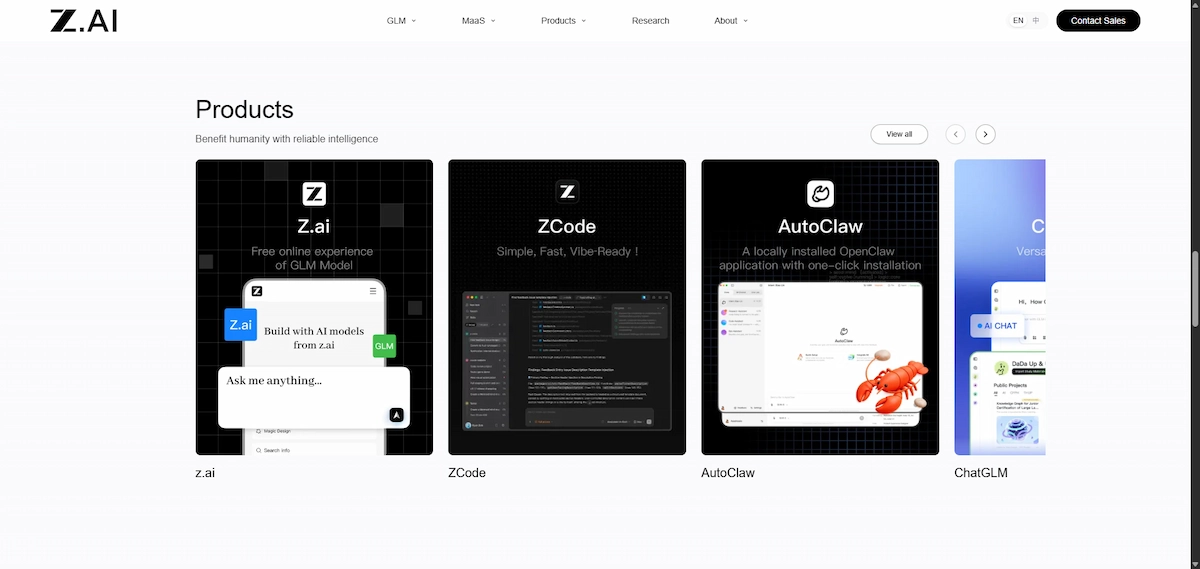
Zhipu AI sells four things to individuals and small teams. Each one has its own account, limits and price, so the rest of this section separates them.
Z.ai chat
The simplest way to try the models is chat.z.ai, a free web chat that works without a payment. You pick a GLM model, type a question and get an answer, with options for reasoning mode and web search. Features and limits change often, so the upgrade screen inside the app shows what your account gets today.
Z.ai API and BigModel platform
Developers use the Z.ai API to call GLM models from their own software. The endpoint follows the OpenAI format, supports tool calling and context caching, and an Anthropic-compatible endpoint lets tools written for Claude run on GLM with a few settings. If you only want a support bot or a simple assistant, our guide on how to build a chatbot without coding shows which parts you can skip.
Servers sit mostly in China, which adds roughly 100 to 200 milliseconds of delay for users in the US or Europe. Hosting partners such as Together AI and Cloudflare also offer GLM-5.3-Flash at the same list price.
GLM Coding Plan
The GLM Coding Plan is a flat monthly subscription for coding agents. It works inside Claude Code, Cline, OpenCode, Cursor and ZCode, and every tier includes GLM-5.3 and GLM-5.3-Flash. Since 30 July 2026 the plan counts credits instead of prompts. A request on GLM-5.3 uses about three times more credits than the same request on Flash.
Agent workflows also need planning around cost and limits, and the guide on AI agents for business covers that side of the work.
ZCode and AutoClaw
ZCode is the desktop coding agent from Z.ai, and AutoClaw is a desktop agent for spreadsheet analysis and business tasks. A Chinese news report from 27 October 2026 says ZCode gives each user 300 million GLM-5.3-Flash tokens per day for free, usable in a set night window. That offer came from one source, so confirm it inside the app before counting on it.
How to get started with Z.ai step by step

- Open chat.z.ai and try a model in the browser without paying.
- Register on the Z.ai Open Platform if you want to call the API.
- Create an API key on the API keys page and keep it private.
- Choose the endpoint: the general API for pay-per-token use, or the dedicated coding endpoint if you hold a GLM Coding Plan.
- Send a first request with the OpenAI SDK by changing the base URL, the key and the model name from the documentation.
- Check the billing page, then repeat the test on a cheaper model to compare cost and quality.
Start your tests on GLM-5.3-Flash, since it costs roughly a tenth of the flagship per token, and move up only when the answers are not good enough.
How to use GLM in Claude Code, Cline and other tools
The GLM Coding Plan is built for coding agents. Z.ai offers an endpoint that follows the Anthropic format, so Claude Code, which is made by Anthropic, can run on GLM without any change to the tool itself. The official list of supported tools includes Claude Code, Roo Code, Kilo Code, Cline, OpenCode, Cursor and ZCode.
The Z.ai documentation describes two routes. The quick one is a helper started with the command npx @z_ai/coding-helper, which loads the plan into your tools. The manual one sets ANTHROPIC_BASE_URL to https://api.z.ai/api/anthropic and ANTHROPIC_AUTH_TOKEN to your Z.ai key, either in the Claude Code settings file or as environment variables. After a restart, the /status command shows which model is active.
Two cautions apply. The plan must use the dedicated coding endpoint and not the general API, and Z.ai limits plan use to officially supported tools. The documentation also advises against hardcoding the model mapping, so that updates reach you automatically. Some users report that a /logout before the first start clears early errors.
Agents work best when the rest of the toolset is under control, and our guide to an AI tool stack for business shows how to keep the number of subscriptions down.
Z.ai pricing explained
Z.ai pricing has two parts: pay-per-token API rates and the monthly Coding Plan. The numbers below were checked in October 2026 against the official Z.ai pricing page and several independent trackers. Prices can change without notice, and many articles still list older rates.
Z.ai API pricing per million tokens
| Model | Input | Cached input | Output |
|---|---|---|---|
| GLM-5.3 | $1.40 | $0.26 | $4.40 |
| GLM-5.3-FlashX | $0.37 | $0.075 | $1.25 |
| GLM-5.3-Flash | $0.15 | $0.03 | $0.50 |
| GLM-5 | $1.00 | not listed here | $3.20 |
| GLM-4.7, 4.6, 4.5 | $0.60 | not listed here | $2.20 |
| GLM-4.5-Air | $0.20 | not listed here | $1.10 |
| GLM-4.7-Flash, GLM-4.5-Flash | free | free | free |
Output tokens drive the bill, because long answers cost more than long prompts. Cached input is far cheaper than normal input, so agents that repeat the same instructions save the most. For a wider view of what AI tools cost across a company, see our guide on how much AI tools cost.
GLM Coding Plan prices: Lite, Pro and Max
| Plan | Monthly price | Yearly, per month | Credits per 5 hours | Credits per week |
|---|---|---|---|---|
| Lite | $18 | $12.60 | 2,000 | 10,000 |
| Pro | $80 | $56 | 12,000 | 60,000 |
| Max | $168 | $117.60 | 28,000 | 140,000 |
Quarterly billing takes about 20% off and yearly billing about 30%. Use during peak hours, Monday to Friday from 14:00 to 18:00 in Beijing time (UTC+8), costs double the credits of the off-peak rate. One source also lists a team plan from $88 per seat, which the official page does not show.
Older guides quote $3 to $10 per month, $72 for Pro or $160 for Max. Those belong to earlier promotions or earlier plan structures.
Is Z.ai free?
Partly. The chat.z.ai web chat is free, and the API has no charge for GLM-4.7-Flash and GLM-4.5-Flash. New API accounts have also received starter credits in the past. GLM-5.3-Flash is not free any more. It was cheaper only during the launch promotion, which ended on 9 September 2026.
If your goal is a free model for everyday chat, compare it with the options in our list of free ChatGPT alternatives before you pay for anything.
API or Coding Plan: which is cheaper?
It depends on how steadily you code. Z.ai says the monthly credits equal roughly 15 to 30 times the subscription fee in API terms, which makes the plan cheaper for daily agent work. For occasional use, a few calls on Flash cost only cents, so the pay-per-token route wins.
A simple check: estimate your weekly token use, price it at the API rates above and compare it with the plan. Heavy users of Claude Code and similar tools tend to land on Pro or Max, and light users on the API.
Which GLM model should you use?
The right model depends on the job and the budget. The table matches common cases to a model, using the prices from the section above.
| Case | Model | Reason |
|---|---|---|
| Free test in the browser | chat.z.ai | No payment needed |
| Cheap everyday coding | GLM-4.7 | $0.60 input and $2.20 output per million tokens |
| Run on one GPU at home | GLM-4.7-Flash | 30B mixture of experts, about 24 GB in a quantized build |
| Low-cost API with image input | GLM-5.3-Flash | $0.15 and $0.50, multimodal, 1M context, MIT license |
| Faster answers | GLM-5.3-FlashX | Up to 200 tokens per second according to Z.ai |
| Hard coding and agent jobs | GLM-5.3 | Flagship, $1.40 and $4.40 |
A sensible rule is to start on a cheap model, keep the prompts that fail and send only those to the flagship. That keeps most of the bill on the low-priced tier.
GLM benchmarks: independent results and vendor claims
Benchmark numbers for GLM come from two kinds of source, and mixing them leads to wrong conclusions. The table marks which is which.
| Result | Source | Type |
|---|---|---|
| GLM-4.7 scores 73.8% on SWE-bench Verified | Reported from Z.ai material | Vendor |
| GLM-5.3 raises Terminal-Bench 3.0 from 4.6 to 28.3 and DeepSWE v1.1 from 46.2 to 66.9 | Z.ai launch chart | Vendor |
| GLM-5.3 scores 45 on the Artificial Analysis index, the top open-weight result in one summary | Artificial Analysis, via a ranking site | Independent index |
| GLM-5.2 placed second on Code Arena front-end coding in June 2026 | Public arena | Independent vote |
| GLM-5.3 is the most cyber-capable open-weight model so far, about four months behind the US best | US CAISI, cited by Anthropic | Government assessment |
| GLM 5.2 passed 9 of 9 coding tasks at $1.99 per 1,000 tasks, the same score as nine other models | DataLLM Lab test | Small independent test |
The last row shows the main lesson. On ordinary coding tasks many models now reach the same score, so the price difference matters more than the pass rate. The gap appears on long agent jobs, which is where Z.ai aims its releases.
Zhipu AI vs DeepSeek, Kimi, Qwen and Claude
Zhipu competes in two groups. Among Chinese open-weight labs the rivals are DeepSeek, Moonshot AI with its Kimi models, MiniMax and Alibaba Qwen. Against US providers the comparison is with Anthropic, OpenAI and Google, where Zhipu trades some top-level quality for lower prices and open weights.
| Company | Strength | Open weights | Listing |
|---|---|---|---|
| Zhipu AI (Z.ai) | Coding agents, long tasks, coding subscription | Yes, MIT for most models | Hong Kong, January 2026 |
| DeepSeek | Very low prices, strong reasoning | Yes, MIT | Private |
| Moonshot AI (Kimi) | Long context | Selective | Private |
| MiniMax | Consumer and multimodal products | Mixed | Public since January 2026 |
| Alibaba Qwen | Broad open model range | Yes | Part of Alibaba |
On benchmarks, the picture changes with every release. One summary puts GLM-5.3 at the top of open-weight models on the Artificial Analysis index, while a ranking site lists a DeepSeek model first in the same category. Coding claims from Zhipu put its models near the top, but independent indices rank them lower on the hardest tasks.
Against Claude and GPT, reviews say GLM matches them on many everyday tasks at a fraction of the price. One report puts GLM-5.3 at roughly one-sixth of the GPT-5.5 price per token. The US government assessment from CAISI places GLM-5.3 about four months behind the best American models on its cyber tests. If you want to see how else you could replace a paid assistant, read our overview of AI tools better than ChatGPT.
Zhipu AI vs OpenAI: what is the difference
Both companies talk about general intelligence as the goal, but the routes differ. Zhipu releases most models as open weights, sells mainly to businesses and builds on domestic infrastructure shaped by Chinese rules. OpenAI keeps its main models closed, runs a large consumer product and relies on US cloud and chip supply. In price, GLM-5.3 costs a fraction of the leading OpenAI models per token, while OpenAI still leads on the hardest tasks.
Zhipu AI strengths and weaknesses
The points below come from the company documents, independent trackers and published reviews.
Where Zhipu AI is strong:
- Price: GLM-5.3 costs $1.40 and $4.40 per million tokens, and Flash is far cheaper.
- Open weights: MIT-licensed downloads allow self-hosting and fine-tuning.
- Agentic coding: the GLM-5 line is built for long coding runs and works inside popular tools.
- Long context: GLM-5.2, GLM-5.3 and Flash all offer around 1 million tokens.
- Funding: the stock listing gives the firm money for research and computing power.
Where it falls short:
- Not the top open-weight model on every list: independent indices often place DeepSeek or Kimi ahead on hard tasks.
- Capacity problems: a computing shortage in early 2026 led to user complaints and paused signups.
- Hosted data in China: the app and API route requests through Chinese servers.
- Entity List: US restrictions limit some business use and raise trust questions in the West.
- Losses: reported losses are large compared with revenue.
- Vendor benchmarks: many headline results come from Zhipu itself.
Limits you will hit in daily use
- Credit windows: every plan has a cap per 5 hours and a cap per week, and heavy agent runs can reach the first one quickly.
- Flagship cost: GLM-5.3 uses about three times more credits than GLM-5.3-Flash for the same request.
- Peak hours: use on weekday afternoons in Beijing time costs double.
- Price changes: Z.ai raised API prices by 10% in April 2026, and plan promotions have ended before.
- Capacity: early 2026 brought outages and a pause on new signups.
- Latency: servers in China add 100 to 200 milliseconds for users in the US or Europe.
- Input types: GLM-5 handles text only, and image input arrived with GLM-5.3-Flash.
- Tool restrictions: the Coding Plan works only in the tools Z.ai lists as supported.
Is Zhipu AI safe?
Safe depends on what you send and where you run the model. Three issues matter: data handling, the US trade restriction and a recent claim from Anthropic. Each one is separate, and none of them says anything about everyday chat questions that contain no private data.
Data, servers and privacy
The hosted chat and API send requests to servers that are mainly in China. Chinese providers fall under the 2017 National Intelligence Law and follow local content rules, which affects sensitive or political topics. For private or regulated information, the safer choice is to self-host the open weights or to use a provider outside China. Our guide on AI data privacy for business lists the questions to ask before you send company data to any model.
The US Entity List
In January 2025 the US Commerce Department added Zhipu and several related entities to the Entity List, citing national security concerns. The listing limits the access of the company to US technology, including advanced chips. Zhipu said it strongly opposed the move, that the decision lacked a factual basis and that its business did not depend on US large-model technology.
Reports say the company then moved toward Chinese chips such as Huawei Ascend and Cambricon for some of its models. If you work with US government clients or in a regulated sector, check the compliance rules of your own country before you use the hosted service.
Anthropic claims about GLM-5.3
On 12 October 2026 Anthropic published a report on distillation attacks. It says Zhipu copied the cyber skills of leading US models while building GLM-5.3, first trying Claude Fable 5 and then switching to an older Claude model and a model from another lab. Anthropic also says the US CAISI rated GLM-5.3 the most cyber-capable open-weight model released so far, and that its safeguards can be bypassed easily.
Keep two points in mind. These are claims from a competitor, and Z.ai had not answered publicly when Reuters reported the story on 13 October. Z.ai said earlier that it held the GLM-5.3 weights for two extra weeks to complete safety checks. Anthropic also measured how many exploits the model could build in its own tests, which shows the capability is real but does not settle the dispute about how it was reached.
Who should use Zhipu AI
Zhipu fits some users much better than others.
- Developers and small teams who want a cheap coding model for agents and scripts.
- Companies with their own servers that want open weights and no per-token fees.
- Researchers who study open models or need very long context.
- Cost-focused buyers who test several providers before choosing.
It is a weaker fit for teams that must keep all data outside China, for strict regulated sectors and for anyone who needs the best score on the hardest benchmarks. Before you settle on one provider, read how to choose AI tools for business, because price is only one part of the decision.
Zhipu AI strategy: AGI goal and the Touch High plan
The long-term aim of the company is general intelligence, and Zhang Peng has described it as making machines think like humans. In July 2026 the firm gave this goal a concrete plan called Touch High, to run over two years, with four parts.
- Long-horizon tasks: models that work on large projects for days or weeks.
- Autonomous agent systems: groups of agents with different roles that act like digital employees.
- Self-training models: synthetic data, self-play and sandboxes to create training signal.
- Safety governance: interpretability and alignment built into the model.
A July 2026 letter attributed to Tang Jie described the stock listing as a reset that lets the company return fully to research. About 70% of the IPO proceeds were set aside for model research through 2028.
What is next for Zhipu AI
No model named GLM-5.5 has been released. The official release log, the documentation index and the Hugging Face page show GLM-5.3 and GLM-5.3-Flash as the newest entries as of mid-October 2026. Unconfirmed reports from 21 October describe a next base model between 2.5 and 3.5 trillion parameters, with a hard training run. Treat that as a rumor until Z.ai confirms it.
The release pace so far has been a new major model every two to three months, so a new GLM could appear soon. Until Z.ai confirms a name, a date and a price, plan your work around GLM-5.3 and GLM-5.3-Flash.
Final verdict on Zhipu AI
Zhipu AI is the strongest Chinese option for people who want cheap, open and capable models for coding. GLM-5.3 and Flash cost far less than most US models, the weights can be self-hosted and the Coding Plan works with the tools developers already use. Z.ai is a real company with a stock listing, a steady release schedule and a clear product line.
The weak points are the Chinese hosting, the Entity List and the unresolved dispute with Anthropic. A sensible start is the free chat and the free Flash models for tests, GLM-5.3-Flash on the API for low-cost work and the Coding Plan only if you code every day. Keep private data away from the hosted service unless you have checked the rules that apply to you.
Zhipu AI FAQ
What is Zhipu AI?
Zhipu AI is a Chinese artificial intelligence company based in Beijing that develops the GLM family of language models. It was founded in 2019 as a Tsinghua University spin-off and is known internationally as Z.ai.
Is Zhipu AI the same as Z.ai?
Yes. Z.ai is the international brand of Zhipu AI, adopted in July 2025. The legal company name is Knowledge Atlas Technology, and inside China people still say Zhipu.
Who owns Zhipu AI?
Zhipu AI is a publicly listed company on the Hong Kong stock exchange under code 2513. Founders, Chairman Liu Debing and early backers such as Alibaba, Tencent and Meituan hold large stakes, and public investors own the rest of the shares.
Is Zhipu AI a Chinese company?
Yes. The headquarters are in Beijing, and the firm is listed in Hong Kong. It also has offices in the Middle East, the United Kingdom, Singapore and Malaysia.
Is Z.ai free?
The web chat at chat.z.ai is free, and the API has no charge for GLM-4.7-Flash and GLM-4.5-Flash. GLM-5.3, GLM-5.3-Flash and the GLM Coding Plan are paid, starting at $0.15 per million input tokens for Flash and $18 per month for the Lite plan.
Is Zhipu AI open source?
Mostly. Most GLM models are open-weight under the MIT license. GLM-5.3 uses a custom license with a security review for very large hosting companies, and some products such as the chat app stay closed.
What does GLM stand for?
GLM stands for General Language Model. It is the name of the model family created by Zhipu AI and Tsinghua University researchers, and it has no link to the statistics term generalized linear model.
What is the latest GLM model?
GLM-5.3, released in August 2026, is the newest flagship, and GLM-5.3-Flash is the newest smaller model. No GLM-5.5 has been released, and the reports about it are unconfirmed.
Is Zhipu AI safe to use with sensitive data?
Use caution. The hosted chat and API send data to servers mainly in China, which fall under Chinese law. For private or regulated information, run the open weights on your own servers or choose a provider outside China.
Why is Zhipu AI on the US Entity List?
The US Commerce Department added Zhipu in January 2025, citing national security concerns. Zhipu rejected the reasoning and said it does not rely on US large-model technology.
Which GLM model should I use?
Use GLM-5.3-Flash for low-cost API work, GLM-4.7 for cheap coding, GLM-4.7-Flash to run a model on your own computer and GLM-5.3 for the hardest coding and agent jobs.
Can I use Z.ai outside China?
Yes. The chat, the API and the model downloads are open to users in many countries. Check the sign-up page for your country, and expect extra delay from servers located in China.
How did Z.ai train GLM without Nvidia chips?
Reports say the GLM-5 family was trained on about 100,000 Huawei Ascend 910B chips with the MindSpore framework. Z.ai has not confirmed every detail itself, and the chips are slower than the latest Nvidia hardware.
Can I run GLM on my own computer?
Smaller models, yes. GLM-4.7-Flash runs in about 24 GB of RAM or VRAM in a quantized build. The large flagship models need a multi-GPU server.
Does GLM work with Claude Code?
Yes. Z.ai provides an Anthropic-compatible endpoint at api.z.ai/api/anthropic, and the GLM Coding Plan officially supports Claude Code, Cline, Roo Code, Kilo Code, OpenCode, Cursor and ZCode.
How much context does GLM support?
GLM-5.2, GLM-5.3 and GLM-5.3-Flash support about 1 million tokens. GLM-5 and GLM-4.6 support around 200,000 tokens.
Is GLM better than ChatGPT or Claude?
GLM matches them on many everyday tasks at a much lower price, but the leading US models still score higher on the hardest agent and coding tests. The right choice depends on budget, data rules and the kind of work.
What are the downsides of Z.ai?
The main ones are hosted data in China, the US Entity List, credit limits and double cost at peak hours, delay for users outside Asia and benchmark claims that mostly come from the company itself.