Japan is a large market for AI tools, but the tools people use there every day are not always the ones English guides list first. Global assistants such as ChatGPT, Gemini, Copilot and Claude lead daily use, while Japanese companies add local products for speech, documents, HR and enterprise work.
This guide covers AI tools in Japan from three angles: which tools are used there, which Japanese AI tools exist, and which tools handle the Japanese language well. You also get a section on privacy rules, a scorecard for choosing a tool, prompts for Japanese text and the mistakes that cost teams the most time.
Every number comes from a named survey or report. Data on Japan is thin, and several popular articles repeat claims that nobody can verify, so the sources are marked in the text.
Key takeaways
- ChatGPT, Gemini and Copilot lead among active generative AI users in Japan, according to a Japan Research Center survey from December 2025.
- Workplace use in Japan is lower than the global average: 51 percent against 72 percent in a BCG survey of working professionals from July 2025.
- Japanese AI tools are strongest in speech, documents, HR software and enterprise models trained for the Japanese language.
- Keigo, the system of polite speech, is the main quality test for any tool that writes Japanese business text.
- Data rules matter: the privacy regulator told businesses in 2023 that they are responsible for how personal data enters generative AI services.
- Test before you buy: run the same Japanese document through three tools and let a native speaker rate the results.
Which AI tools are used in Japan?
The most used AI tools in Japan are global products, and the local differences show up in the choice of assistant, the search tools and the meeting software. The table below groups the tools that surveys, local agencies and Japanese blog posts name most often.
| Category | Tools used in Japan | Note |
|---|---|---|
| AI assistants | ChatGPT, Gemini, Copilot, Claude | Shares differ by survey and by industry |
| Image, video and music | Midjourney, Stable Diffusion, FLUX, Runway, Kling, Suno, Udio | Named in a Japanese blog post as examples, not a survey |
| Search and research | Perplexity, Genspark, Felo, Google AI Overviews and AI Mode | Traditional search is still the main habit |
| Documents and meetings | Notion AI, Slack AI, Zoom AI Companion, Microsoft 365 Copilot, Notta | Check Japanese support before you roll out |
AI assistants and chatbots
The Egg, a digital marketing agency in Tokyo, reports a Japan Research Center survey from December 2025. Among active generative AI users, ChatGPT had a usage rate of 37 percent, Gemini 30 percent and Copilot 17 percent, while Claude and Perplexity were each under 4 percent. A later survey in the same article shows a narrower gap, with ChatGPT at 31 percent and Gemini at 23 percent. None of the surveys states a sample size.

Industry data looks different. TweakTown reported a poll by the Japan Online Game Association, covering 2025 data, where every surveyed online game company used generative AI in some form. Gemini was used by 94 percent, Claude by 84 percent and GitHub Copilot by 76 percent, and the article notes that the sample size was not disclosed. The lesson is simple: the average user and a game studio pick different tools, so check your own industry before you copy a ranking.
AI image, video and music tools
A Japanese blog post lists Midjourney, Stable Diffusion and FLUX for images, Runway and Kling for video, and Suno and Udio for music. It is one opinion without survey data, so treat it as a list of names to test, not as market share. Creative teams in Japan use the same tools as teams elsewhere, and the main local requirement is Japanese text inside images, which many image tools still get wrong.
For a content workflow in Japan, our guide to AI content creation shows how images, video and writing tools fit together. The same checks apply to Japanese output.
AI search and research tools
Search is where Japanese habits are easiest to see. CyberAgent data from December 2025, quoted by The Egg, shows that 31 percent of users rely on generative AI for daily search, while 91 percent still use traditional search engines. The same data says 63 percent of users sometimes end a search without clicking any link when a Google AI Overview appears.
The Egg also reports from its own accounts that click-through rates in Japan have roughly halved since AI Overviews spread, with the largest drops on informational queries. That figure comes from one agency without a stated sample, so use it as a signal, not as a benchmark. Tools such as Perplexity, Genspark and Felo are named by local writers as research alternatives.
AI for documents, slides and meetings
Meeting software is the category where the Japanese language decides the result. Notion AI, Slack AI, Zoom AI Companion and Microsoft 365 Copilot are widely listed for Japanese business teams. One vendor review points out that Otter.ai does not support Japanese, so confirm language support for any English-first product before you plan a rollout.
For transcripts and minutes in Japanese, local tools such as Notta and Rimo appear in the Japan ranking of RankmyAI, and the next section covers them in detail.
Japanese AI tools: companies and products made in Japan
RankmyAI, a ranking site that uses web traffic, reviews and investment data, lists 184 Japan-headquartered AI tools. Its top 25 for August 2026 includes Sakana AI, SmartHR, AnyMind Group, Notta, Kakehashi, Cinnamon AI, ELYZA, AI inside and Rimo.

The ranking shows who is visible, but it does not describe what each product does, so the sections below add that context from company and news sources.Features and prices of Japanese AI tools change quickly, so confirm every product on its official website before you buy.
Japanese language models and platforms
Sakana AI is a Tokyo research company that builds models with an evolutionary approach to merging existing models. TechCrunch reported in November 2025 that it raised a Series B round at a valuation of 2.65 billion dollars to keep building models for Japan. ELYZA develops large language models trained for the Japanese language, and Preferred Networks builds the PLaMo models and its own MN-Core AI chips.

Large Japanese companies run their own models too. A survey of Japanese language models from March 2026 lists tsuzumi from NTT, cotomi from NEC and Rakuten AI.

It also names Takane from Fujitsu, co-developed with Cohere, and Sarashina from SB Intuitions, a SoftBank unit. The same survey carries benchmark claims without sources, so this guide does not repeat them.
Meeting notes, transcription and voice
Notta turns meetings into transcripts and notes, and local reviews highlight Japanese as its core language. Rimo is a Japanese transcription tool from the same RankmyAI list. Kotoba Technologies works on real-time speech translation, according to the NeuronFeed startup database.
For a team that records many Japanese meetings, a local transcription tool is usually the first product worth testing.
HR, back office and document AI
SmartHR is a cloud HR product for labor procedures, Cinnamon AI and AI inside focus on reading and processing documents, and PKSHA builds language and chatbot algorithms for customer contact.

Yellow Blue is listed by NeuronFeed for document translation. These companies sell mostly to Japanese businesses, so their support and contracts usually assume a Japanese-speaking team.
Enterprise AI from Fujitsu, NTT Data and Rakuten
Large Japanese suppliers sell AI as part of enterprise IT. Fujitsu and NTT Data build custom systems, and Rakuten offers its own model. Microsoft Azure OpenAI Service and Google Vertex AI are the global options with Japanese language support. A vendor article from Gnani lists the evaluation points enterprises use in Japan: keigo awareness, data localization, speech support and integration with older systems.
Because the Gnani article ranks its own product first, treat it as a checklist of criteria and not as a ranking. If your company is planning agents that act on tasks, our guide to AI agents for business explains what these systems do and where human review stays necessary.
Robotics and industrial AI
Industrial AI is a strong area for Japanese companies. Mujin builds a robot operating system for warehouses and factories, ACSL makes drones, and Telexistence works on remote-controlled robots. These are specialist products, so they matter for manufacturing and logistics teams more than for office work.
| Company | Known for | Best fit |
|---|---|---|
| Sakana AI | Research on models built by merging existing models | Research and model development |
| ELYZA | Language models trained for Japanese | Companies that need Japanese text quality |
| Preferred Networks | PLaMo models and MN-Core chips | Technical and industrial teams |
| Notta | Meeting transcripts and notes | Teams with many Japanese meetings |
| SmartHR | Cloud HR and labor procedures | HR and back office |
| Cinnamon AI | Document reading | Finance and legal paperwork |
| PKSHA | Language and chatbot algorithms | Customer contact |
| Mujin | Robot operating system | Warehouses and factories |
AI tools for the Japanese language
Japanese is the hardest test for any assistant. The same idea changes shape with the level of politeness, the reader and the type of document. Teams that publish in Japan need AI tools for Japanese that handle three things: translation, writing and tone.
AI translation tools for Japanese
Humble Bunny, a marketing agency in Tokyo, tested five tools on English to Japanese translation. It ran each one with and without a prompt: Google Translate, DeepL, ChatGPT-4o, Claude 3.5 and Gemini. Without a prompt, Claude 3.5 scored highest with 26 out of 30 points, and Google Translate scored lowest with 15 out of 30.

The test used one passage and one native-speaker rater, and the models are now older, so read it as an example of method and not as a current ranking. The agency also found that a prompt with context and a glossary improved results, which matches what most teams see in practice.
AI writing tools for Japanese content
A 2023 article from the same agency names Rytr, Simplified, Frase, ClickUp, Narrato, WordAI, Copy.ai, QuillBot and Writerly as writing tools with Japanese options. The article is dated, and general assistants now cover most of the same work, so use it to see what exists and test the tool on your own text.

The agency lists speed and low cost as the main advantages and unnatural phrasing as the main risk. That risk is higher in Japanese than in English, because a small mistake in word choice can make a message sound cold or rude to the reader.
Keigo, tone and business documents
Keigo is the system of polite speech in Japanese. It has three main levels: teineigo for polite speech, sonkeigo to respect the other person and kenjogo to lower yourself. Business writing mixes them, and the correct mix depends on who writes to whom.
Typical Japanese business documents are the houkokusho for reports, the teiansho for proposals and the gijiroku for meeting minutes. Each one has a fixed structure, so give the assistant an example of a document from your company, not only a topic.
How to prompt AI for Japanese content
Good prompts for Japanese text name the reader, the level of politeness, the document type and the terms that must stay unchanged. If you want to improve your prompts in a structured way, our guide to prompt engineering for business covers roles, examples and templates that carry over to Japanese work.
- Business email: “Write a business email in Japanese to a customer who is a senior manager. Use polite keigo, keep it under 150 words and do not change the product names in this glossary: [glossary].”
- Translation check: “Compare this English text and its Japanese translation. List every sentence where the meaning, the politeness level or a number is different.”
- Tone fix: “Rewrite this Japanese message so it sounds polite but direct. Explain each change in English in one line.”
Always ask a native speaker to read anything that goes to customers. An assistant can sound correct and still choose the wrong level of politeness.
AI tools for Japanese business teams
Teams that work in Japan often combine global assistants with local business software. The tools below are the ones that vendors and local agencies list most often as the working stack for Japan.
| Tool | Category | What it solves in Japan |
|---|---|---|
| Microsoft 365 Copilot | Office assistant | Documents, slides and mail inside tools many Japanese companies already use |
| Google Workspace with Gemini | Office assistant | Docs, sheets and mail for teams on Google |
| Notion AI | Knowledge base | Notes and wikis in Japanese and English |
| Slack AI and Zoom AI Companion | Chat and meetings | Summaries of threads and calls |
| LINE WORKS | Business messaging | Chat that fits Japanese messaging habits |
| Kintone | No-code workflow apps | Internal forms and process apps |
| Sansan | Business card management | Contacts from meishi, the paper business cards |
| Notta and Rimo | Transcription | Meeting minutes in Japanese |
Do not adopt this list as a whole. Start from your own process, pick one task such as meeting minutes or customer replies, and add a second tool only when the first one works. Our guide on how to build an AI tool stack for business shows how to connect tools without paying for overlapping features.
Real-time translation and voice AI tools in Japan
Live meetings are where foreign teams struggle most in Japan. Transync AI, a vendor of real-time voice translation, names three points to check in any AI voice tool for Japan: keigo context so the translation uses the right level of formality, very low delay, and a stable setup that does not crash the video call. The article promotes its own product, so use the three points as a checklist and not as proof that one tool wins.
Test a voice tool on a real call before you rely on it. Ask a Japanese colleague to rate the tone, check that names and numbers come through correctly, and confirm that the tool works with Zoom, Teams or Google Meet, whichever your partner uses.
Free AI tools in Japan
Free options exist at two levels. Global assistants such as ChatGPT, Gemini, Claude and Copilot offer free plans, and Japanese directories collect small browser tools. Free AI Tools JP, for example, is a Japanese-language directory of 60 tools that its maker describes as free and without signup, including keigo conversion, proofreading, summaries, furigana, text to speech and speech to text.

The directory is a very small project, so treat it as a source of ideas. Free plans are fine for practice and tests, but they often have usage limits, and they are a poor place for customer data. Move to a business plan once personal data or contracts enter the workflow.
AI tool stack for companies entering Japan
The same Transync AI article lists a Japan stack for foreign companies: Sansan for digitizing business cards, LINE WORKS for team chat, Kintone for workflow apps, Notion AI for a bilingual knowledge base, Calendly for scheduling across Japan Standard Time and Grammarly for polished English. The list comes from a vendor, so check each product yourself.
The practical lesson is that foreign teams should respect local habits. Business cards, LINE-style messaging and formal documents still shape daily work in Japan, and tools that fit those habits are easier for Japanese partners to accept.
AI tools in Japan by industry
Manufacturing and robotics
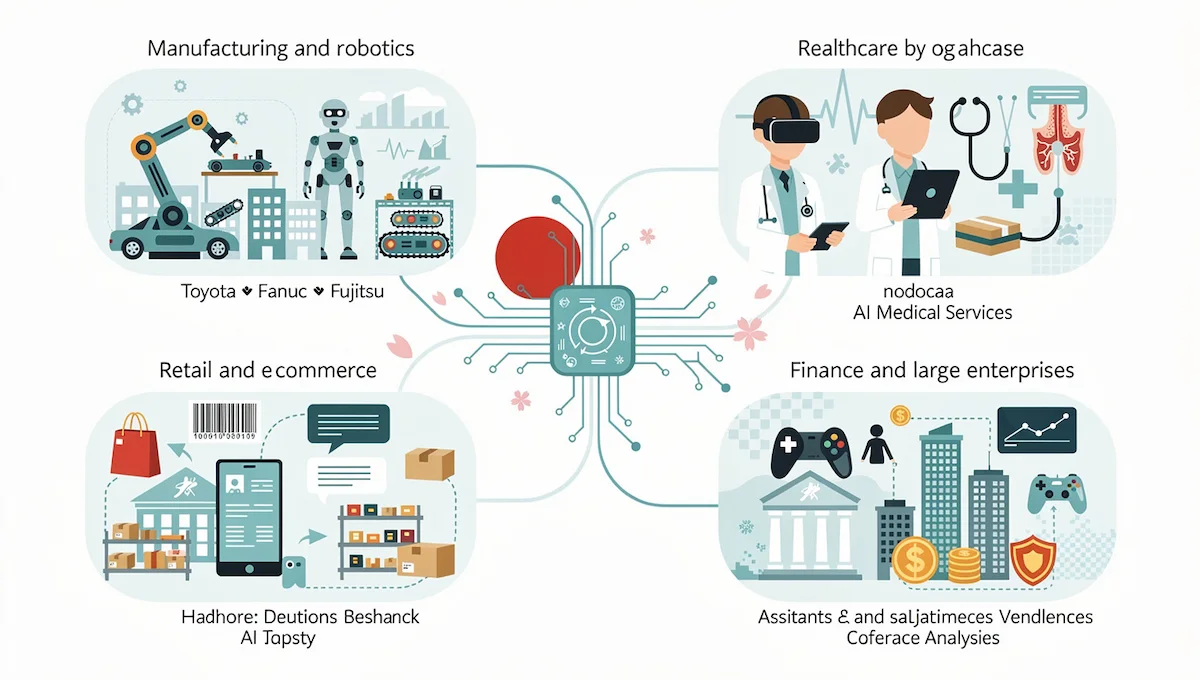
ITBusinessToday names Toyota, Fanuc and Fujitsu among Japan companies that use AI in manufacturing and robotics. It also lists platforms for machine learning and computer vision. The article gives no sources for its market claims, so use it as a list of names and not as proof of results.
Healthcare
The World Economic Forum describes three tools built by Japanese doctors. nodoca supports the diagnosis of influenza. AI Medical Services makes an endoscopy tool. Acute Medical Innovation makes a stethoscope that supports the finding of heart disease. The article also covers the regulatory approval path, which makes it a useful source for any company that plans to sell medical AI in Japan.
Retail and e-commerce
Retail teams use the same assistants and search tools as other sectors, plus local tools for customer contact and document processing. Names such as Rakuten appear in several sources, but no source gives reliable numbers on retail adoption, so this guide does not claim any.
Gaming
Gaming is the industry with the best survey data. In the poll of the Japan Online Game Association, companies named player preference analysis and behavior prediction as the top uses of AI. Gemini, Claude and GitHub Copilot led the tools list. The sample size was not disclosed, so use the result as a direction.
Finance and large enterprises
The Japanese consulting firm TIMEWELL lists Sumitomo Mitsui Banking Corporation, Toyota Motor Corporation and Panasonic Connect as enterprise adopters in a 2026 tool comparison. The article sells AI services and includes figures without sources, so verify any result you want to quote with the company itself.
How widely are AI tools used in Japan?
Adoption is rising from a low base. The Egg quotes the Japan Research Center, which found that generative AI use was 19 percent in December 2024 and 45 percent in December 2025. A BCG survey of working professionals from July 2025 puts workplace use in Japan at 51 percent, against a global average of 72 percent.
The numbers come from different samples, and none of the articles states how many people were surveyed, so compare the direction, not the exact percentages. The direction is clear: use is growing fast, and workplace use is still behind other countries.
AI PICKS, a Japanese comparison site, also tracks national subsidies for digitalization and AI adoption and public procurement notices that mention AI. If your company is based in Japan, check which subsidies apply to your project. For a view of how AI changes daily work in any company, read our guide on AI in the workplace.
Data privacy and rules for AI tools in Japan
Japan regulates AI mostly through guidance and through its privacy law. That law is the Act on the Protection of Personal Information, known as APPI. The rules decide what you may type into an assistant, so read this section before you roll out any tool to a team.
What APPI means for business users
On 2 June 2023, the Personal Information Protection Commission published a warning about generative AI services. For businesses, the points were clear. Personal information in a prompt must be necessary for the purpose you intended. Using it for another purpose can violate APPI without consent. You should also confirm that the provider does not use the data for machine learning. The commission also stated that the responsibility for compliance lies with the business that decides to use the service.
The commission publishes the text of the act and its policies in English in the Laws and Policies section of its official site.
The AI Promotion Act and business guidelines
Japan passed its first AI law on 28 May 2025. Its full name is the Act on Promotion of Research and Development and Utilization of Artificial Intelligence-Related Technologies. White and Case describes it as a basic law that sets principles, has no monetary penalties and creates an AI Strategic Headquarters led by the Prime Minister. The Cabinet Office approved a Basic AI Plan on 23 December 2025, and a draft code for generative AI businesses followed on 26 December 2025.
The act asks AI developers, providers and business users to make reasonable efforts to use AI well and to follow government policies. The practical rules for companies sit in the AI Guidelines for Business from the Ministry of Economy, Trade and Industry and the Ministry of Internal Affairs and Communications. The ministries published version 1.0 on 19 April 2024, and version 1.1 followed on 28 March 2025 for developers, providers and users.
This section is general information and not legal advice. Laws and guidelines change, so ask a lawyer in Japan when you handle customer data or sensitive information.
Questions to ask every AI vendor
- Data use: does the provider train its models on your inputs, and can you switch that off?
- Location: where is the data stored and processed?
- Retention: how long are prompts and files kept, and can you delete them?
- Notices: does the provider explain its use of personal data in Japanese?
- Controls: can an admin manage users, logs and sharing settings?
- Contract: who is responsible if personal data is exposed?
Japan has no single checklist for every product, so use these questions as a minimum before any rollout.
How to choose AI tools for Japan
A good choice starts with the task, not with the product. Write down what you need the tool to do, then score each product on the criteria below. For a general method that works for any company, our guide on how to choose AI tools for business adds a longer checklist.
| Criterion | What to check | How to test it |
|---|---|---|
| Japanese quality | Natural phrasing, correct terms, correct numbers | Run the same document through three tools |
| Keigo | The right level of politeness for the reader | Ask a native speaker to rate five messages |
| Data rules | APPI, storage location, training on inputs | Read the vendor terms and ask the questions above |
| Integrations | LINE WORKS, Kintone, Microsoft 365, Google Workspace | Connect one real workflow |
| Support | Help in Japanese, local contract and invoices | Send a support question before you buy |
| Price | Price in yen, per user or per usage, free tier limits | Calculate the cost for your team size |
| Result | Time saved and errors found | Measure one task before and after |
How to test an AI tool in Japanese
Pick one real document, such as a customer email or a meeting recording. Run it through three tools with the same prompt. Remove the tool names, give the results to a native speaker and ask for a rating on naturalness, politeness and accuracy. Repeat with a second document, because one lucky result proves nothing.
Pricing changes often and is usually shown in yen or dollars depending on the vendor, so check the current plan before you decide. Our guide on how much AI tools cost explains the usual price models and what to compare.
How to start with AI tools in Japan, step by step
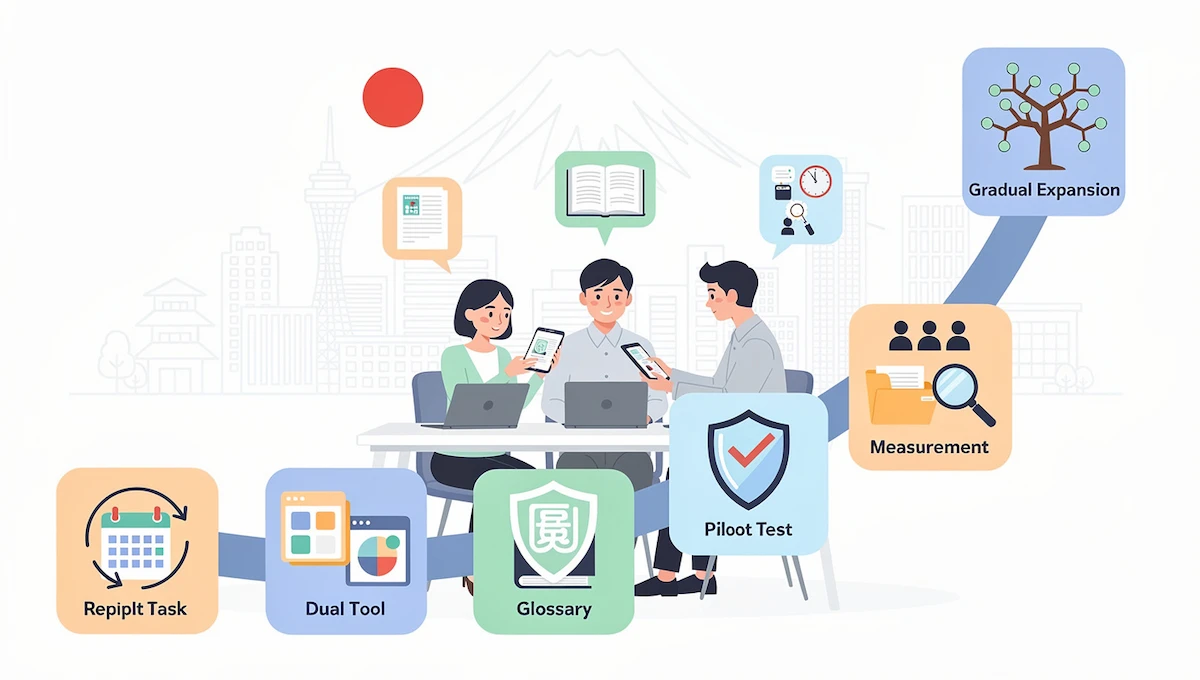
- Step 1: Pick one task that repeats every week, such as meeting minutes, customer replies or report drafts.
- Step 2: Choose two tools: one global assistant and one local product for the language or the document type.
- Step 3: Prepare a glossary of company terms, product names and the level of politeness for each reader.
- Step 4: Set data rules that say what may and may not go into a tool.
- Step 5: Run a small pilot with three users and ask a native speaker to review the output.
- Step 6: Measure the result in minutes saved and mistakes found.
- Step 7: Expand slowly to the next task or team.
For ideas on where AI fits in a company, our guide on how to use AI in business lists use cases by department.
Common mistakes when using AI tools in Japan
Translating English text word for word
A literal translation keeps the English structure and sounds foreign to a Japanese reader. Give the assistant the purpose and the reader, and let it rewrite the message instead of translating it.
Using the wrong level of politeness
An email to a customer in casual language can damage a relationship. State the reader and the level of keigo in the prompt, and have a native speaker approve templates once.
Skipping the review by a native speaker
AI text can look correct to a non-native reader and still be wrong. Review costs little compared with a lost customer, especially for contracts, price quotes and legal text.
Ignoring APPI and the location of data
Pasting customer names or personal data into a free chatbot can create a legal problem. Use business plans with clear data terms and keep personal data out of prompts when you can.
Picking an English-first tool without Japanese support
Some products do not handle Japanese transcripts or input well. Small teams with limited budgets should test the Japanese output in a free trial first, and our guide to AI for small business explains how to run low-cost tests.
AI tools for learning Japanese
General assistants such as ChatGPT, Claude and Gemini can act as a conversation partner. They explain grammar and rewrite your sentences in a more natural way. Ask them to correct your text and explain each correction in English, and compare their answers with a teacher or a native speaker.
For business Japanese, practice with real situations: a first meeting, a phone call, an email to a customer. Ask the assistant to play the role of a manager and to point out where your keigo is too casual or too formal.
AI tools for travel and daily life in Japan
ChatGPT, Gemini, Claude and Perplexity help with itineraries, restaurant ideas and translations of signs and menus. A travel blog that tested the same 10-day trip across several assistants reported that some answers gave outdated rail pass prices. Confirm fares, passes and opening hours on the official sites before you book.
Choosing between global and local AI tools in Japan
Teams in Japan usually need both kinds of product. A global assistant gives you strong general writing, coding and analysis. A local tool gives you Japanese speech, Japanese documents and a contract written for Japan.
Use a global tool when the task is open ended, such as drafting, research or code. Use a local tool when the input is Japanese audio, a scanned form or an HR process that follows Japan labor rules. Many companies in Japan run one of each and review the output with a native speaker.
Before you commit, check three points on any product sold in Japan: the languages of the interface and support, the place where the data is stored, and the way the vendor bills in yen. Foreign teams that enter Japan often skip these checks and lose weeks later. For a broader view of privacy risks in company tools, see our guide to AI data privacy for business.
The future of AI tools in Japan
Three trends stand out in the sources. The government now has a basic law, a Basic AI Plan and an AI Strategic Headquarters. Japanese model developers, from Sakana AI to large companies, keep investing in models for the Japanese language. Writers also point to labor shortages as a reason for companies to adopt AI, though the sources give no hard figures for that claim.
For business users, the practical result is more choice. Expect more Japanese-language models, more local products for speech and documents, and clearer rules for providers.
Final thoughts on AI tools in Japan
The best AI tools in Japan are the ones that match your task, your reader and your data rules. Start with a global assistant, add one Japanese tool for the job it does best, and let a native speaker check the output. A small pilot with real documents tells you more than any ranking.
Frequently asked questions
What AI tools are most used in Japan?
ChatGPT, Gemini and Copilot lead among active generative AI users, according to a December 2025 survey from the Japan Research Center. Claude and Perplexity are each under 4 percent in that survey. Results differ by industry, and game companies report higher use of Gemini and Claude.
Which AI tools were made in Japan?
Japanese AI tools include Sakana AI, ELYZA, Preferred Networks, Notta, Rimo, SmartHR, Cinnamon AI, AI inside and PKSHA. Large companies also build models, such as tsuzumi from NTT, cotomi from NEC, Takane from Fujitsu and Sarashina from SB Intuitions.
Is ChatGPT popular in Japan?
Yes. In the Japan Research Center survey quoted by The Egg, ChatGPT led with 37 percent of active generative AI users. A later survey showed 31 percent, with Gemini at 23 percent. None of the surveys states its sample size.
Do ChatGPT, Claude and Gemini work well in Japanese?
They work well for most business tasks, but quality changes with the model and the prompt. One agency test found that Claude 3.5 scored highest without a prompt, although that test is dated. Test the current version on your own documents.
What is the best AI translation tool for Japanese?
No single tool wins in every case. Google Translate, DeepL, ChatGPT, Claude and Gemini all work, and results depend on the text and the prompt. Run your own documents through three tools and let a native speaker rate the results.
What are the best AI tools for Japanese business?
A common setup has three parts. Use Microsoft 365 Copilot or Google Workspace with Gemini for office work. Add a local tool such as Notta for Japanese meetings. Use business software such as LINE WORKS or Kintone for workflows. Start with one task and add tools slowly.
Is there an AI law in Japan?
Yes. Japan passed the Act on Promotion of Research and Development and Utilization of Artificial Intelligence-Related Technologies on 28 May 2025. It is a basic law without monetary penalties, and practical rules sit in guidelines from the ministries.
What does APPI mean for AI tools?
APPI is the privacy law. In 2023, the privacy commission told businesses that personal information in a prompt must be necessary for the intended purpose and that the business is responsible for compliance. Check how the provider uses your data.
Where is my data stored when I use AI tools in Japan?
It depends on the provider and the plan. Read the vendor terms, look for the storage location and the training policy, and ask the vendor in writing if the answer is not clear. Enterprise plans usually give more control than free plans.
Can AI write keigo correctly?
Often yes, but not always. Tell the tool who reads the message and which level of politeness you want, give an example, and have a native speaker approve important templates.
What AI tools help me learn Japanese?
General assistants can explain grammar, correct your sentences and play a conversation partner. Compare their corrections with a teacher, and practice real business situations if you need keigo.
What AI tools help plan a trip to Japan?
ChatGPT, Gemini, Claude and Perplexity can build itineraries and suggest places. One blog test found outdated rail pass prices in several answers, so confirm fares and opening hours on official sites.
Are Japanese AI tools available in English?
Some are, and some are sold only in Japanese, because many HR and document products target Japanese companies. Check language support, contracts and support hours before you buy.
How much do AI tools cost in Japan?
Prices depend on the product, the plan and the number of users, and they change often. Most vendors offer a free tier or trial. Check the current price in yen or dollars on the vendor site and calculate the cost for your team.