AI tools cost between $0 and $200 per month for one person, and the price depends on the plan you pick, not on the brand. A free tier covers light use. One paid plan at about $20 a month covers daily work. Plans from $100 to $200 are built for people who hit the limits every day, and teams pay $20 to $30 per seat.
If you are asking how much do AI tools cost for your own use, the short version is this: start free, add one paid plan when the limits slow you down, and skip the rest until a clear need shows up. The sections below list prices for chatbots, writing, image, video, coding and automation tools. After that you will see what a small business pays and where the extra charges hide.
All prices are US list prices in dollars, before tax, checked in October 2026. Vendors change them often, so confirm the number on the pricing page before you pay.
What AI tools cost at a glance
AI tools cost most people between $0 and $20 per month. A free tier is enough for light use, one plan at about $20 covers daily work, and plans from $100 to $200 are meant for heavy users. Teams pay $20 to $30 per seat each month, and enterprise contracts are quoted by the vendor.
| Tier | Price per month | Who it fits |
|---|---|---|
| Free | $0 | Testing and light use |
| Starter | $5 to $15 | Casual daily use with fewer limits |
| Standard | About $20 | Daily work, writing, research, light coding |
| Power | $100 to $200 | Heavy coding, long documents, constant use |
| Team | $20 to $30 per seat | Small teams that need admin controls |
| Enterprise | Quote from the vendor | Large companies with security and contract needs |
The standard tier is the price most people end up paying. The cheap plans below $10 and the power plans above $100 are the newer additions, and they are where most of the AI pricing changes happened this year.
How AI pricing works
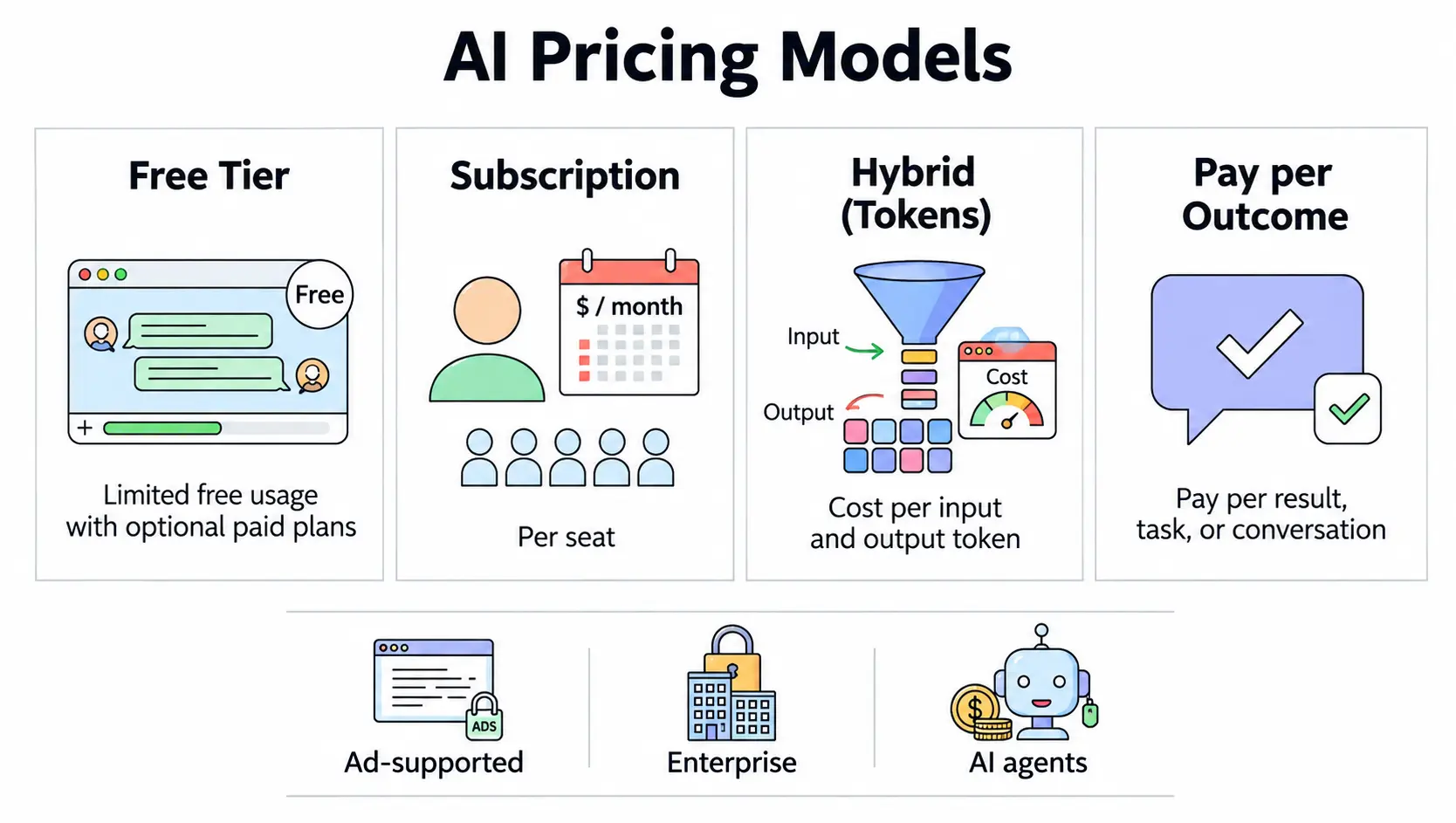
Five models of AI pricing cover almost every tool. Knowing which one a tool uses tells you whether your AI tools cost stays flat or grows with use.
Free tiers and their limits
Almost every major assistant has a free tier. ChatGPT, Claude, Gemini and Perplexity all let you chat without paying. The catch is the limits. Free plans cap daily messages, give you a smaller model, and restrict file uploads, image creation and deep research. Since February 2026, ChatGPT Free and Go also show ads to adult users in the US.
For occasional drafts and quick questions, a free tier is enough. For work with deadlines, the caps tend to show up at the wrong moment.
Monthly subscriptions and per seat pricing
A subscription is a flat fee a month. For one person it is simple, $20 is $20. For a team the bill is multiplied by the number of seats. Ten people on a $25 plan cost $250 per month, and ten people on a $50 enterprise plan cost $500.
Below enterprise level there is no bulk discount at the major vendors, so doubling the team doubles the bill. Many business plans also have a minimum seat count, usually two.
Usage based and token pricing
Developers and automation tools pay by usage instead of a flat fee. The unit is the token, a piece of text of about three quarters of a word, and prices are quoted per million tokens. Output costs several times more than input. If the term is new to you, the glossary of AI terms explains it in plain words.
Claude Sonnet 5.5, for example, is listed at $2 per million input tokens and $10 per million output tokens. Small models from several vendors start around $0.10 per million input tokens. A chat subscription never includes API credits. API access is billed separately, and mixing the two up is one of the most common mistakes new buyers make.
Hybrid plans and enterprise quotes
Hybrid plans combine a monthly seat fee with usage fees once you pass a limit. Claude Enterprise is listed at $20 per seat plus usage at API rates. Large organizations get a quote instead of a price, and the quote covers single sign on, audit logs and a contract.
Reported figures for ChatGPT Enterprise sit around $60 per seat with a minimum of 150 seats, but the vendor does not confirm that number publicly, so treat it as a starting point for a sales call.
Outcome and agent based pricing
Some vendors charge per result instead of per user or per token. Salesforce Agentforce, for example, is listed at $2 per conversation, or about $0.10 per action when bought as credits. This model can match the bill to the value when results are easy to measure. It can also grow faster than headcount, because one team can run many agents without adding a single seat.
How much do AI chatbots cost: ChatGPT, Claude, Gemini and Perplexity
AI pricing for the four big chatbots is almost the same at the standard tier. The differences show up in the cheap plans below $10, in the power plans above $100, and in what each plan includes besides chat. The official ChatGPT pricing page lists the current OpenAI plans.
ChatGPT pricing
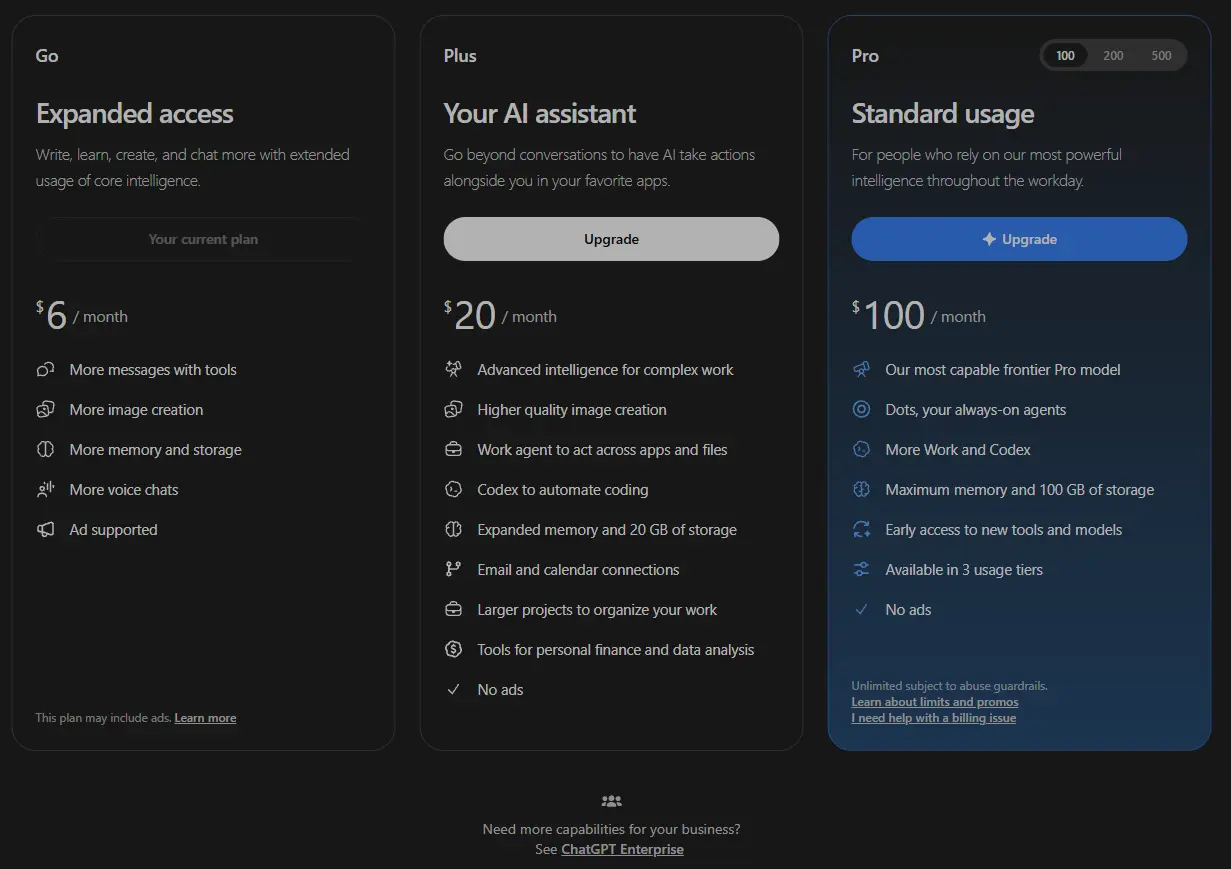
| Plan | Price | Notes |
|---|---|---|
| Free | $0 | Limited uploads and image creation, ads in the US |
| Go | $6 a month | Higher limits than Free, ads in the US |
| Plus | $20 per month | No annual discount, includes Codex |
| Pro | From $100 a month | Two main tiers at $100 and $200, more usage and longer sessions |
| Business | $20 per seat billed annually, $25 monthly | Two seat minimum, admin controls |
| Enterprise | Quote | Single sign on, compliance controls |
ChatGPT has the most tiers of any assistant, and two of them are called Pro. Check the exact price in the billing screen before you confirm, because the label is the same and the price is not.
Claude pricing

- Free: $0, daily message caps.
- Pro: $20 per month, or $17 a month billed annually ($200 up front). Includes Claude Code.
- Max: $100 per month for 5 times the Pro usage, or $200 a month for 20 times. Billed monthly only.
- Team Standard: $20 per seat billed annually, $25 monthly, from 2 seats.
- Team Premium: $100 per seat billed annually, $125 monthly, for heavy users on a team.
- Enterprise: $20 per seat plus usage at API rates, annual contract.
Anthropic does not publish exact message counts for Pro or Max. Usage runs in sessions that reset every few hours, plus a weekly cap, and long prompts and attachments use the allowance faster.
Google AI pricing
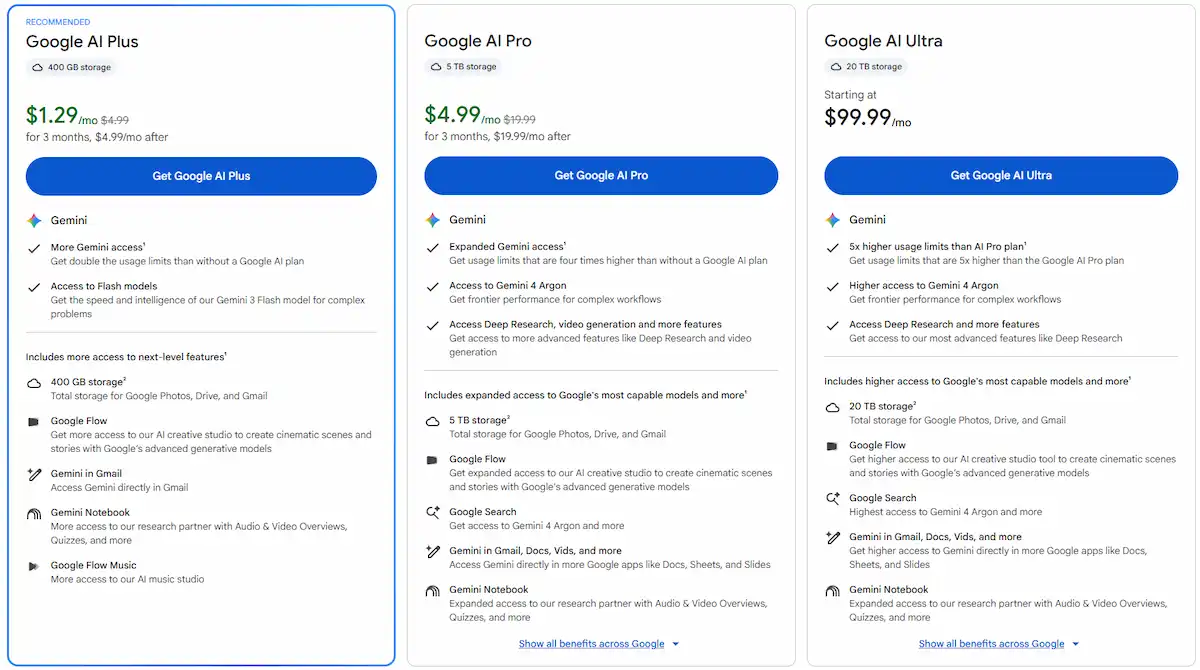
| Plan | Price per month | What you get |
|---|---|---|
| Free | $0 | Gemini app with limits, 15 GB storage |
| AI Plus | $4.99 | 400 GB storage, 2 times the free usage |
| AI Pro | $19.99 | 5 TB storage, 4 times the free usage |
| AI Ultra | $99.99 or $199.99 | 5 times or 20 times the AI Pro limits |
Google bundles storage and other Google services into these plans, which changes the math if you already pay for extra storage. Google AI Pro can also be shared with up to five family members at no extra cost, and the details are on the Google AI plans page. One catch for companies: these plans are sold to personal Google accounts only. Workspace customers get Gemini inside their Workspace plan instead.
Perplexity, Grok, Mistral and Microsoft Copilot
- Perplexity Pro: $20 per month, or $17 billed annually. Max is $200. Enterprise Pro is $40 per seat.
- SuperGrok: $30 a month. SuperGrok Plus is $100 and Heavy is $300.
- Mistral Le Chat Pro: $14.99 per month, and $5.99 for verified students for 12 months.
- Microsoft 365 Premium: $19.99 a month. It includes Copilot in the Office apps, but only for the account owner, not for family members.
Which AI subscription is the cheapest?
The cheapest AI subscription from a major vendor is Google AI Plus at $4.99 per month. ChatGPT Go follows at $6, Mistral Le Chat Pro at $14.99, and Claude Pro at $17 a month when billed annually.
On ChatGPT Plus vs Claude Pro price, both are $20 when billed monthly. Claude Pro drops to $17 on the annual plan and saves $40 per year, while ChatGPT Plus has no annual option. Google AI Pro at $19.99 is the lowest of the standard plans in list price, and it adds storage on top.
How much do other AI tools cost
A chatbot is only one line in the bill, and the AI tools cost of a full setup depends on how many of these you add. Writing, design, video, code and automation tools each have their own price, and most of them start with a free plan.
Writing and content tools
Grammarly Pro costs about $12 per month, Jasper about $59, and Writesonic $49 to $79. Canva Pro, which adds AI design features, is $10. Notion with AI features runs $10 to $20 per user. For most people one chatbot at $20 replaces two or three of these, so check for overlap before you add another one. If content is your main use, the guide on AI content creation shows which tool fits which job.
Image and video generators
Midjourney is the main paid image tool. Basic is $10 a month, Standard $30, Pro $60 and Mega $120, and annual billing takes about 20 percent off. ChatGPT and Google AI plans also include image creation, with caps that get tighter on the cheaper tiers. If you make more than about 100 images per month, API billing is usually cheaper than a higher subscription tier.
Video starts at about $12 a month with Runway. Voice tools such as ElevenLabs go from a free plan to $99 per month. The guide on AI video creation covers how these tools fit into a production workflow.
Coding assistants
GitHub Copilot costs $10 a month for individuals and $19 per user for businesses. JetBrains AI starts at $10 for Pro, and Windsurf Pro is $20. Claude Pro includes Claude Code and ChatGPT Plus includes Codex, so a developer may already have an assistant inside a chat plan.
For engineering teams the seat price is only part of the bill. Once agent workflows run, total spend per developer, seat plus tokens, lands between $200 and $600 per month.
Meeting, notes and automation tools
Otter.ai runs $6 to $17 a month, Granola $14, and Zapier about $16 to $20 on a paid plan. Agent platforms are the expensive end of this group. Lindy Plus is $49.99 per month, and a busy agent can add another $50 to $100 a month in model costs on top of the subscription. Before you pay for one, read how AI agents for business work and what jobs they handle well.
Customer service, marketing and sales tools
Business tools with AI built in are priced per seat or per agent. Tidio starts at about $29 per month, Intercom at about $74, and Zendesk AI at about $55 per agent. HubSpot has free CRM tools and paid seats from about $15, and Missive costs $14 per user. SEO and content tools such as Surfer, Frase or Clearscope run $30 to $200 per month. Outreach tools run from $30 for Instantly to $49 for Apollo and $59 for Reply.io per seat, and LinkedIn Sales Navigator Core is $89.99 per month billed annually.
Most small businesses add one or two of these after the main chatbot, and marketing AI spend rarely goes above $300 per month for teams under 25 people. The guide on AI marketing automation shows how these tools connect to each other.
How much do AI tools cost for a small business
AI tools cost a five person team anywhere from $0 to about $200 per month in dedicated AI spend for a working setup. Including the office suite that hosts the tools, that range is $35 to $270. Most small businesses report a total between $100 and $500 a month. Most of that money goes to chat seats first and specialist tools second.
Monthly cost for 1, 5 and 10 people
| Team size | Typical setup | Monthly cost |
|---|---|---|
| 1 person | One $20 plan and one specialist tool at $10 to $30 | $30 to $50 |
| 5 people | Two paid business seats at $20 to $25, the rest on free tiers | About $40 to $50 |
| 5 people, full | Five ChatGPT Business seats and five Claude Team seats, billed annually | $200 |
| 10 people | Ten seats at $25, one marketing tool at $80, one automation tool at $40 | About $420 to $470 |
Add 30 to 50 percent to the AI tools cost in the first year for training, integration and rework. Buying five seats on day one is the most common mistake. Start with two seats for the people who use AI daily, watch who hits limits for three months, and add seats only where the limits are a problem.
Business plan or personal plan
A personal plan at $20 is cheaper per seat than a business plan at $25, but it is a poor fit for company data. Business tiers add admin controls and a written promise that your inputs are not used to train the models. Personal plans and free tiers may use your inputs unless you opt out. If staff handle customer data, contracts or financial figures, the extra $5 per seat is the cheapest protection you can buy. The guide on AI data privacy for business covers what to check before you pay.
Free tier risks for company work
A free tier is a weak starting point for company work. Inputs on many free plans may be used to improve future models unless you opt out. Free users usually get smaller or older models, and capacity limits hit hardest at peak hours, which is when the team needs the tool. A team that works on free output often spends more time on fixes than the paid seat would have cost. Move to a business plan at $20 to $30 per seat as soon as customer data, contracts or client work enter the prompts.
Google Workspace or Microsoft 365
Both suites cost $7 at the entry tier and $14 at the standard tier per user per month on annual billing. The difference is the AI layer. Google includes Gemini in the Business Standard plan, across Docs, Sheets, Slides, Drive and Meet. Business Starter at $7 only includes Gemini in Gmail, so it is not an AI plan.
Microsoft charges extra. Copilot for business is listed at $21 per user a month on top of a qualifying Microsoft 365 license, and the enterprise add-on is $30. For a team of five the gap is roughly $570 per year. If your team lives in Excel and Teams, the extra cost can still make sense. Before you commit, the checklist in how to choose AI tools for business helps compare the two.
What companies spend on AI tools
Company spend is far higher than the price of one seat, because it adds up across many tools and many people. In a survey of 250 US marketing and sales professionals, 69 percent of businesses said AI tools cost them between $50 and $10,000 per year. AI services such as agencies and consultants cost $100 to $5,000 per month for 57 percent of them, and hourly rates for AI help ran from $25 to $250.
| Company size | Yearly AI spend | Share of businesses in that range |
|---|---|---|
| 1 to 10 employees | $50 to $500 | 67% |
| 11 to 50 employees | $501 to $2,500 | 50% |
| 51 to 250 employees | $50 to $5,000 | 65% |
| 251 to 500 employees | $501 to $2,500 | 67% |
| 501 or more | $50 to $25,000 | 64% |
At the top end the numbers are much larger. Zylo reports an average of $1.2 million per year on AI native apps per organization, up 108 percent from the year before. That figure is about $3 million for companies with 2,501 to 10,000 employees and $4.7 million above 10,000. In the same survey, 78 percent of IT leaders reported unexpected charges from usage based or AI pricing in the past year. ChatGPT is the most expensed app by number of transactions, which shows how much of the spend enters through personal cards and not through procurement.
AI tools cost by budget: starter, professional and power user
Three budgets cover most buyers, and the AI tools cost for each one is the sum of the plans listed. Each total below uses the list prices from the sections above.
Starter: $0 to $6 per month
Use the free tiers of ChatGPT, Claude and Gemini, plus free plans of Notion and Canva. If the limits hurt, add ChatGPT Go at $6. This setup gives you one assistant for daily use, a workspace, and basic design tools.
Professional: $40 to $70 a month
- ChatGPT Plus: $20
- Claude Pro: $20
- Notion Plus: $10
- Canva Pro: $10
- Focus audio or similar tool: $6
The total is $66. Two chatbots, a workspace and a design tool cover most knowledge work. Dropping to a single chatbot brings the total to about $46.
Power user: $200 to $400 per month
A power setup pays for the top model tier and a few specialist tools. One example is Claude Max at $200, ChatGPT Plus at $20, Notion Business at $20, Granola at $14, Superhuman at $30, Lindy Plus at $49.99, Zapier at $20, Canva Pro at $10 and a focus tool at $6. That is about $370 a month.
Paying for every top tier at once, including ChatGPT Pro, Claude Max, Perplexity Pro and Gemini Ultra, lands around $800 to $900. That level only makes sense when AI work is how you earn money. To build a setup step by step instead of buying everything at once, follow the method in AI tool stack for business.
How much do AI tools cost by profession
The same price list produces different totals depending on the job. These are typical stacks at October 2026 prices.
| Profession | Main tool | Add on | Monthly total |
|---|---|---|---|
| Freelance writer | Claude Pro, $20 | Perplexity Pro, $20 | $40 |
| Software developer | ChatGPT Plus, $20 | API credits, $50 to $100 | $70 to $120 |
| Graphic designer | Midjourney Standard, $24 billed annually | ChatGPT Plus, $20 | $44 |
| Marketing manager | ChatGPT Business, $25 | Perplexity Pro, $20 | $45 |
| Data analyst | ChatGPT Plus, $20 | Claude Pro, $20 | $40 |
A total of $40 to $45 is where most professionals end up, because one extra plan for research or a second model covers the gaps in the first.
Subscription or API: which is cheaper
AI pricing for developers works differently from a chat plan. A subscription wins when you use a tool all day. API pricing wins when usage is light or comes in bursts.
Subscription or API by use
The figures below are rough estimates for typical use, not quotes.
| Use | Subscription | API estimate | Cheaper option |
|---|---|---|---|
| Light chatbot, 1,000 messages per month | $20 | $5 to $8 | API |
| Image creation, 50 images a month | $20 | $2 to $4 | API |
| Code help, 100 sessions per month | $20 | $15 to $25 | Subscription |
| Document analysis, 500 files a month | $20 | $30 to $50 | Subscription |
The API has no chat app and needs some technical setup, so it fits developers and automation builders. For everyone else the flat monthly plan is simpler and the bill is easier to predict.
API prices per million tokens
| Model | Input | Output | Best for |
|---|---|---|---|
| Claude Haiku 5.5 | $0.10 | $0.50 | High volume, simple tasks |
| Claude Sonnet 5.5 | $2 | $10 | General use |
| Claude Opus 5.5 | $4 | $20 | Complex reasoning and coding |
| GPT-6 Luna | $0.10 | $0.50 | High volume, chatbots |
| GPT-6.1 Sol | $2 | $10 | Mid range |
| GPT-6 Astra | $10 | $50 | Complex reasoning, agent work |
| Gemini 4 Argon | $2 until November 30, 2026, then $4 | $10 until November 30, 2026, then $20 | Frontier workloads |
Batch processing cuts Claude rates by half for jobs that do not need an instant answer. Rates change more often than subscription prices, so check the vendor page before you build a budget on them.
How to estimate your monthly API bill
Convert words to tokens by dividing by 0.75, then multiply by the price. Take 10,000 chats a month with 500 words in and 500 words out. That is about 6.7 million input tokens and 6.7 million output tokens. On a small model at $0.10 and $0.50 the bill is about $4. On a mid range model at $2 and $10 it is about $80. Output costs more than input, so long answers push the bill up faster than long questions. Add 20 percent as a margin, because usage tends to grow after launch.
Buy or build: what custom AI costs
Most companies buy seats and tokens from a vendor. Building means paying for engineers, compute and upkeep, and it only makes sense when no off the shelf tool fits the job.
- Single purpose agent: $5,000 to $15,000 to set up, then $200 to $800 per month to run.
- Multi workflow internal tool: $15,000 to $50,000 to set up, then $500 to $2,500 per month.
- In house AI engineer: salaries of $112,000 to $178,000 per year, plus about 30 percent for benefits and taxes.
- Upkeep: 15 to 30 percent of the build cost per year for monitoring and updates.
- Pilot with an agency: $5,000 to $20,000 is a common first step before a bigger contract.
Open source models such as Llama or Mistral remove license fees, but you still pay for hardware, storage, security and engineering time. For a team under 50 people, three off the shelf tools usually do the same work for less. Custom work starts to pay off when per seat enterprise pricing passes the amortized build cost, which is typically around 75 to 100 active seats.
Hidden costs of AI tools
The listed AI tools cost is the smaller part of the bill for many buyers. Several items add to it, first for individuals and then for companies.
Tax, currency and card fees
List prices are in US dollars before tax. VAT, GST or sales tax adds 5 to 20 percent depending on where you live. Foreign cards often add a conversion fee of 1.5 to 3.5 percent on every charge, every month. A $20 plan can easily cost $24 on the statement.
Rate limits and overage charges
Every plan has a cap. ChatGPT lists everyday text chats as unlimited but caps reasoning models, uploads and deep research. Claude uses session limits with a weekly cap. When you hit a cap you either wait for the reset or move up a tier, and the jump from $20 to $100 is steep because most vendors sell nothing in between. A few vendors sell extra usage at API rates.
Annual lock in and subscription creep
Annual billing saves 10 to 20 percent, but it locks your seat count and removes the option to switch when a better plan appears, which happens often. Subscription creep is the second problem. Ten tools at $10 to $20 each cost $100 to $200 per month, and many are used twice. Review the list every quarter and cancel any tool you have not opened in 30 days.
Learning time and rework
Every new tool takes two to five hours to learn. Research on small businesses puts the share of saved time that goes back into fixing AI output at about 26 percent. For a company, training, integration and rework add 40 to 60 percent on top of the visible tool cost in the first year. The AI for small business guide shows where that extra spend pays back.
Company level costs: shadow AI, renewals and overruns
- Shadow AI: tools bought by employees on personal or company cards, outside procurement, usually on click through terms and at higher prices than a negotiated contract.
- Overlapping tools: generative AI is the tenth most redundant app category in enterprise portfolios, with about seven separate apps per organization, which means seven contracts and seven renewals.
- Renewal premiums: vendors raise prices for AI features already inside the contract, whether or not you use them.
- Usage overages: going over a prepaid block of tokens or credits costs more per unit than the negotiated rate, and under using it wastes the commitment.
- Compliance work: in healthcare, finance and government, controls for GDPR or HIPAA can cost as much as the license.
- Budget overruns: 68 percent of business AI projects went over budget in 2026, by 42 percent on average, and data preparation alone can take 40 to 60 percent of a project budget.
How to pay less for AI tools
Five moves lower the AI tools cost without dropping the tools you use every day.
Annual billing
Claude Pro goes from $20 to $17 a month and saves $40 per year. Perplexity Pro goes to $17 and saves $36. ChatGPT Business drops from $25 to $20 per seat. Midjourney takes about 20 percent off. ChatGPT Plus has no annual discount at all. Use monthly billing for the first two or three months of a new tool, and switch to annual only after you know you will keep it.
Family sharing
Google AI Pro is the only major plan with an official family plan. At $19.99 per month for up to six people, a family of four pays about $5 per person. ChatGPT, Claude and Perplexity sell single user plans, and sharing one login breaks their terms and can get the account flagged. A household with different needs can mix one shared Google plan with one ChatGPT Plus or Claude Pro seat for the heaviest user, about $40 in total.
Student discounts
Verified students pay about $10 a month for Perplexity Education Pro and $5.99 per month for Mistral Le Chat Pro for the first 12 months. Google has run free access offers for students on AI Pro, and these renew at the full price unless you cancel, so check the current terms. ChatGPT Go at $6 is the cheapest paid OpenAI plan that anyone can buy.
Multi model services
A few services sell access to several models through one plan, usually for $10 to $20 per month. They help when you pay for two or more plans and use each one lightly. They help less when one model carries most of your work, because the bundle usually lacks platform extras such as Claude Code, custom GPTs or bundled storage, and new releases can arrive later. Compare the price against the plans you would actually cancel, not against all five standard plans together, which adds up to about $110 per month and few people pay.
One paid plan and free tiers
One paid plan plus the free tiers of the others gives better value than three paid plans. Pay for the tool you open every day. Keep the free versions of ChatGPT, Claude, Gemini or Perplexity for quick second opinions and research.
Cancel overlapping tools
ChatGPT and Claude overlap. Notion AI and a chatbot overlap for writing, and Grammarly overlaps for editing. List what each subscription does that your main assistant cannot, and cancel the rest. Each duplicate is a charge with no added capability.
Is paying for AI tools worth it
Whether the AI tools cost is too high depends on the time a plan saves. A $20 plan pays for itself fast when time has a price. If you bill $50 per hour, saving 24 minutes in a month covers the fee. Surveys of small business workers report savings of 5 to 9 hours per week, and 41 percent of small businesses using these tools report higher revenue.
Payback differs by use. Drafting and admin tools pay back inside the first month. Marketing and outreach tools take 60 to 180 days. A custom AI build takes two to four years to show a clear return. The method in AI ROI for business shows how to put numbers on it for your team.
The risk is not paying for AI. The risk is paying for tools that nobody opens. A tool without a changed workflow is the most expensive purchase in this category, whatever the price tag says.
How to choose a plan and track your spend
Four questions before you pay
- How often will you use it? Daily users get value from a flat plan. Occasional users do fine on a free tier.
- Do you need the strongest model? For research and complex writing the gap is large. For simple tasks the gap is much smaller than the price difference.
- Are you using it or building with it? Building means API pricing, not a subscription.
- Do you have compliance needs? Healthcare, finance and legal work usually needs a business or enterprise contract.
Audit your AI spend in six steps
- List every charge, including tools paid on personal cards and expensed later.
- Add tax and card fees to each line to get the true monthly total.
- Log what you use for two weeks, which tool, for what job, and whether another tool could have done it.
- Mark the overlaps and cancel the duplicates.
- Check where you hit limits, because that decides whether you need a higher tier or a different tool.
- Decide, then review again in 90 days, since prices moved several times this year.
Mistakes when reading price tables
- Comparing plan names instead of limits. Two plans called Pro can differ a lot in usage.
- Budgeting the list price and forgetting tax and fees.
- Choosing annual billing before testing monthly.
- Trusting a table with no date on it.
- Judging by price per month alone. A better unit is cost per finished task, so divide the monthly fee by the work you completed.
What changed in AI pricing in 2026
- January: ChatGPT Go went global at $6.
- February: Ads started on ChatGPT Free and Go in the US.
- April: OpenAI added a $100 Pro tier and cut ChatGPT Business by $5 per seat.
- June: Google cut AI Plus from $7.99 to $4.99.
- Google I/O: Google AI Ultra was repriced and split into $99.99 and $199.99.
- July: Microsoft raised list prices across most commercial plans.
The $20 standard plan stayed where it was, so AI pricing moved at the edges. Vendors added cheaper plans below it and pricier plans above it instead. Prices per token keep falling, with Opus input pricing going from $15 to $5 per million tokens, while total company spend keeps rising because usage grows faster. Google has also announced that rates for one of its Gemini API models double on December 1, 2026.
Expect three more shifts. Agent workflows use far more tokens than a chat, so one automated job can cost many times a single question. AI keeps moving into software you already pay for, which makes the line item harder to see on the invoice. And premium plans at $200 to $300 keep multiplying while the $20 plan holds still.
The bottom line on how much AI tools cost
Start with free tiers. Add one plan at about $20 when the limits slow you down, and pick annual billing only after a few months of steady use. Move to $100 or more only if you hit the cap every week. Small teams should buy two business seats first and add more when the usage shows up in the admin panel. Check taxes, caps and overlap before you add the next subscription.
Frequently asked questions
How much do AI tools cost a month?
Most people pay between $0 and $20 per month. Free tiers cost nothing, standard plans for ChatGPT, Claude, Gemini and Perplexity cost about $20, and power plans cost $100 to $200. Business plans run $20 to $30 per seat, and enterprise plans are quoted by the vendor.
What is the cheapest AI subscription?
Google AI Plus at $4.99 a month is the cheapest paid plan from a major vendor. ChatGPT Go is $6 and Mistral Le Chat Pro is $14.99. Free tiers from ChatGPT, Claude, Gemini and Perplexity cost nothing and are enough for light use.
Is ChatGPT Plus or Claude Pro cheaper?
Both cost $20 per month when billed monthly. Claude Pro costs $17 a month on the annual plan, which saves $40 per year. ChatGPT Plus has no annual discount, so Claude Pro is cheaper only if you pay for the full year.
Do AI subscriptions include API access?
No. ChatGPT Plus, Claude Pro, Perplexity Pro and Google AI plans do not include API credits. The API is billed per token and separately from any chat plan. If you build an app or an automation, budget for API costs as a separate line.
Are AI tools worth paying for?
They are when you use them often. Someone who bills $50 per hour recovers a $20 plan after about 24 minutes of saved time in a month. If you open the tool twice a month, a free tier is the better choice.
Should I pay for AI tools monthly or annually?
Pay monthly for the first two or three months. If you are still using the tool after that, move to annual billing and save 10 to 20 percent. Annual plans lock your seat count, and most vendors do not refund them after you cancel.
Are AI tools tax deductible?
In most countries, AI subscriptions used for paid work count as a business expense, like other software. Keep the receipts and note the share used for business if you also use the tool privately. Rules differ by country and business type, so ask a tax adviser.
Is there a family plan for AI tools?
Google AI Pro and AI Plus can be shared with up to five other family members at no extra cost. ChatGPT, Claude and Perplexity have no family plan. Microsoft 365 Family covers up to six people for the Office apps, but Copilot works only for the account owner.
Why do most AI plans cost $20?
OpenAI set the $20 price for ChatGPT Plus in February 2023, and competitors matched it to avoid looking more expensive. Vendors have kept that price and added cheaper plans below it and plans from $100 to $500 above it, so the standard price never moved.
Is AI getting cheaper or more expensive?
Both. The price per token for developers keeps dropping, and new cheap plans from $4.99 to $6 have appeared. At the same time, power plans from $100 to $300 have multiplied, and total spend per company grows because usage grows faster than prices fall.
What is the difference between ChatGPT Plus and ChatGPT Business?
ChatGPT Plus is $20 per month for one person and may use your inputs to improve models unless you opt out. ChatGPT Business is $25 per seat monthly or $20 billed annually, with a two seat minimum, admin controls and a written promise that your inputs are not used for training.
What happens if I hit the usage limit on a paid plan?
You wait for the reset or move to a higher tier. ChatGPT caps reasoning models, uploads and deep research, and Claude Pro uses session limits plus a weekly cap. Most vendors do not sell small top ups, so the next step is often the $100 plan.
Can I use AI generated content commercially?
Paid plans from ChatGPT, Claude and Perplexity grant commercial rights to the content you generate. Midjourney requires the Pro or Mega plan for companies with more than $1 million in yearly revenue. You stay responsible for copyright and trademark issues, so read the terms of each tool.
Are AI prices the same in every country?
List prices are mostly set in US dollars, but tax, currency conversion and card fees change what you pay. VAT, GST or sales tax can add 5 to 20 percent. Some vendors also sell different plans or prices by region, so check the price inside the app before you confirm.
Is open source AI free?
The license is free, the running costs are not. You pay for hardware, storage, security and engineering time. Self hosting can be cheaper for large steady workloads, but a small team usually pays less with a managed cloud service or a $20 plan.