An AI tools marketplace is a website where you can find, compare and buy AI tools, agents and models from many vendors in one place, and where builders can list their own products for sale. The big names are the cloud marketplaces from AWS, Microsoft and Google Cloud, agent stores such as Salesforce AgentExchange and the GPT Store, and open hubs such as Hugging Face. Directories like Futurepedia and There is An AI For That sit next to them and help you discover tools, but most do not sell them.
This guide explains each type of AI marketplace, from cloud stores to the AI agent marketplace, compares the main platforms, and shows how to choose one and how to buy through it as a company. If you build tools, you also get a section on how to list and sell them, with the fees and rules that matter. The last parts cover security, trends and the mistakes that cost buyers and sellers the most.
Marketplaces change fast, and many guides online are written by vendors who place their own product first. Where a claim comes from a vendor or a single report, the text says so, and prices are left for you to confirm on the official page.
Key takeaways
- Not every marketplace sells the same thing. Cloud marketplaces sell software and agents billed to your cloud account, app stores sell add-ons for one product, and directories only list tools.
- Cloud marketplaces suit companies that already buy from AWS, Microsoft or Google Cloud, because purchases count against existing spend and follow the same security rules.
- Agent marketplaces such as AgentExchange and the GPT Store sell ready-made agents, templates and actions for one platform.
- An AI tools directory is for discovery. Treat its rankings with care, because several sell paid listings and featured spots.
- Test with your own data before you buy, compare the total cost including fees, and check how the vendor uses your data.
- Sellers need to match the platform. Each marketplace has its own publishing rules, review process and revenue terms.
| Type | What it does | Examples |
|---|---|---|
| Cloud marketplace | Sells software, agents and tools billed through a cloud account | AWS Marketplace, Google Cloud Marketplace, Microsoft Marketplace |
| Agent marketplace | Sells or shares agents, actions and templates for one platform | Salesforce AgentExchange, GPT Store, Poe, Agentverse, Apify Store |
| App store | Sells add-ons for a single product | Salesforce AppExchange, HubSpot App Marketplace, Shopify App Store |
| Model hub | Hosts open models, datasets and demo apps | Hugging Face |
| Prompt marketplace | Sells prompts made by other users | PromptBase, PromptHero, FlowGPT |
| AI tools directory | Lists and reviews tools, usually without selling them | Futurepedia, There is An AI For That, Toolify |
What is an AI tools marketplace?
InsertChat defines an AI marketplace as a platform for discovering, comparing and buying AI models, tools and solutions from several vendors in one place. It sorts marketplaces into three kinds: cloud provider marketplaces such as AWS, Azure and Google Cloud, model hubs such as Hugging Face, and specialized marketplaces for one kind of AI solution. That is a good starting point, although the real picture is wider, because agent stores, app stores and prompt marketplaces have grown quickly.
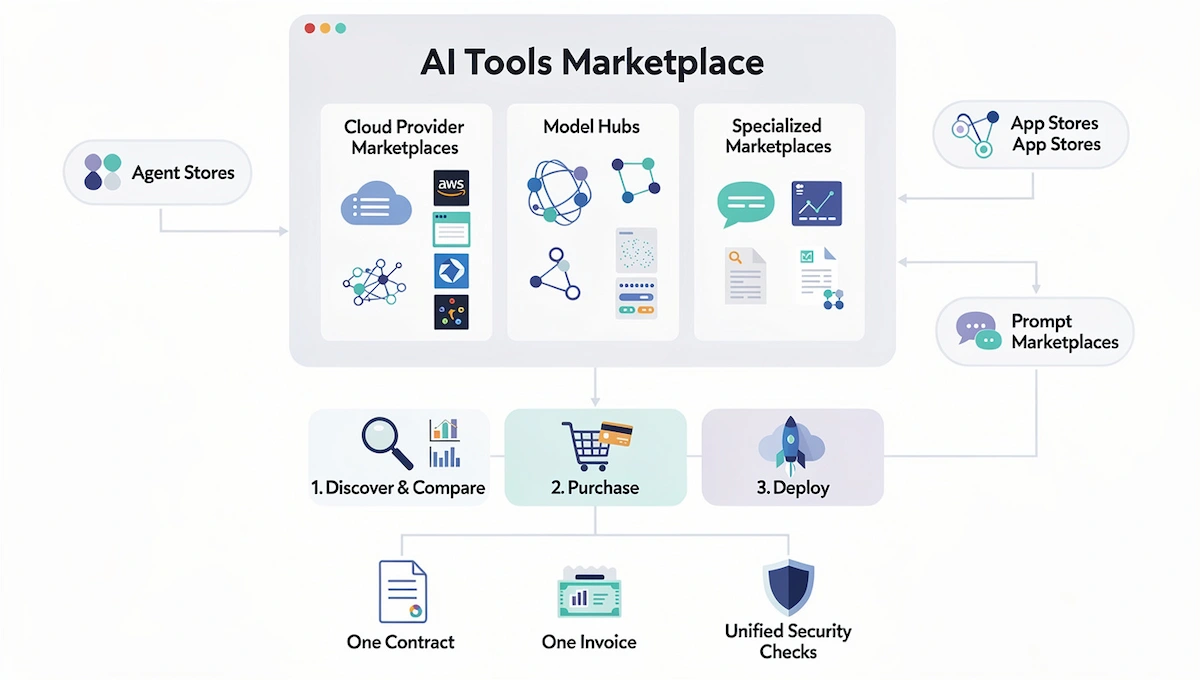
The buying steps look similar on most platforms. AWS describes three: find and evaluate a solution, purchase it in the marketplace, then configure and deploy it. On Google Cloud, a dedicated view lists AI agents available for deployment, and each product card links to a details page with features, pricing and deployment options. The practical benefit is one contract, one invoice and one set of security checks, instead of a new vendor relationship for every tool. For plain definitions of terms such as model, agent and prompt, see our AI terms glossary.
Who uses an AI marketplace?
Three groups use them, and each wants something different.
- Buyers: IT and operations teams that want approved tools with clear pricing, and small teams that want to try a tool without a long sales process.
- Sellers and builders: developers, agencies and software companies that want reach, billing and trust without building their own store.
- Operators: teams that run agents in production and need monitoring, access control and updates.
Fluence makes a useful point here: the best marketplace depends on whether you are a buyer, a builder, a seller or an operator, so decide that first.
Benefits of an AI marketplace
InsertChat lists five benefits of an AI marketplace: easier discovery, simpler procurement, faster deployment, lower risk and integration with the tools you already run. Discovery is the first gain, because one search can replace weeks of vendor research. Procurement is the second, since one contract and one invoice cover many tools. Faster deployment follows when a listing can be turned on from a console instead of a custom project.
The risk benefit needs a caveat. Marketplaces review listings to different degrees, and a review does not replace your own test. Treat the platform as a filter that saves time, not as a promise that a tool will work for your team.
AI tools marketplace vs directory, app store, model hub and platform
These terms are often mixed up, and the difference decides where you should look. InstantDM separates a marketplace from a platform and a framework, and Fluence adds directories and model marketplaces to the list.
| Term | Main purpose | Do you buy there? |
|---|---|---|
| AI tools marketplace | Find, buy and sell tools from many vendors | Yes, with billing and listing rules |
| AI tools directory | Discover and compare tools | Usually no, you click through to the vendor |
| App store | Extend one product with add-ons | Yes, but only for that product |
| Model hub | Share and download open models and datasets | Mostly free, some paid features |
| Agent platform | Build and run your own agents | You pay for the platform, not for listings |
| Framework | Code library for building agents | No, you build with it |
A directory such as Futurepedia can send you to a tool, and a marketplace such as AWS can bill you for it. Knowing which one you are on saves you from trusting a ranking as if it were a purchase guide.
Types of AI marketplaces
The sections below follow the way buyers and sellers actually sort these platforms. Each one names the main players, what you can find there and what to watch for.
Cloud marketplaces for AI tools and agents
Cloud marketplaces are the largest AI tools marketplace category for companies. AWS Marketplace has a dedicated page for AI agents and tools from AWS partners, grouped into five kinds of offer: software with embedded agents, pre-built agents, agent tools, agent development solutions and professional services. Its use case filters include content creation, customer support, data analysis, finance and accounting, IT support, legal and compliance, research, sales and marketing, and software development. Offers come in several delivery formats, among them SaaS, API, container image and machine image.
Google Cloud Marketplace has a curated view of AI agents available for deployment. You describe the task in a search bar, review the suggested agents and then open a details page for features, pricing and deployment options. Filters cover category, industry, business function and compatibility, for example with the A2A protocol and Gemini Enterprise.
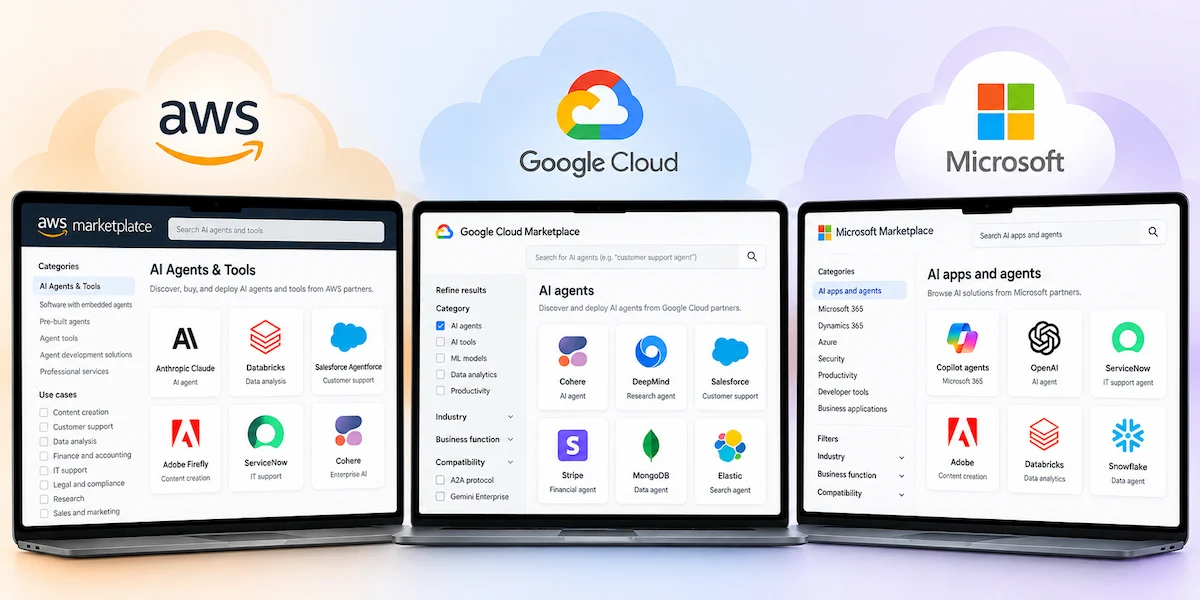
Microsoft Marketplace now brings together AppSource and Azure Marketplace. According to a Microsoft partner blog post, it has an AI apps and agents category with more than 3,000 listings, and partners can build agents that extend Microsoft 365 Copilot and Azure AI Foundry. These figures come from Microsoft itself, so confirm the current number on the marketplace.
The main draw is billing. A purchase can count toward an existing cloud commitment, and the products follow the same governance and security controls as the rest of the cloud account. The main limit is that listings are written by vendors, so you still need to test the tool yourself.
AI agent marketplaces
An AI agent marketplace sells or shares ready-made agents, actions and templates that run on one platform. Salesforce AgentExchange launched on 4 March 2025 as a marketplace and community for Agentforce. Salesforce says partners and Agentblazers can offer four kinds of components there: actions, prompt templates, topics and agent templates. It launched with more than 200 initial partners and says listed solutions pass security and customer reviews.
The GPT Store from OpenAI opened in January 2024 for ChatGPT Plus and Team users, with Enterprise to follow. To appear in the store, a builder must save the GPT for everyone, verify a Builder Profile and follow the usage policies and brand guidelines. OpenAI said the store uses human and automated review. It also announced a revenue program for US builders based on user engagement, with details to follow, so check the current terms before you plan income around it.
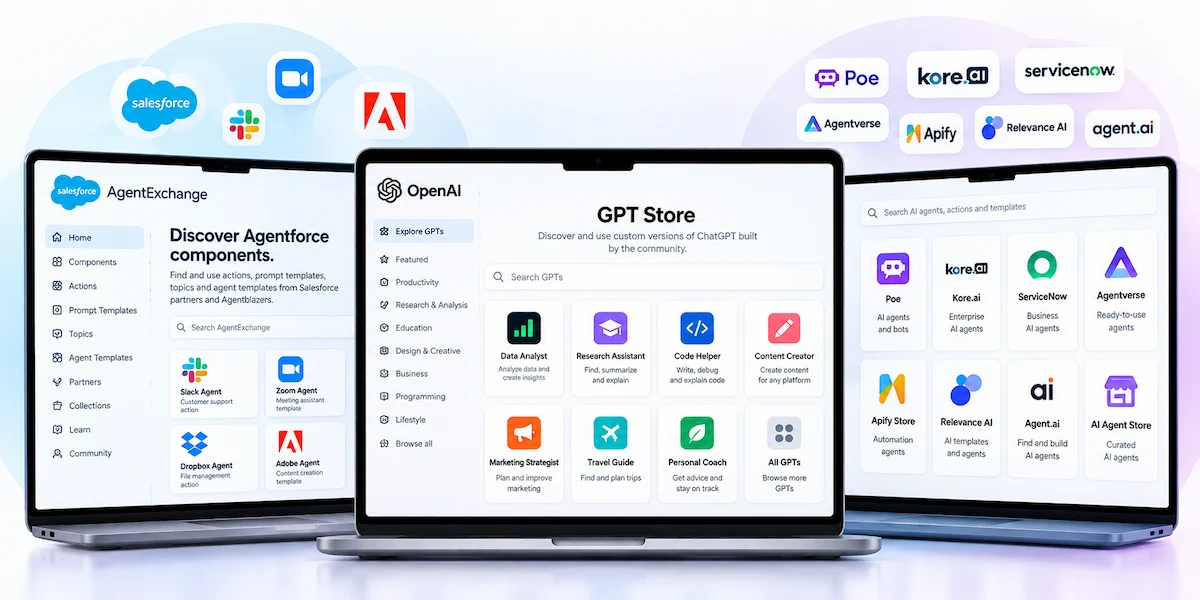
Other names that appear often in guides from Fast.io, InstantDM and DevSquad include Poe, Kore.ai, ServiceNow, Agentverse, Apify Store, Relevance AI, Agent.ai and the AI Agent Store. Most of those guides come from companies that sell agent infrastructure, so use them to find names and then read the terms of each platform yourself. If you want to understand what agents can do for a business before you shop, our guide to AI agents for business covers use cases and the points where a person still reviews the work.
How an AI agent marketplace works
Most agent stores follow the same pattern. A builder packages an agent, a template or an action, adds a description and pricing, and submits it for review. After approval, buyers find it in the store and add it to their own account on the same platform. On AgentExchange, for example, the components plug into Agentforce, and in the GPT Store the agent runs inside ChatGPT.
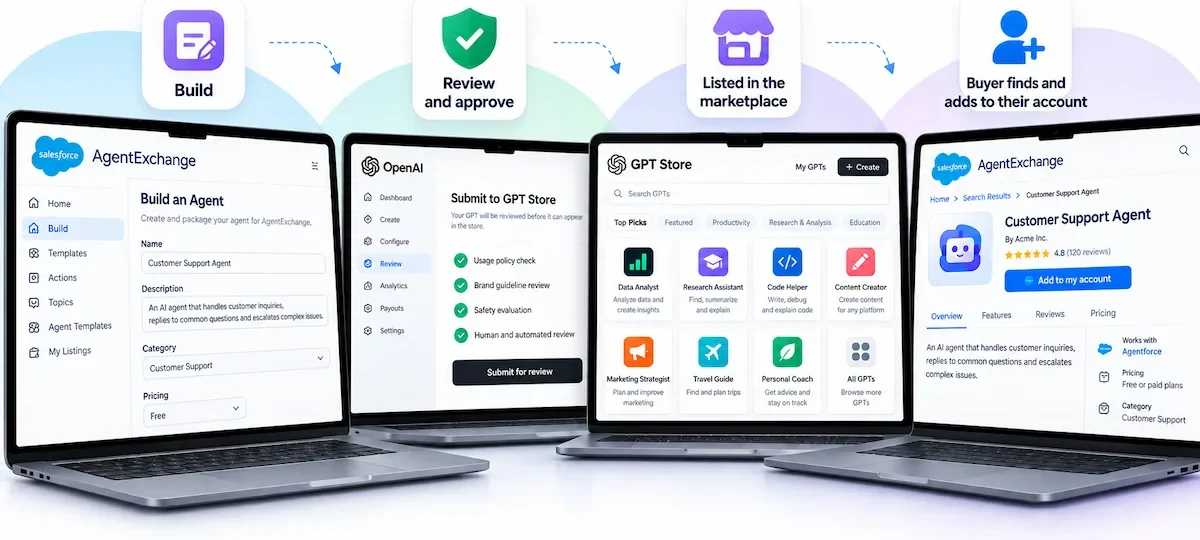
That tie to one platform is the key limit of an AI agent marketplace. An agent built for one platform rarely moves to another without rework, so buyers should check where the agent runs before they pay. InstantDM also lists catalogs of agent skills and MCP directories, where developers share tools that agents can call, and hire markets where you pay an agent for a single job.
Other AI marketplaces worth knowing
Beyond the large platforms, InstantDM and Fast.io mention several smaller catalogs. The list includes Relevance AI Agent Store, AI Hive Marketplace, the Oracle Fusion AI Agent Marketplace, Agentman, Agent.ai, Agentverse, Apify Store and Hugging Face Spaces. Several are young, and their catalogs, fees and rules change quickly, so check each one before you rely on it.
App stores and software marketplaces
Many tools reach buyers through the app store of a product they already use. Dupple lists Salesforce AppExchange, the HubSpot App Marketplace, the Shopify App Store and Zapier in this group, together with review sites such as G2 and Capterra and deal and launch sites such as AppSumo and Product Hunt.
These platforms fit teams that want an add-on for a system they already run. They have limits too. Dupple notes that Product Hunt gives a noisy signal, that AppSumo buyers should check how long a product will be supported, and that G2 and Capterra include sponsored placements.
Model hubs
A model hub hosts models, datasets and demo apps, and most of it is open. Hugging Face describes its Hub documentation as covering models, datasets and Spaces, which are interactive apps you can run in the browser. Repositories are Git-based and version controlled, and model cards explain the limits and biases of each model.
A model hub is the right place for developers who want to download, fine-tune or host a model themselves. It is a poor fit for a business team that wants a finished tool with support, so look at a cloud marketplace or an app store instead.
AI prompt marketplaces
A prompt marketplace sells prompts written by other users, usually for image models and chat assistants. TextCortex lists PromptBase, PromptHero, FlowGPT, its own prompt marketplace and Etsy as places to sell prompts, though the guide ranks its own product first and states no criteria. Buyers get a quick start and sellers get a small side income.
Quality varies a lot, because a good prompt depends on the model, the task and your data. If you want to write your own, our guide to prompt engineering for business covers roles, examples and templates that work in most assistants.
AI tools directories
An AI tools directory collects thousands of tools in categories with short descriptions, filters and ratings. Futurepedia, There is An AI For That, Toolify, TopAI.tools, AIxploria and Future Tools are the names that appear most. They are useful for discovery, but they are not marketplaces in the strict sense, because you usually click through to the vendor to buy. The directories section below covers how they work and how to read them.
Best AI tools marketplaces compared
No ranking can tell you which AI tools marketplace is best for every buyer, because the right choice depends on where you already work. The table lists the main platforms by type, and the sections after it show what each one is best for. We built the list from official pages and from guides by Fluence, InstantDM, Dupple, DevSquad and Fast.io. We did not test every platform hands-on, and none of them paid for a place here.
| Platform | Type | Best for |
|---|---|---|
| AWS Marketplace | Cloud marketplace | Companies that already buy through AWS |
| Google Cloud Marketplace | Cloud marketplace | Teams on Google Cloud or Gemini Enterprise |
| Microsoft Marketplace | Cloud marketplace and app store | Teams that use Microsoft 365, Copilot or Azure |
| Salesforce AgentExchange | Agent marketplace | Companies that run Agentforce |
| GPT Store | Agent marketplace | Individual builders and ChatGPT users |
| Hugging Face Hub | Model hub | Developers who want open models and demos |
| HubSpot, Shopify and Zapier stores | App stores | Add-ons for one product you already use |
AWS Marketplace
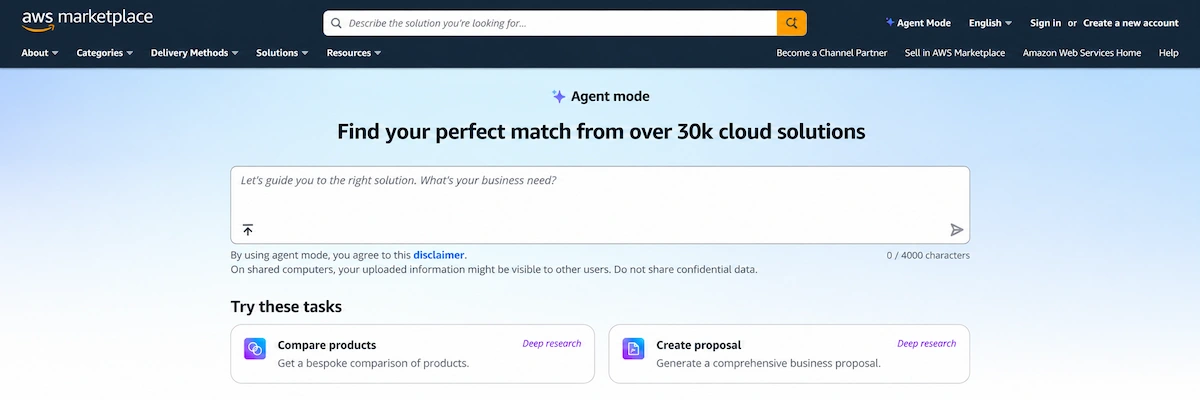
Best for: companies that already buy cloud services from AWS and want agents and tools on the same invoice. AWS describes thousands of agents, tools and services from its partners, with a simple path of find, purchase and deploy. Limits: offers differ in delivery format, from SaaS to container images, so read each listing before you commit.
Google Cloud Marketplace
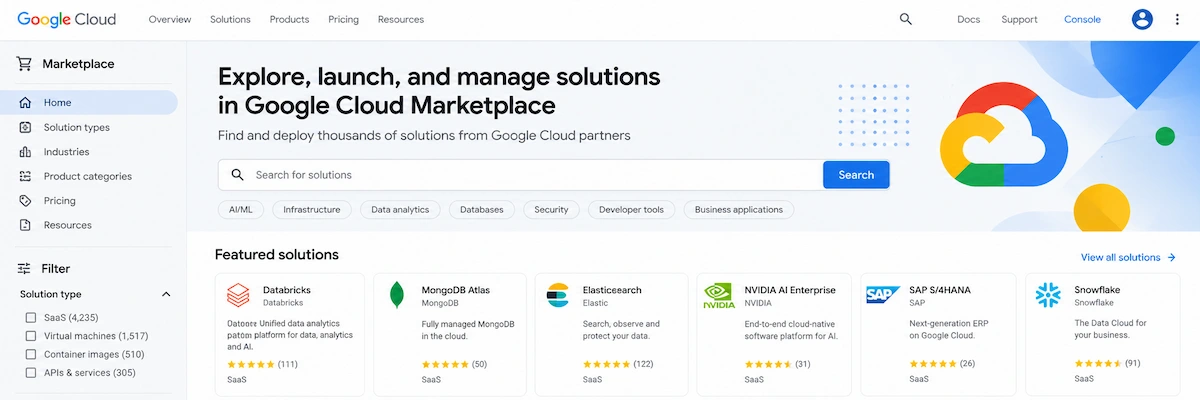
Best for: teams that work in Google Cloud. Its AI agents view lets you describe a task in a search bar and filter by category, industry, business function and compatibility. Limits: the official page does not list who the providers are or what the deployment steps look like, so the details page of each agent matters.
Microsoft Marketplace
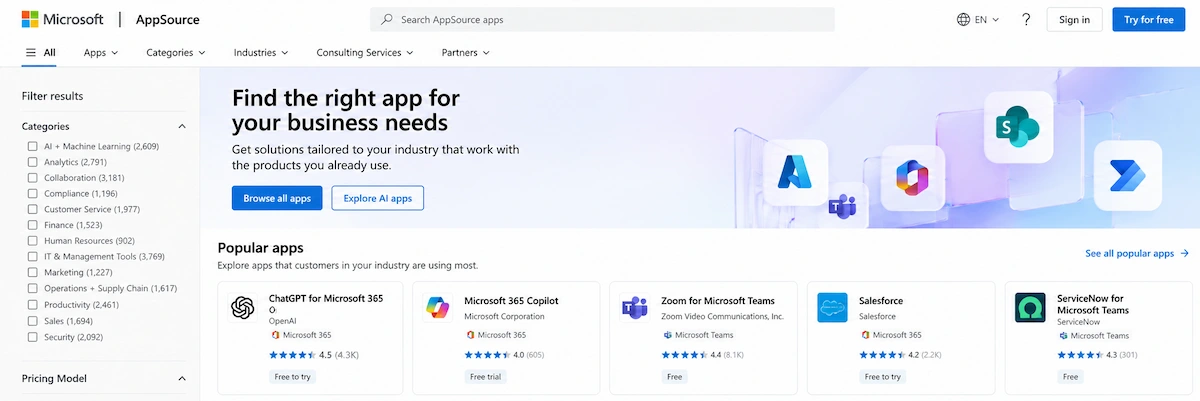
Best for: companies built around Microsoft 365, Copilot and Azure. It combines AppSource and Azure Marketplace, and Microsoft says it lists more than 3,000 AI apps and agents. Limits: the numbers come from Microsoft, and most listings are aimed at Microsoft customers.
Salesforce AgentExchange
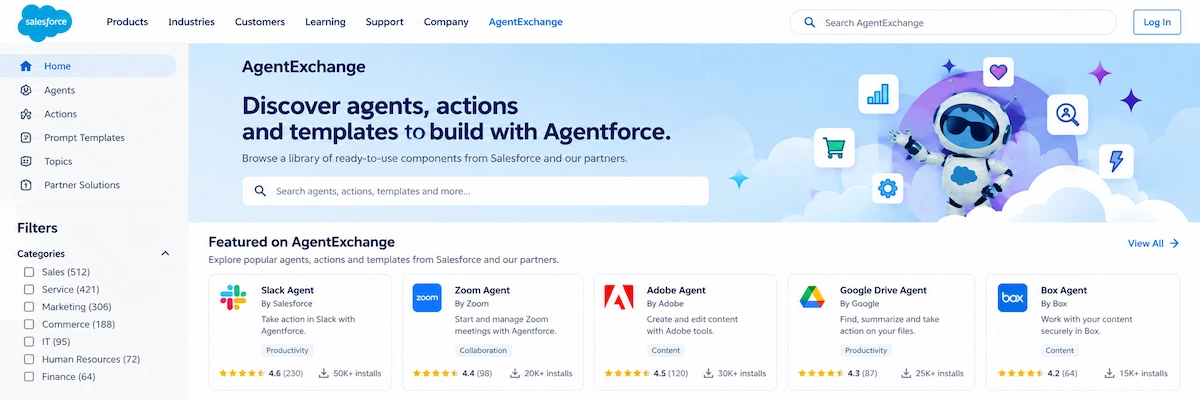
Best for: Salesforce customers who run Agentforce and want actions, topics, prompt templates and agent templates built for it. Salesforce says every solution goes through security and customer reviews. Limits: it only serves one platform, so it does not help if your agents run elsewhere.
OpenAI GPT Store
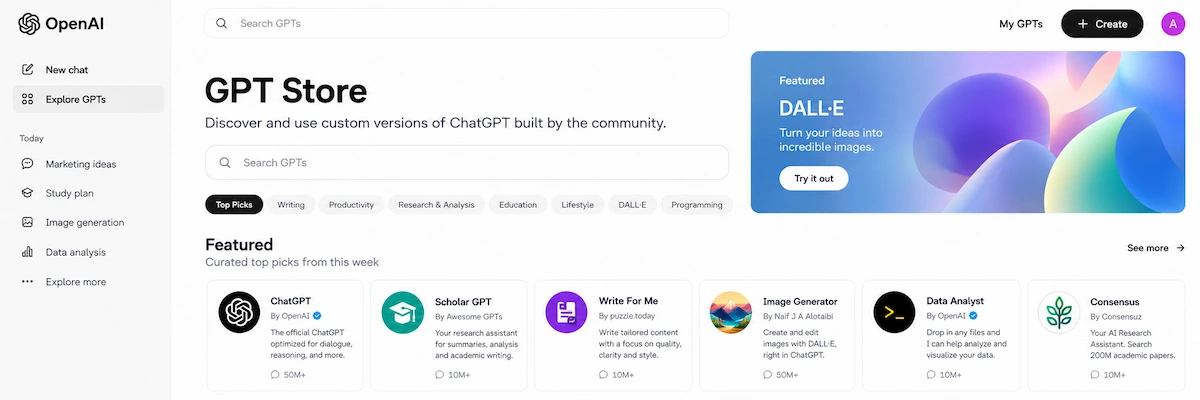
Best for: individual builders and small teams that want to share a custom GPT without building a store. Publishing is open to anyone who verifies a Builder Profile and follows the usage policies. Limits: OpenAI announced revenue sharing for US builders in 2024 and gave few details at the time, so confirm the current terms in the OpenAI help center before you plan around income.
Hugging Face Hub
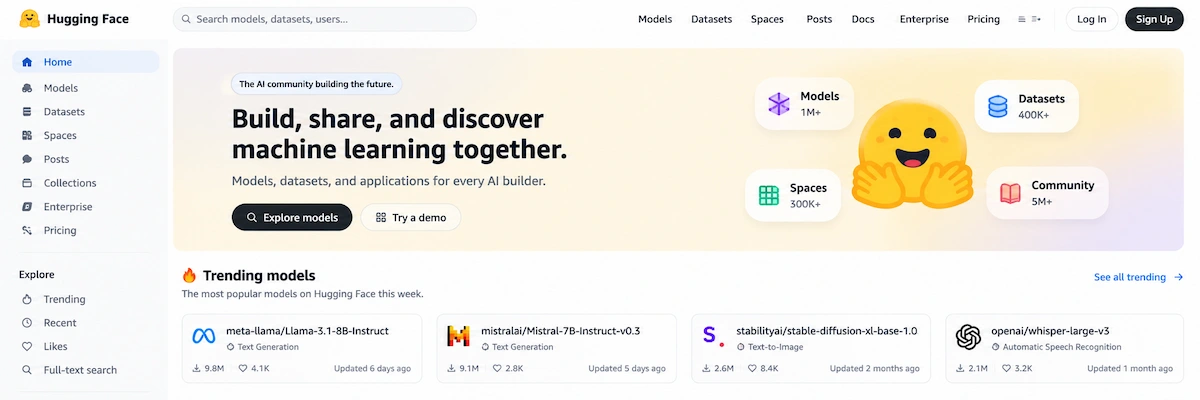
Best for: developers who need open models, datasets and Spaces. Limits: it is built for technical users, so a business team without developers will find it hard to turn a model into a finished tool.
AI agent marketplaces compared
The table below uses only official descriptions, so you can see what each AI agent marketplace actually lists and where the agents run.
| Marketplace | Where agents run | What sellers list |
|---|---|---|
| Salesforce AgentExchange | Agentforce | Actions, topics, prompt templates, agent templates |
| GPT Store | ChatGPT | Custom GPTs |
| Microsoft Marketplace | Microsoft 365 Copilot, Azure AI Foundry | AI apps and agents |
| Google Cloud Marketplace | Google Cloud, with compatibility filters such as Gemini Enterprise | AI agents |
| AWS Marketplace | AWS | Pre-built agents, agent tools, agent development solutions |
Best AI tools directories
An AI tools directory helps you find tools you did not know existed, and a free AI tools directory is often the quickest way to build a first shortlist. MakeTechEasier names seven: There is An AI For That, Futurepedia, TopAI.tools, AIxploria, AI Hustle, SearchTools.AI and AI Tools Directory. ToolWorthy compares twelve, among them Toolify, Future Tools, OpenTools, Insidr.ai, aitools.fyi, Dang.ai, ToolPilot and These AI Tools. Momen adds Pick AI, AI Tool Hunt and Toolpilot.ai to the same kind of list.
Directories also have a free side. If you only want a short list of free options for one popular assistant, our guide to free ChatGPT alternatives is faster than browsing a catalog of thousands of tools.
These reviews are useful for names, but each has a catch. MakeTechEasier notes that AI Hustle has a small catalog and that SearchTools.AI lists adult content. ToolWorthy discloses that it runs its own directory, and it points out that some directories charge for featured spots, sell dofollow links or ask for a backlink in return for a free listing. Momen sells a directory builder.
How to read an AI tools directory ranking
- Check who owns it. A directory owned by a software vendor will favor its own products.
- Look for paid placement. Featured, verified and sponsored labels often mean a listing was bought.
- Check the date. Tool counts and prices go stale quickly, and several guides in this niche are dated.
- Find the source of reviews. Ratings written by the vendor mean little compared with user reviews or your own test.
- Use two or three directories at most. ToolWorthy suggests founders start with five to eight, but a buyer only needs a few to build a shortlist.
What can you buy on an AI marketplace? Use cases by function
AWS groups its AI agents and tools by the work they do, and the same logic helps on any platform. Search by function first, then compare vendors inside that group.
| Function | Typical use |
|---|---|
| Customer support | Answering common questions, routing tickets, drafting replies |
| Sales and marketing | Lead research, content drafts, campaign reports |
| Content creation | Text, images and video for campaigns |
| Data analysis and research | Summaries, reports and market scans |
| Finance and accounting | Invoice handling, reconciliation, reporting |
| IT support and software development | Help desk answers, code assistance, testing |
| Legal and compliance | Contract review, policy checks |
| Procurement and supply chain | Supplier research, order tracking |
Start with one function where you already know the process and the numbers. That makes it easy to see whether a purchased tool really saves time.
How to choose an AI tools marketplace
Start with the job, not the platform. Write down what you want to buy or sell, which systems you already use and who must approve a purchase.
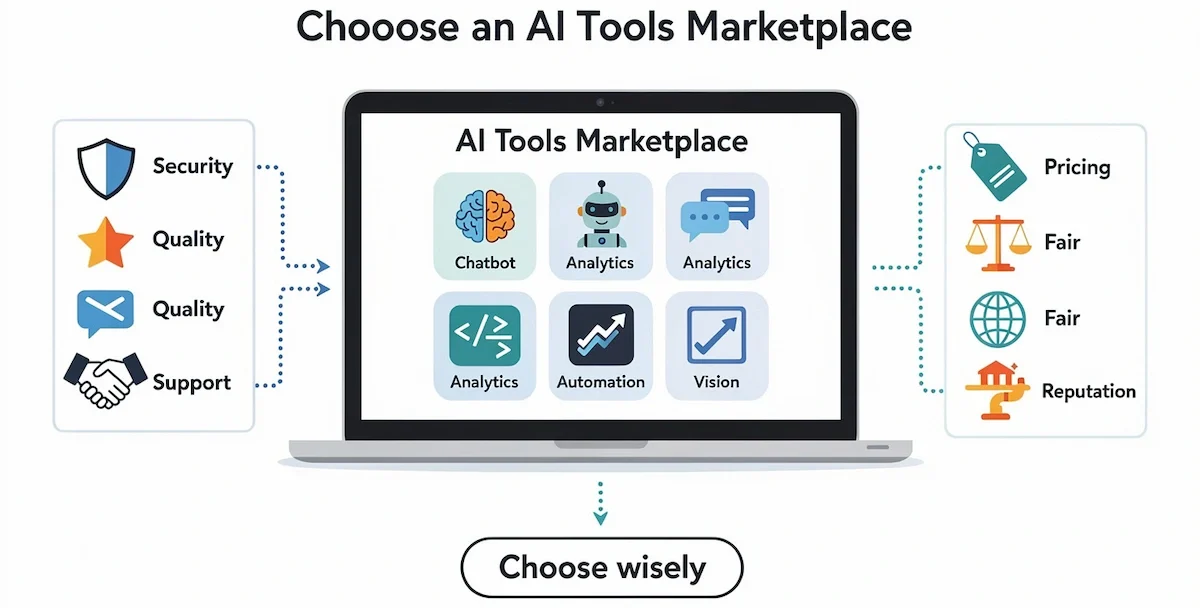
Then check each AI tools marketplace against the points below. Our guide on how to choose AI tools for business adds a longer checklist that works for any product.
Features of a good AI marketplace
Platforms differ in more than size. Before you pick one, check which of these features it offers.
- Search and filters: Google Cloud Marketplace, for example, filters by category, industry, business function and compatibility.
- Details pages: a listing should show features, pricing and deployment options before you talk to anyone.
- Security review of listings: Salesforce says solutions on AgentExchange pass security and customer reviews.
- Billing through your account: purchases on AWS and Microsoft marketplaces can count toward an existing cloud commitment.
- Integration with your systems: the tool should work with your cloud, your CRM and your identity setup.
- Versioning and updates: you should know how agents and tools are updated and who approves changes.
Choose by scenario: buyer, builder, seller or operator
Fluence suggests choosing by the role you play. The table turns that idea into a simple starting point.
| Your role | What you need | Where to start |
|---|---|---|
| Buyer | Clear pricing, trials, security terms | The cloud marketplace or app store you already use |
| Builder | Tools to create and test agents | A model hub or an agent platform |
| Seller | Reach, billing and publishing rules | The marketplace where your customers already buy |
| Operator | Monitoring, access control and updates | The platform that runs your agents in production |
Test with your own data
InsertChat advises testing a marketplace solution with real data before you commit, and that holds for every listing. A demo uses clean examples, and your files, customers and edge cases will show the real quality. Ask for a trial, a sandbox or a proof of concept, and run the same task in two or three tools so you can compare results.
Compare the total cost and the fees
The price on a listing is rarely the full cost. InsertChat tells buyers to compare the total cost including fees, and Fast.io points out that sellers pay platform fees that vary by marketplace. Add subscription price, usage charges, setup time, support and the marketplace fee if one applies to you. Our guide on how much AI tools cost explains the usual price models and what to compare.
Check trust, security and data use
DevSquad lists three areas to review: security and risk, scalability and customization, and integration with existing systems. Fluence adds a step it calls verify before adopting, which means reading the vendor terms, the data policy and any security documents before you connect anything. Ask whether the vendor trains models on your inputs, where data is stored and who can see it.
Check integrations and exit cost
Agoragentic, a vendor in this space, argues that you should look at framework fit and exit cost, which means asking how hard it is to leave. Treat it as one vendor view, but the question is sound. Check whether you can export your data, move agents to another platform and cancel without a penalty. InsertChat makes the same point as a check on migration options.
How to buy AI tools for business through a marketplace
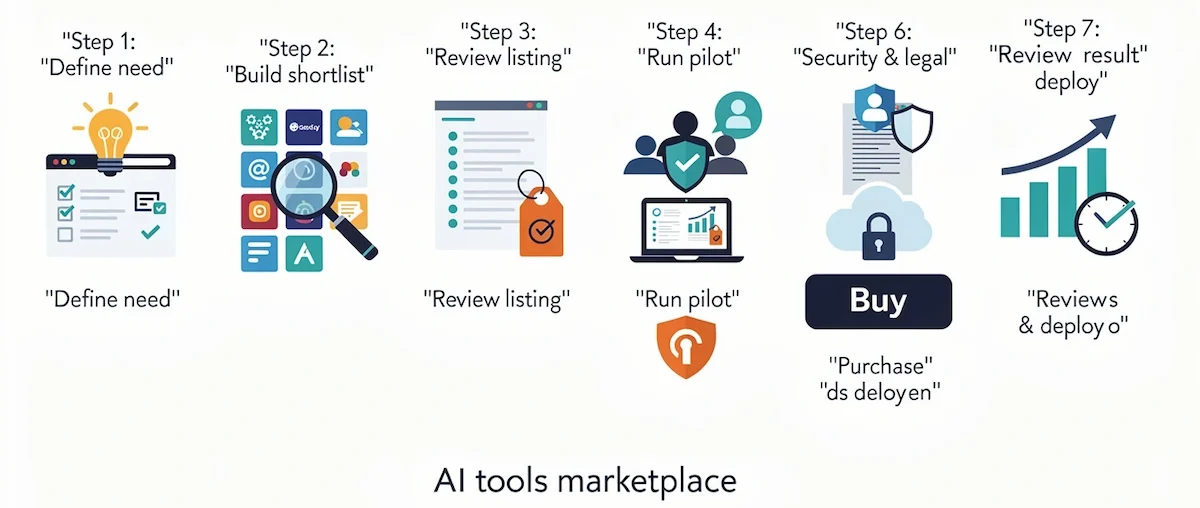
Buying through a marketplace is faster than a classic procurement process, but it still needs a plan. AWS describes three steps, and they work on most platforms: find and evaluate the solution, purchase it in the marketplace, then configure, deploy and start using it.
Our guide to AI for small business shows how a small team can run the first test without a large budget.
- Step 1: Define the need. Name the task, the owner and the result you expect, for example fewer hours on support tickets.
- Step 2: Build a shortlist. Use a cloud marketplace or an app store for tools you can buy, and a directory for ideas.
- Step 3: Review the listing. Read features, pricing, delivery format and support terms on the details page.
- Step 4: Run a pilot. Test with real data and a small group of users.
- Step 5: Check security and legal. Review data terms, certifications and the contract before a wider rollout.
- Step 6: Purchase and deploy. Use the marketplace billing, and set up access control and monitoring.
- Step 7: Review the result. Compare cost and time saved with your starting numbers.
Buy from a marketplace or build your own agent?
ATxEnterprise compares enterprise AI with off-the-shelf products, and the same question applies to agents. A marketplace tool is faster to start, has a known price and often comes with support. A custom build gives you control over data and behavior, but it needs developers, testing and maintenance. DevSquad and LowCode Agency sell development services, so their guides lean toward custom work.
A sensible path is to buy first for common tasks such as support answers or content drafts, and build only where your process is unique and the value is clear.
Enterprise buyer checklist and red flags
Large companies add more steps. ATxEnterprise recommends aligning tools with business goals and asking vendors a fixed list of questions, and it warns about red flags during evaluation. Dupple, based on its own tracking of enterprise buyers, reports that buying committees have grown and that buyers care most about data residency and privacy, governance and auditability, model portability, reliability in daily use and ROI cases with specific numbers. These figures come from one publisher without a stated method, so read them as a direction.
Questions to ask every vendor
- Where is our data stored, and for how long?
- Does the vendor train models on our inputs, and can we turn that off?
- Which security certifications does the vendor hold, and can we see the reports?
- How do we export our data and move to another provider?
- What support and uptime terms are in the contract?
- Who is responsible if something goes wrong?
Red flags
- The vendor will not explain how it uses your data.
- Prices, limits or fees are unclear or change without notice.
- The listing makes big claims without customer examples or a trial.
- The ranking you found puts the vendor first on its own list, with no stated method.
- You cannot export your data.
Keep a record of what you bought, what it costs and what it delivers. Our guide on how to measure AI ROI for business shows which numbers to track before and after a purchase.
How to sell or list an AI tool
If you build tools, an AI tools marketplace gives you reach, billing and a trust signal without building a store. Each platform has its own rules, so read the seller terms before you invest time. Start with the questions every platform asks: what you are selling, how it is delivered, how it is priced and who handles support.
Where to list an AI tool or agent
- GPT Store: save the GPT for everyone, verify your Builder Profile and follow the usage policies and brand guidelines. A review process checks each GPT.
- Salesforce AgentExchange: partners and Agentblazers can offer actions, prompt templates, topics and agent templates for Agentforce.
- Microsoft Marketplace: Microsoft says partners can build agents that extend Microsoft 365 Copilot and Azure AI Foundry, and it offers publishing guidance and co-sell options.
- AWS and Google Cloud marketplaces: software vendors list SaaS, API and container offers that customers buy through their cloud account.
- App stores: HubSpot, Shopify and Zapier list apps and integrations for their own users.
Publishing workflow: build, test, version, publish
TrueFoundry describes a developer workflow in three stages: development, testing and validation, and publishing with versioning. The same order works on any platform. Build the tool against the rules of the target marketplace, test it with real tasks and edge cases, write a clear listing with pricing and limits, and submit it. After approval, keep version notes, because buyers want to know what changed and when.
Monetization models and fees
| Model | How it works | Where you see it |
|---|---|---|
| Subscription | Buyers pay a monthly or yearly fee | Cloud marketplaces, app stores |
| Usage based | Buyers pay per task, message or credit | Agent platforms, API products |
| One time purchase | Buyers pay once for a prompt, template or file | Prompt marketplaces, Gumroad |
| Free with paid upgrade | A free tier brings users, paid plans add features | App stores, model hubs |
| Pay per task | Buyers hire an agent for one job | Hire markets such as UpAgents, listed by InstantDM |
Fees differ by platform and change over time, so look up the current rate in the seller guide before you set a price. Fast.io covers platform fees in its own guide, but it sells agent storage, so check the numbers with the marketplace itself.
Listing in AI tools directories
Directories bring traffic more than sales. ToolWorthy warns that paid submission does not guarantee inclusion, that some directories are backlink farms and that you should track signups and revenue with tagged links before you pay for more listings. A sensible plan is to start with a few directories that fit your audience, check the traffic they send and drop the rest.
Selling prompts and templates
Prompt marketplaces such as PromptBase, PromptHero and FlowGPT are the lowest barrier to entry, because you can sell a good prompt without building software. TextCortex says detailed, specific prompts are what buyers pay for. Focus on one task, add example outputs and explain which model the prompt was tested with, since results change between models.
Platforms to build and sell AI tools
Pickaxe lists ten platforms for building and selling AI tools: Pickaxe, MindStudio, Poe, Coze, CustomGPT.ai, CalStudio, Stack AI, Relevance AI, Gumroad and Lovable. The guide is written by Pickaxe, ranks itself first and chooses criteria that match its own features, so treat it as a list of names to test. The questions that matter are billing, access control, who owns the customer relationship and how much margin is left after AI usage costs.
Marketplace or your own platform?
A marketplace gives you reach, billing and trust, and it takes a fee and sets rules. Your own platform gives you control over price, branding and customer data, and you handle billing, support and marketing yourself. Pickaxe raises the same question in its FAQ, and InstantDM asks whether a team can use a marketplace and a platform together. The answer is yes: many sellers list on a marketplace to get found and keep a site for their best customers.
Buyers face a similar choice between buying many tools and building around a few. Our guide on how to build an AI tool stack for business shows how to keep a stack small and avoid paying for overlapping features.
How to build your own AI marketplace
Some companies want their own store for partners or customers. LowCode Agency, which sells development services, describes six design questions: what infrastructure the store runs on, how an agent is described in a standard format, how agents are run, how knowledge and context are handled at scale, how agents are shown and recommended, and how money and quality are managed. Momen offers a no-code directory builder for the simpler case of a catalog.
Start small. A directory with categories, filters and a submission form is enough for a first version, and you can add billing, reviews and security checks once sellers and buyers show up. Decide early how you will review listings, because quality control is what makes a marketplace trusted.
Security and trust risks on an AI marketplace
A listing on a marketplace is not a guarantee. Marketplaces review listings to different degrees, and most of the description comes from the vendor. Before you connect a tool to production data, treat it like any new software vendor.
- Give the least access that works. Start in a test account and add permissions only when the tool needs them.
- Read the data terms. Find out what the vendor stores, how long and whether it trains on your inputs.
- Check the quality of outputs. Compare results with your own data and a human review.
- Read the model card. For open models, the model card on a hub such as Hugging Face describes limits and biases.
- Plan for exit. Know how to export your data and move to another tool.
Compliance checks
Regulated teams need more than a good demo. Fluence mentions SOC 2, ISO, HIPAA and GDPR as common checks, and ATxEnterprise points buyers to the EU AI Act timeline, the NIST AI Risk Management Framework and the ISO/IEC 42001 standard for AI management systems. Ask each vendor which of these it supports, ask for the reports, and have your legal team confirm which rules apply to your use case.
For a deeper look at privacy rules and settings, see our guide to AI data privacy for business.
Trends in AI marketplaces
Three trends show up across the sources. The first is the growth of the AI agent marketplace. Salesforce launched AgentExchange with more than 200 partners, and Microsoft reports more than 3,000 AI apps and agents in its marketplace. The second is a new kind of catalog that InstantDM describes as agent skills and MCP directories, where developers share tools that agents can call. The third is pay-per-task hire markets, where buyers pay an agent for one job.
Buying is changing too. Dupple reports longer vendor questionnaires, certifications and pilot phases, though it gives no method for those claims. For buyers the lesson is simple: expect more questions from your own security team, and prepare answers before you start.
Common mistakes with AI tools marketplaces
Trusting a ranking without criteria
Many lists online are written by vendors who rank their own product first and state no method. Look for the criteria, the date and any disclosed conflict of interest.
Buying before testing
A strong listing page does not prove the tool works on your data. Run a pilot first.
Ignoring fees and exit cost
Marketplace fees, usage charges and switching costs add up. Check them before you sign.
Listing everywhere at once
Sellers who submit to dozens of directories spend money and time with little return. Start with a few and measure.
Skipping the data terms
Connecting a tool to customer data without reading the terms creates risk you cannot undo. Read them first.
Final thoughts on the AI tools marketplace
The right AI tools marketplace depends on who you are and where you already work. Buyers should begin with the cloud or app store they use, test with real data and compare the total cost. Anyone who uses an AI marketplace should know whether it sells, lists or only reviews. Sellers should pick one platform that fits their product, read the rules and measure the result before they list elsewhere.
Frequently asked questions
What is an AI tools marketplace?
It is a platform where you can find, compare and buy AI tools, agents and models from many vendors, and where builders can list their own products. Cloud marketplaces, agent stores and app stores are the main types.
What is an AI agent marketplace?
An AI agent marketplace is a store where builders list agents, actions and templates, and buyers add them to a platform they already use. AgentExchange for Agentforce and the GPT Store for ChatGPT are two examples.
What is the difference between an AI marketplace and an AI tools directory?
A marketplace sells products and handles billing, while a directory mostly lists and reviews tools and sends you to the vendor. Some directories sell paid listings or featured spots.
What are examples of AI marketplace platforms?
Cloud examples are AWS Marketplace, Google Cloud Marketplace and Microsoft Marketplace. Agent examples are Salesforce AgentExchange and the GPT Store. Hugging Face is a model hub, and Futurepedia is an AI tools directory.
Where can I buy AI tools for my business?
The most common places are AWS Marketplace, Google Cloud Marketplace and Microsoft Marketplace, plus app stores such as Salesforce AppExchange, HubSpot and Shopify. Choose the one tied to systems you already use.
Where can I sell my AI tool or agent?
Options include the GPT Store, Salesforce AgentExchange, Microsoft Marketplace, AWS Marketplace, Google Cloud Marketplace and app stores. Each has its own rules, review process and fees, so read the seller terms first.
Are AI tools marketplaces free?
Browsing is free on most platforms. Buyers pay for the tools they buy, and sellers may pay fees or share revenue. Check the current terms of each platform.
How much do marketplaces take from sales?
It depends on the platform and changes over time. Look up the rate in the official seller guide, because third-party guides often quote old figures.
Is the GPT Store the only marketplace for AI agents?
No. Salesforce AgentExchange, Microsoft Marketplace, AWS Marketplace, Google Cloud Marketplace, Poe, Agentverse and others also list agents, each for different platforms.
Is Product Hunt an AI tools directory?
Not exactly. It is a launch platform where new products get votes and attention. Dupple notes that the signal can be noisy, so use it for discovery and not as proof of quality.
What is the best AI tools directory overall?
No single directory wins for everyone. Futurepedia and There is An AI For That appear in most lists, but the best choice depends on whether you want a broad catalog, curated picks or a place to submit your own tool.
Are AI tools directories free to use?
Browsing is free in nearly all of them. Sellers may pay for featured listings or faster review, so check the submission page before you pay.
Are AI tools directories accurate?
They vary. Tool counts, prices and ratings can be out of date, and some directories sell featured spots. Check the date, the source of the reviews and the vendor site before you decide.
Should I pay to list my AI tool in a directory?
Only after a test. Start with free or low-cost listings, track the traffic and signups they send with tagged links, and pay for upgrades only when the numbers justify it.
Are marketplace listings safe to use with production data?
Not automatically. Treat every third-party tool like a new vendor: test in a sandbox, give the least access, read the data terms and plan how to leave.
Can I list my agent on more than one marketplace?
Usually yes, unless a platform asks for exclusivity. Check each set of seller terms, keep your listing details consistent and note that an agent built for one platform may need rework for another.
Do I need coding skills to use an AI marketplace?
Not to buy. Most listings are ready to deploy, and many can be switched on from a console. Building and publishing your own agent usually needs some technical skill, although no-code builders exist.
How do I build my own AI marketplace?
Begin with a simple catalog, add listing rules and a review step, then add billing and security checks. Decide how agents are described and run before you scale.
Can I use a marketplace and my own platform together?
Yes. Many sellers list on a marketplace to be found and keep their own site for direct customers. Buyers can also use a marketplace for purchase and billing while running the tool in their own systems.
What should enterprises check before buying AI tools in a marketplace?
Data residency and privacy, security certifications, governance and audit options, export and exit terms, support and uptime, and clear pricing. Run a pilot before a wider rollout.
Which AI tools marketplace should I open first?
Open the one tied to the systems you already use. Companies on AWS, Microsoft or Google Cloud should start with that cloud marketplace, and Salesforce teams with AgentExchange. Use a directory when you want ideas before you commit.