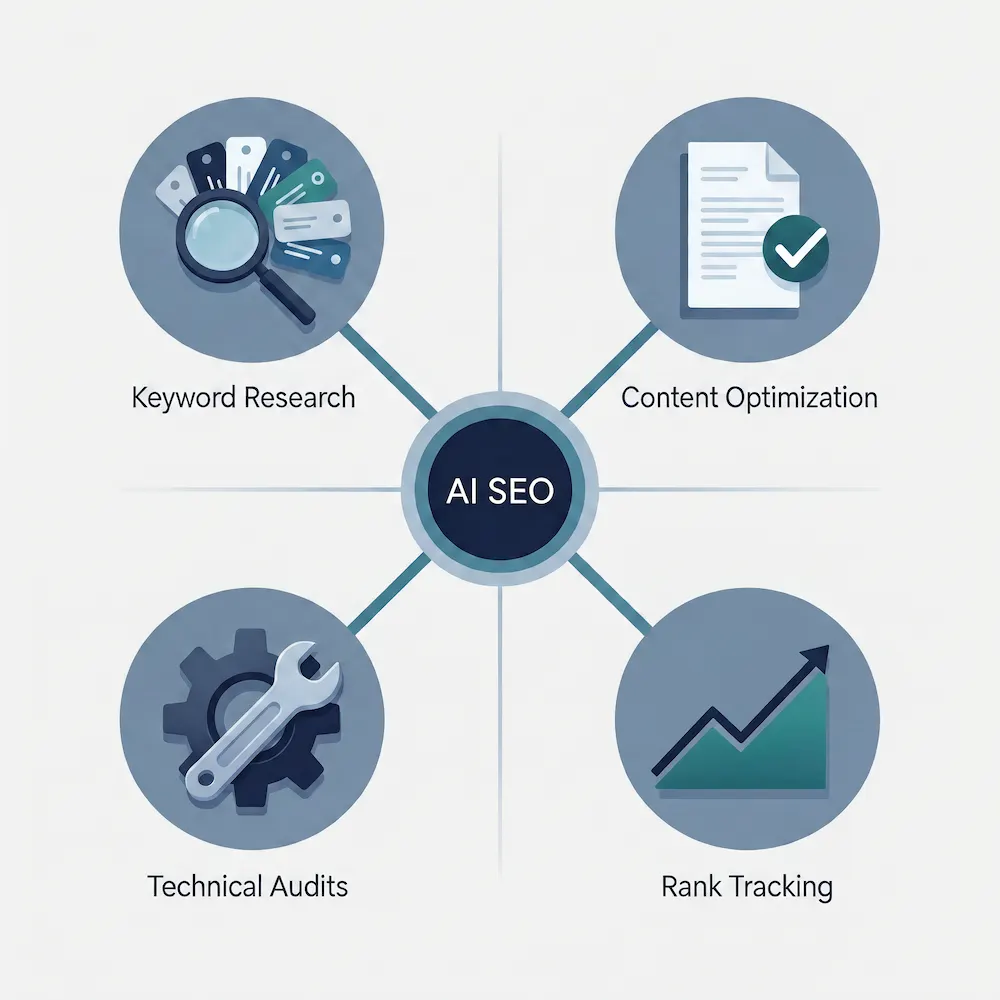
AI SEO tools are software products that use machine learning and language models to speed up search engine optimization work, such as keyword research, content briefs, technical audits and rank tracking. Many people also search for them as SEO AI tools, and both names describe the same group of products. Some of them help you do SEO faster, and a newer group tracks how your brand appears in answers from ChatGPT, Perplexity and Google AI Overviews.
The market grew quickly, and almost every SEO vendor now calls its product AI-powered. That makes it hard to see what a tool really does, what it costs and where it stops being useful. Prices and plan names also changed several times this year.
This guide explains what AI SEO tools are, what they can do, which types exist, what the main products cost in October 2026 and how to pick one. It also covers the limits, because no tool can do SEO for you from start to finish.
What are AI SEO tools?
AI SEO tools are programs that apply artificial intelligence to search optimization tasks. They read search results, crawl pages, compare your content with pages that already rank and return suggestions, drafts or fixes. Under the hood they use machine learning, natural language processing and large language models.
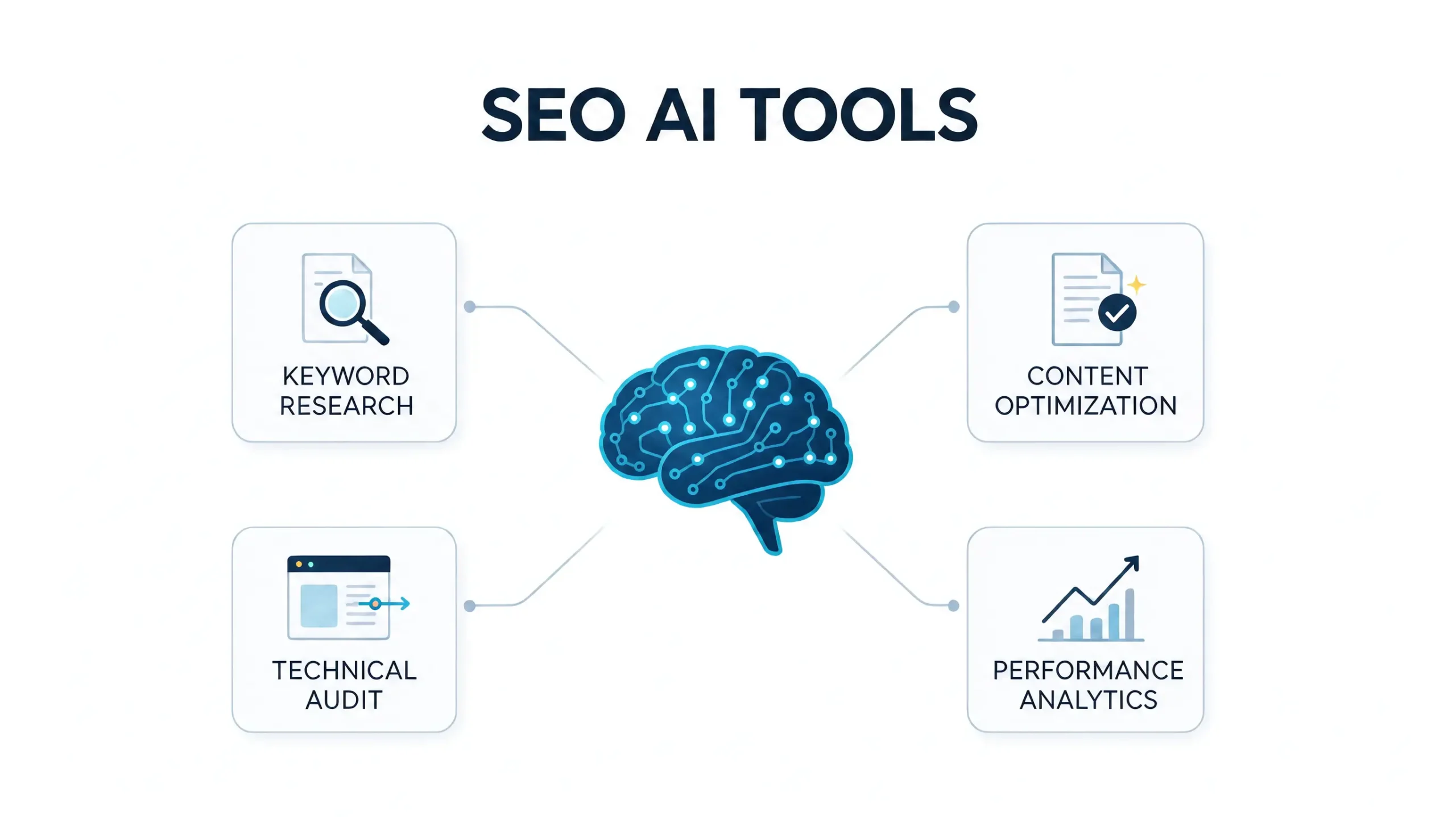
A classic SEO tool collects data: keywords, backlinks, rankings and site errors. An AI SEO tool goes one step further and interprets that data. It groups keywords by intent, scores a draft against competitors, explains why a page lost traffic or applies a change to your site. Most products still leave the final decision to a person.
What is an AI SEO tool in simple words?
An AI SEO tool is an assistant for the repetitive parts of search optimization. Think of a research helper that reads the top ten results for a keyword in a minute and tells you which topics, headings and questions they cover. You still decide what to write and whether the advice makes sense.
If you ask what is an AI SEO tool, the short answer is: software that reads search data for you and suggests the next step, from a keyword list to a fixed title tag.
AI SEO tools vs traditional SEO tools
Traditional tools report what is happening. AI tools try to explain it and act on it. The table shows the difference in daily work.
| Task | Traditional SEO tools | AI SEO tools |
|---|---|---|
| Keyword research | Lists keywords with volume and difficulty | Groups keywords by intent and suggests topics |
| Content | Shows competitor pages | Builds a brief, scores a draft and may write one |
| Technical SEO | Reports errors from a crawl | Explains the error and may apply the fix |
| Reporting | Charts and tables | Written summaries and alerts |
| AI answers | Not covered | Tracks brand mentions and citations |
| Human work | Read the data and decide | Review the advice and decide |
In practice the line is blurred. Semrush, Ahrefs and SE Ranking started as traditional suites and added AI features, so most tools sold today are a mix of both.
SEO AI tools vs GEO and AEO tools
Two different jobs sit under the name SEO AI tools. The first is classic optimization done faster with AI. The second is GEO (generative engine optimization) or AEO (answer engine optimization), where a tool tracks whether your brand is mentioned or cited in AI answers. Reviews often mix the two, which leads to buying the wrong product.
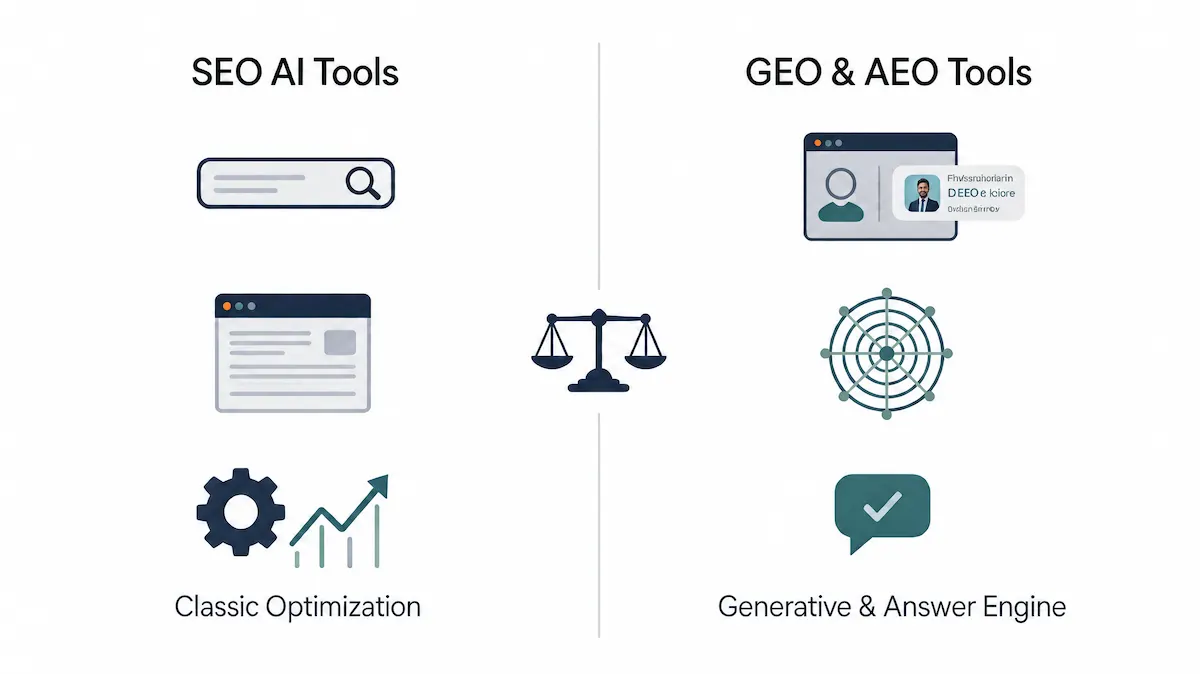
Google takes a clear position on this. In its 2026 guide, it says that optimizing for generative AI search is still SEO, and it calls GEO and AEO terms you may see used by others. We come back to this in the Google section below.
AI SEO terms explained: GEO, AEO, LLMO and AIO
The names overlap, and even Wikipedia says that no agreed definition exists as of early 2026. The table shows how they are most often used.
| Term | Usual meaning |
|---|---|
| AI SEO | Using AI inside normal SEO work, or optimizing for AI answers, depending on the author |
| GEO (generative engine optimization) | Improving how your brand appears in answers from generative AI search |
| AEO (answer engine optimization) | Optimizing for answers and assistants, such as Copilot |
| LLMO (large language model optimization) | Getting mentioned by language models such as ChatGPT or Gemini |
| AIO (artificial intelligence optimization) | A broad label that some authors use for all of the above |
Microsoft uses GEO and AEO as two separate terms, while Google treats both as part of SEO. When you read a review, check which meaning the author has in mind.
What can AI SEO tools do?
The list below follows the daily workflow of an SEO team. Not every tool covers every step, and most products are strong in one or two of them.
Keyword research and clustering
AI SEO tools suggest keywords from a short description of your site, group them by search intent and show which ones belong on the same page. Ahrefs, for example, can generate keyword ideas from a niche description and return alternatives in more than 40 languages. For a step-by-step method, see our guide on keyword research with AI.
Content briefs, writing and optimization
Content tools scan the top results for a keyword and build a content brief with headings, questions and related terms. Frase, Surfer, Clearscope and MarketMuse work this way, and some also write a first draft. A score tells you how close your page is to what already ranks, which helps with structure but does not replace original information.
Technical audits and on-page fixes
Audit tools crawl your site and flag missing headings, long titles, broken links and weak internal linking. Alli AI goes further: it connects through a code snippet and lets you apply fixes, edit titles and generate schema markup from its dashboard. Ahrefs and Semrush also explain errors and suggest repairs.
Rank tracking and reporting
Rank trackers check positions every day and now add AI summaries that explain a drop or a gain. Reporting tools such as DashThis and Whatagraph pull data from Search Console and Analytics into one dashboard and write a short brief of what changed.
Link building and local SEO
AI helps to find link prospects, check the quality of a backlink profile and draft outreach emails. In local SEO, tools such as Localo and BrightLocal handle Google Business Profile tasks, review replies and local rank maps.
AI search visibility tracking
This is the newest group. These tools send a list of prompts to ChatGPT, Gemini, Perplexity and Google AI features and record whether your brand appears. They report mention rate, average position, citations and share of voice against competitors. Surfer, Semrush, Ahrefs, SE Ranking, Profound and others sell this under different names.
How do AI SEO tools work?
Most products work in three steps. First they collect data from search results, your crawl, Search Console and sometimes their own keyword database. Second, a model reads that data and looks for patterns, such as the headings that top pages share. Third, the tool turns the result into an output: a brief, a score, a draft, a warning or a fix applied to the site.
The models behind them are natural language processing for reading text and large language models for writing and summarizing. If these terms are new to you, our AI terms glossary explains them in plain words.
What data do AI SEO tools use?
The quality of the advice depends on the data underneath. Most tools combine four sources: snapshots of search results, their own keyword and backlink databases, a crawl of your site and the data you connect from Search Console and Analytics. AI visibility trackers add a fifth source, which is a library of prompts sent to AI assistants on a schedule.
Ask a vendor where its numbers come from and how often they refresh. A tool that relies on a small prompt sample or an old database can look precise while the advice is out of date.
One point deserves attention. Most recommendations are based on correlation. A tool sees that top pages share a certain word count or term list and tells you to copy it. That does not prove those features cause the ranking. Treat every score as a hint, not as a rule.
AI SEO agents explained
An AI SEO agent is a tool that runs several steps in a row without waiting for you after each one. A normal tool hands you a report and you decide what to do. An agent reads the data, picks the next task and does it, for example by pulling your Search Console queries, comparing them with competitors and writing a brief for each gap.
Agents are usually good at tasks that have a clear input and a result you can check: keyword clustering, content briefs, internal link suggestions, schema markup, technical audits, rank monitoring and alerts. They struggle with strategy, brand voice and anything where success is a matter of opinion.
Most guides on the topic agree on one rule. Current agents are semi-autonomous, so publishing, redirects, code changes and brand claims should stay behind human approval. Treat an agent as a copilot that suggests and drafts, and read what it wants to change before it goes live.
Types of AI SEO tools
Products differ in what they were built for.
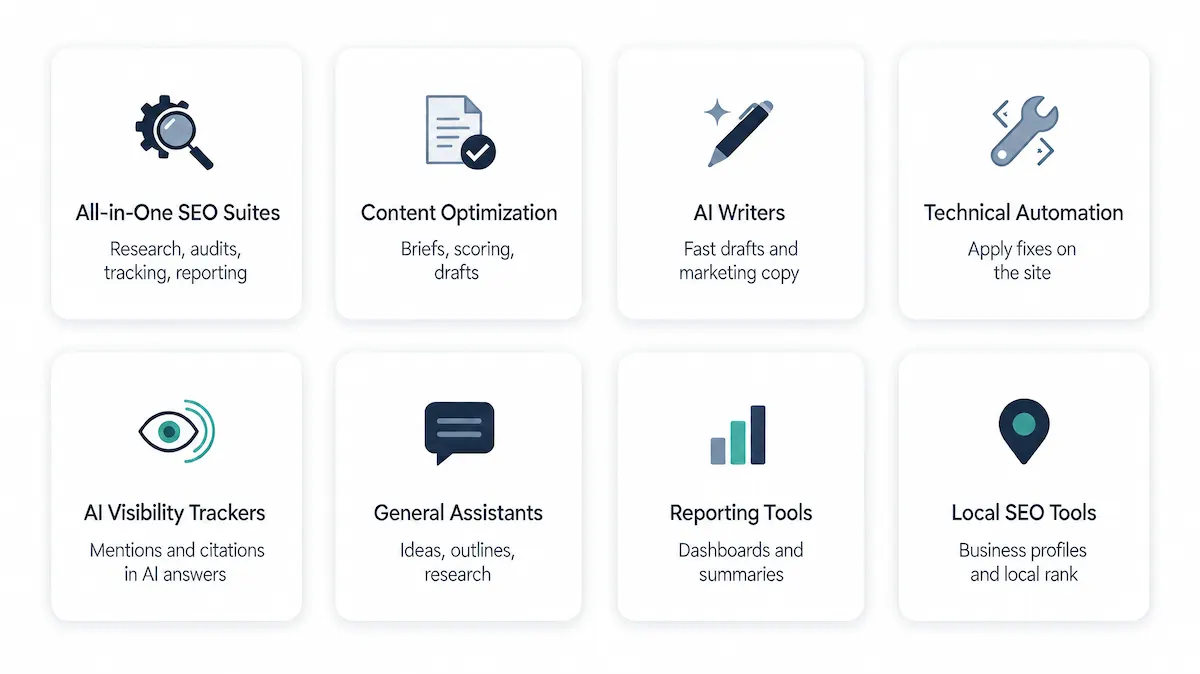
The table groups them by main job, with examples from reviews published in 2026.
| Type | Main job | Examples |
|---|---|---|
| All-in-one SEO suites | Research, audits, tracking, reporting | Semrush, Ahrefs, SE Ranking, Search Atlas |
| Content optimization tools | Briefs, scoring, drafts | Surfer, Clearscope, Frase, MarketMuse, Rankability |
| AI writers | Fast drafts and marketing copy | Jasper, Writesonic |
| Technical automation | Apply fixes on the site | Alli AI, Search Atlas OTTO |
| AI visibility trackers | Mentions and citations in AI answers | Semrush AI Visibility Toolkit, Ahrefs Brand Radar, Profound, SE Visible |
| General assistants | Ideas, outlines, research | ChatGPT, Claude, Gemini, Perplexity |
| Reporting tools | Dashboards and summaries | DashThis, Whatagraph |
| Local SEO tools | Business profiles and local rank | Localo, BrightLocal |
General assistants are useful for ideas and outlines, but they do not give search volume or keyword difficulty. Reviewers recommend pairing them with a dedicated tool to confirm that a topic is worth writing. Teams that plan a wider marketing stack can also look at our list of the best AI tools for marketing.
How to read AI visibility metrics
Trackers report a handful of numbers that look similar from tool to tool. The definitions below are common, but each vendor calculates them in its own way, so read the help page of the product you buy.
| Metric | What it shows |
|---|---|
| Mention rate | How often your brand appears in answers to the prompts you track |
| Citations | How often your pages are listed as a source |
| Average position | Where your brand sits inside the answers that mention it |
| Visibility score | A single number that combines mentions and position |
| Share of voice | Your mentions compared with those of named competitors |
| Sentiment | Whether the answers describe you in a positive or negative way |
Answers from AI assistants change from one run to the next, so one reading means little. Look at the trend over several weeks, and compare it with real traffic and sales from Search Console and Analytics.
Best AI SEO tools in 2026
This section is based on official pricing pages and published reviews. We did not test every product ourselves, so use it as a shortlist, not as a ranking. Most vendor-written lists put their own product first, which is worth remembering when you compare them.
| Tool | Best for | AI features |
|---|---|---|
| Semrush | One platform for SEO and AI visibility | Copilot assistant, AI Visibility Toolkit, content tools |
| Ahrefs | Backlink data and research | AI keyword ideas, intent labels, Brand Radar |
| SE Ranking | Agencies and many projects | AI content editor, AI Overview tracking, AI Search add-on |
| Surfer | Content optimization | Content editor, topical map, AI Tracker |
| Frase | Briefs and outlines | AI writer, question mining, GEO tool in beta |
| Alli AI | Fixing on-page issues | Live editor, schema generator, internal link automation |
| ChatGPT and Claude | Ideas, outlines, research | General assistant with no SEO data |
| Google Search Console | Free first-party data | Generative AI performance report |
Semrush
Semrush is the most complete suite on the list. Its Copilot assistant flags technical problems, toxic backlinks, traffic drops and keyword gaps, and its AI Visibility Toolkit shows how your brand appears in ChatGPT and Google AI answers.
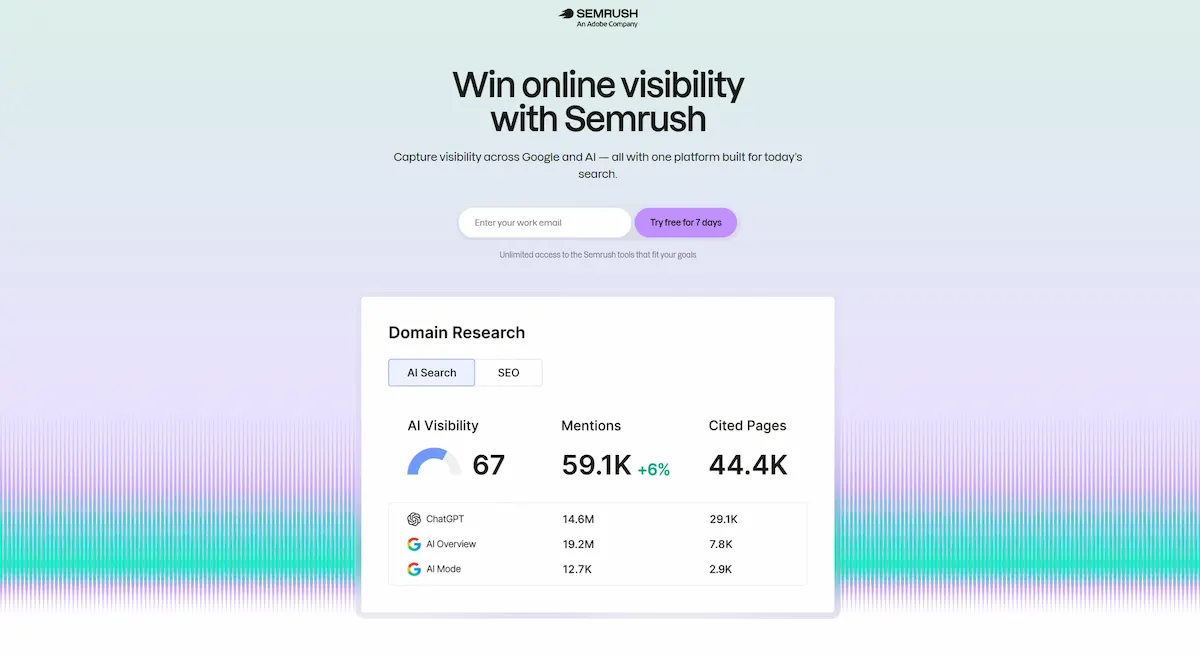
Adobe completed its purchase of Semrush on 28 April 2026, so expect changes in plans over time.
Ahrefs
Ahrefs is known for its backlink index and clean data. Its AI helps with keyword ideas, intent labels and fixes for long titles or broken links, and Brand Radar tracks AI visibility as a separate paid add-on.
Reviewers describe it as the better pick for people who want raw data over guided workflows.
SE Ranking
SE Ranking combines classic rank tracking with an AI content editor and AI Overview tracking.
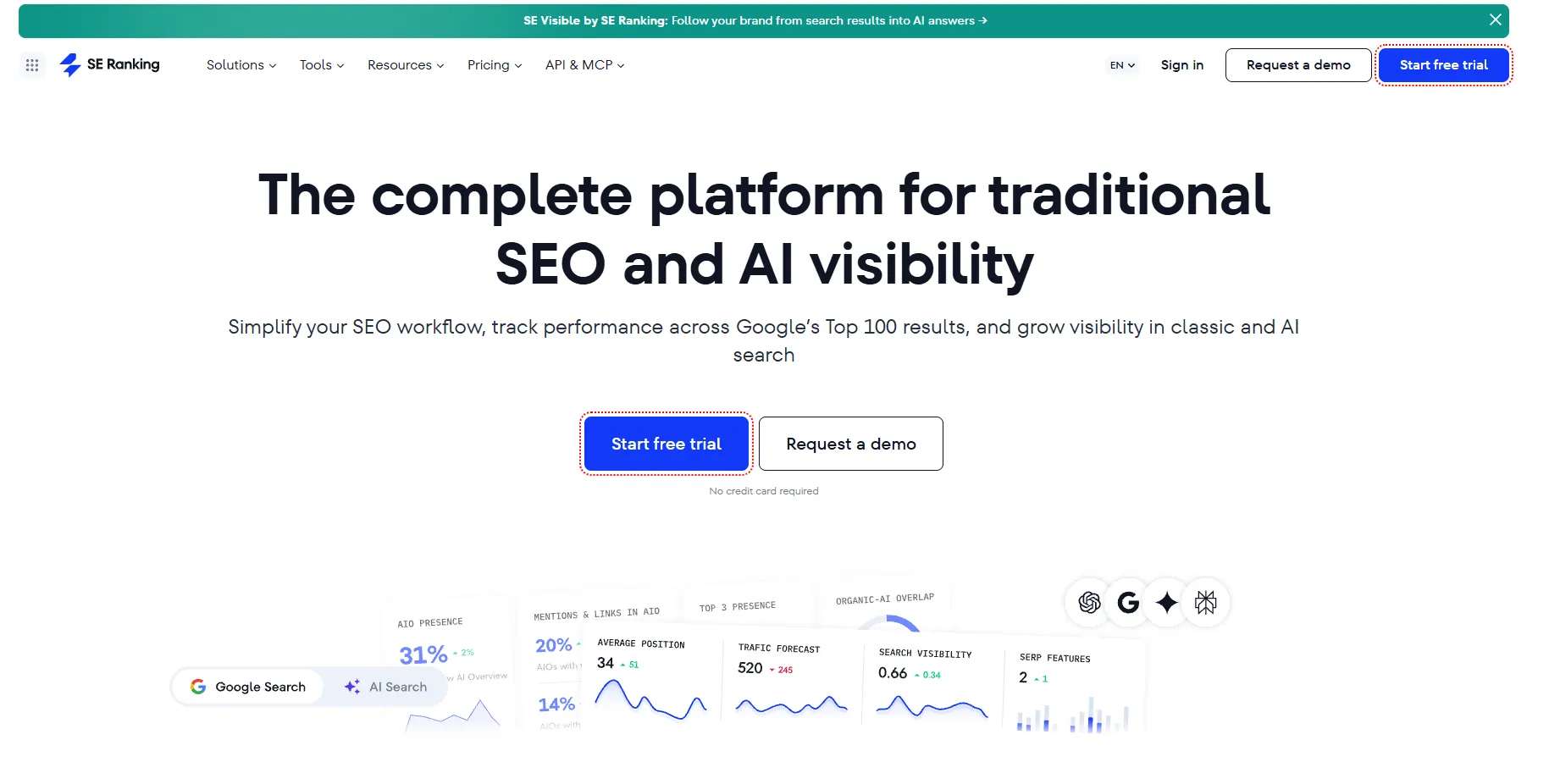
It suits agencies that manage many projects and want reports at a lower price than the two big suites.
Surfer, Frase and other content tools
Surfer scores drafts against the top results and now offers an AI Tracker with mention rate, average position and visibility score. Frase builds briefs and outlines from the top pages. Clearscope grades content for topic coverage, and MarketMuse shows what competitors cover. If you already write with a language model, these tools add the SEO data that assistants do not have, and our guide on AI content creation covers the writing side.
Alli AI
Alli AI targets technical and on-page work.
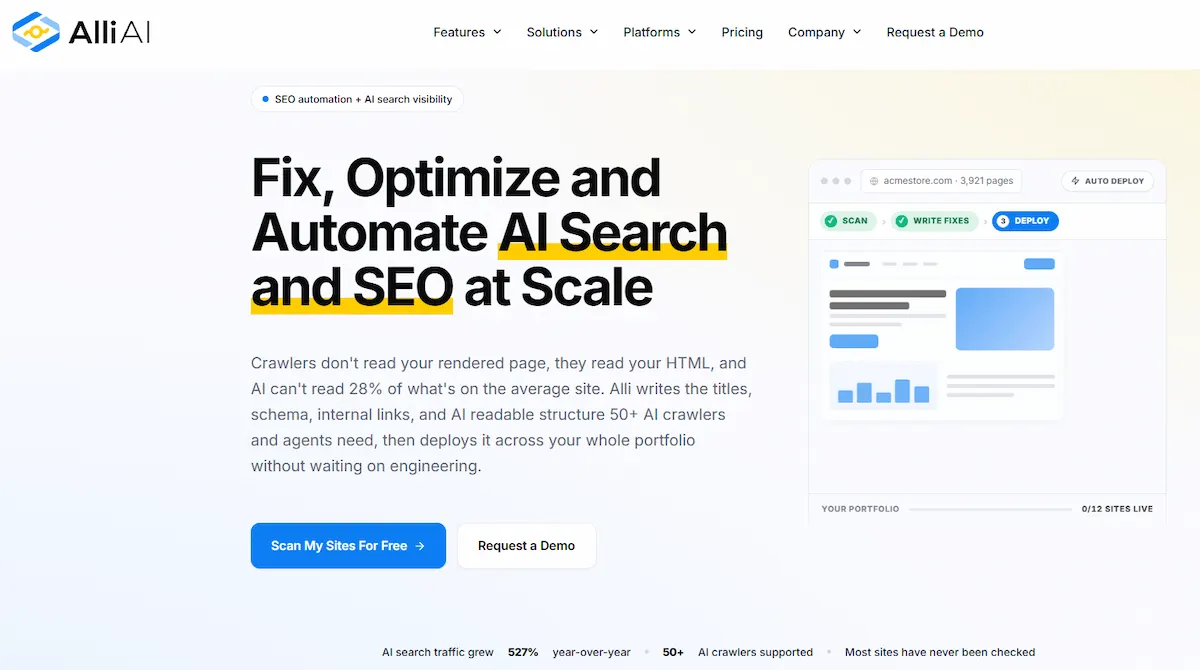
After one code snippet it can fix missing headings and meta descriptions, generate schema markup and suggest internal links, which suits teams without developer time.
ChatGPT, Claude and other assistants
General assistants are not SEO tools, but they are handy for topic ideas, outlines, meta descriptions and summaries. They cannot tell you volume, difficulty or rankings, so check every idea in a real keyword tool before you build a page around it.
How to use ChatGPT and other assistants for SEO
General assistants work best as a thinking partner, not as a data source. Give them real input, such as a keyword list exported from a tool or the text of your page, and ask for a specific result. If the assistant has no web access, paste the text of the competitor pages you want it to compare.
- “Group these 40 keywords by search intent and name the page each group belongs on.”
- “Write five title tags under 60 characters for a page about this topic and this audience.”
- “Here are the headings of the top five pages. List the subtopics they cover and what they miss.”
- “Read my draft and list claims that need a source.”
Do not ask an assistant for search volume, keyword difficulty or rankings, because it has no live data and may invent numbers. Check every suggestion in a keyword tool, and give the assistant clear context, a goal and an example of the format you want, since vague requests return vague answers.
AI SEO tools for WordPress and Shopify
Many small sites already have AI inside the platform they use. Yoast SEO AI writes meta titles and descriptions from the WordPress editor, and Rank Math offers a similar assistant called Content AI. Shopify Magic drafts product descriptions and other store text from your product data. These features are narrow, but they cost little or nothing extra, so check what your plan includes before you add a separate subscription. Alli AI works with any content management system through its code snippet.
More AI SEO tools worth a look
- Clearscope: grades content for topic coverage and does not write for you.
- MarketMuse: shows what competitors cover and where your content is thin.
- Rankability: builds a brief, scores a draft and monitors existing pages.
- Writesonic: started as an AI writer and now tracks brand visibility in AI answers.
- Profound: an AI visibility tool aimed at larger brands.
- SE Visible: the AI tracker from SE Ranking, sold on its own.
- Mangools AI Search Grader and Watcher: score your visibility in AI answers and watch changes over time.
- DashThis: a reporting tool that adds written insights on top of connected data.
Check the current plans on the vendor pages, since AI features and prices in this group change quickly.
Best AI SEO tool by use case and budget
| Use case | Reasonable pick | Why |
|---|---|---|
| Starting with no budget | Search Console, a free trial and a general assistant | Real data at no cost |
| SEO and AI tracking in one plan | Semrush One | Both in a single price from $199 |
| Backlinks and research data | Ahrefs | Strong link index and clean data |
| Many client projects | SE Ranking | Project volume and lower price |
| Better content | Surfer, Frase or Clearscope | Briefs and scores based on top results |
| Technical fixes without developers | Alli AI | Applies changes from a dashboard |
| Only AI mentions | AI Visibility Toolkit, Brand Radar or SE Ranking add-on | Dedicated tracking |
| Monthly budget | What fits |
|---|---|
| $0 | Search Console, Ahrefs AI Visibility Checker, free plans of assistants |
| Up to $100 | Semrush AI Visibility Toolkit at $99, or one content tool on a trial |
| $100 to $250 | Semrush SEO at $139, Ahrefs Lite at $129, SE Ranking Core at $129 or Semrush One at $199 |
| Above $250 | Ahrefs Standard and higher, Semrush Pro+ and Advanced, Brand Radar bundle |
AI SEO tools pricing in 2026
Prices below are US monthly prices checked in October 2026 on vendor pages and independent price trackers. They change often, so confirm them on the official sites before you buy. Many articles still list older numbers.
| Product | Price | What you get |
|---|---|---|
| Semrush SEO plan | $139 per month | SEO suite without AI tracking |
| Semrush One Starter | $199 per month ($165.17 billed yearly) | SEO plus AI search tracking, 50 prompts per day |
| Semrush One Pro+ / Advanced | $299 / $549 per month | 100 / 200 prompts per day |
| Semrush AI Visibility Toolkit | $99 per month per domain | AI tracking only |
| Ahrefs Lite / Standard / Advanced | $129 / $249 / $449 per month | SEO suite without AI tracking |
| Ahrefs Brand Radar | $199 per AI platform, $699 for all | Add-on on top of a base plan, includes 2,500 custom prompt checks in the bundle |
| SE Ranking Core / Growth | $129 ($103.20 yearly) / $279 per month | SEO suite, 100 daily prompts on Core |
| SE Ranking AI Search add-on | $89 per month ($71.20 yearly) | 200 more prompts |
Two points stand out. Tracking AI visibility is an extra cost almost everywhere, from about $71 to $199 per month before you add a base plan. And Semrush One is the cheaper route if you need both SEO and AI tracking, since Ahrefs plus Brand Radar costs more for a similar setup. To place these costs next to other tools in your company, read our guide on how much AI tools cost.
Are there free AI SEO tools?
Yes, with limits. Google Search Console is free and now includes a Generative AI performance report that shows how your content appears in Google AI features. Ahrefs offers a free AI Visibility Checker for one-off checks, and many paid tools have free trials of 7 to 14 days. General assistants such as ChatGPT and Claude have free plans for ideas and outlines. A free stack works for a small site, but it will not give you competitor data at scale.
Which businesses need AI SEO tools?
Any site with search traffic can use them, but the need differs by type of business. The table lists common cases and a starting point. These are suggestions based on how the tools are built, not a ranking.
| Business | Main need | Start with |
|---|---|---|
| Online shop | Many product pages, technical fixes | An SEO suite and any AI tools built into the shop platform |
| SaaS company | Topic clusters, comparison pages, AI visibility | A content tool plus a tracker |
| Local business | Map visibility, reviews, local pages | A local SEO tool and Search Console |
| Blogger or publisher | Briefs, refreshes of old posts | A content optimization tool and an assistant |
| Agency | Many projects and clear reports | SE Ranking or Semrush and a reporting tool |
| Startup with a small budget | A few topics it can win | Search Console and free trials |
| Large company | Scale, permissions, API access | An enterprise suite and a tracker |
How to choose an AI SEO tool
Start with the job, not with the brand. Write down the two tasks that cost you the most time, and look for a tool that does those well. Buying a full suite for a single task is the most common waste of money.
- Content work: choose a content optimization tool such as Surfer, Frase or Clearscope.
- Research and links: choose Semrush or Ahrefs.
- Many client sites: check SE Ranking for project volume and price.
- Technical fixes without developers: look at Alli AI or a similar automation tool.
- Brand mentions in AI answers: pick a dedicated tracker and check which engines it covers.
Choose by team size
| Team | Sensible start | Why |
|---|---|---|
| Solo blogger or new site | Search Console, a free trial and a general assistant | Low cost while the site is small |
| Small business | One suite or one content tool | Covers most needs without extra seats |
| Agency | SE Ranking or Semrush with reporting | Many projects and white-label reports |
| Enterprise | A suite with API access and a tracker | Scale, permissions and support |
Whatever the size of the team, a wider checklist that covers price, privacy and support helps, and our guide on how to choose AI tools for business provides one.
Questions to ask before you pay
- Which AI engines and countries does the tracker cover?
- How many prompts, keywords and projects are included, and what does an extra one cost?
- Does the tool apply changes or only suggest them?
- Can you export data and cancel monthly?
- Does the vendor say where it gets its data?
A simple scorecard for comparing tools
When two or three tools look similar, score each one from 1 to 5 on the points below and add the numbers. Give extra weight to the two points that matter most for your team.
| Criterion | What to check |
|---|---|
| Fit for your main task | Does it solve the job you named at the start? |
| Data source | Where do the numbers come from and how fresh are they? |
| Integrations | Search Console, Analytics, your content management system |
| Control | Can you approve changes before they go live? |
| Ease of use | How long until a new team member gets a result? |
| Price over a year | Seats, prompts, projects and add-ons included |
| Support and exit | Help when something breaks, export and monthly cancellation |
How to use AI SEO tools step by step
A simple routine keeps the tools in a helpful role. The steps below fit most content sites.
- Set a goal for one page or topic, such as a keyword you want to rank for.
- Run keyword research and group the terms by intent.
- Build a content brief from the top results and your own notes.
- Write the page with your own facts, examples and experience.
- Check the draft with a content score, but do not chase 100%.
- Review facts, links and tone by hand before you publish.
- Track rankings, clicks and, if it matters to you, AI mentions.
- Refresh the page when data shows a drop or the topic changes.
Each step works best when you keep a short note of what the tool suggested and what you changed. After a few weeks the notes show which suggestions helped your pages and which ones you can ignore. For a longer walkthrough of the same routine, read our how-to on using AI for SEO.
Benefits of AI SEO tools
- Time: keyword grouping, briefs and audits take minutes instead of hours, although reviewers say the real savings are smaller than vendors claim.
- Scale: one person can monitor many pages and projects.
- Clearer reports: written summaries help people who do not read charts.
- Fewer missed issues: crawlers flag technical problems that nobody checks by hand.
- New visibility data: trackers show brand mentions in AI answers that older tools cannot see.
Small teams feel these gains the most, because one person often handles research, writing and reporting at the same time. If you run a small company, our guide on AI for small business shows what to buy first and what to leave for later.
Limits and risks of AI SEO tools
AI SEO tools support the work, they do not replace it. They are strong at structure and speed, and weak at judgment, original ideas and knowing your customers. Several limits matter in daily use.
- Correlation, not proof: scores copy what ranks today and cannot promise a position.
- Generic output: drafts built from the top results sound like every other page on the topic.
- Wrong facts: language models can invent numbers and sources, so every claim needs a check.
- Vendor claims: many figures about traffic gains come from the company that sells the tool.
- Tracking noise: AI answers change between runs, so a mention rate from a few prompts is a rough signal.
- Cost creep: prompt packs, extra seats and add-ons raise the bill beyond the first price.
- Data privacy: some tools need access to your site, analytics or customer data, which is covered in our guide on AI data privacy for business.
What AI SEO tools will not do
- They will not guarantee a ranking or a mention in AI answers.
- They will not decide your strategy, your audience or your brand voice.
- They will not check their own facts, so claims in drafts need a human check.
- They will not replace original information such as your own data, examples and experience.
- They will not see inside the ranking systems of Google, whatever the sales page says.
Is AI content bad for SEO?
Not by itself. Google says in its guidance on generative AI content that such tools can help with research and with adding structure to original content. The risk is volume without value: using AI to produce many pages that add little for users may break the spam policy on scaled content abuse.
The safe approach is to use AI for research and drafting, then add your own expertise, check every fact and publish fewer, stronger pages.
Common mistakes when buying AI SEO tools
- Buying a suite for one task: a full platform costs more than a single content or reporting tool.
- Trusting the score: a green score does not mean the page answers the question better than the others.
- Publishing at scale: many thin pages built from templates invite the spam problems described above.
- Skipping Search Console: the free report shows real impressions and clicks that no outside tool can match.
- Tracking too few prompts: a handful of prompts gives a rough signal at best, so compare trends over weeks and not single days.
- Ignoring the exit: check that you can export data and cancel without a long contract.
What Google says about AI search and SEO
On 15 May 2026 Google published a guide called Optimizing your website for generative AI features on Google Search. Its main message is that the best practices for SEO still apply, because the AI features in Google Search rest on the same ranking and quality systems.
The guide has several practical points for anyone who buys AI SEO tools:
- Pages must be indexed and eligible for snippets to appear in AI Overviews and AI Mode.
- Google says you do not need special schema markup, an llms.txt file, content split into small chunks or text rewritten for AI to appear in its own AI features.
- The Generative AI performance report in Search Console shows how your pages perform in those features.
- Tracking tools from outside see AI answers from the outside only. None of them can see inside the ranking systems of Google, so compare their advice with the official guidance.
One caution: this guide speaks about Google features. Other assistants such as ChatGPT and Perplexity have their own sources, and brand mentions on other sites can affect how they describe you. A tool that tracks those answers can still be useful, as long as you do not treat it as a ranking guarantee.
Is SEO dead because of AI?
Not according to Google. Its 2026 guide says that optimizing for generative AI search is still SEO, and that pages must be indexed and useful to appear in AI Overviews and AI Mode. What changed is the number of places where a brand can be seen. Besides ten blue links, answers from Google, ChatGPT and Perplexity now send traffic and shape opinions, and that is the reason AI visibility tools exist. The basics of crawlable, helpful pages stay the same, and the tools only change how fast you can work on them.
Final verdict on AI SEO tools
AI SEO tools are worth paying for when they remove a task that costs you hours every week, such as briefs, audits or reporting. They are not worth it when they only add a score to look at. Start with the free tools, add one paid product for your biggest bottleneck and test it for a month.
Keep the human parts of SEO in your hands: choosing topics, adding real experience, checking facts and judging whether advice fits your site. If you use several tools, plan them as one set, and our guide to an AI tool stack for business shows how to keep it small.
AI SEO tools FAQ
What are SEO AI tools?
SEO AI tools are software products that use machine learning and language models to help with search optimization. They support keyword research, content briefs, technical audits, rank tracking and the tracking of brand mentions in AI answers.
What is an AI SEO tool?
An AI SEO tool is a program that reads search data and suggests or applies the next step, such as a keyword group, a content brief or a technical fix. A person still reviews the result and makes the final decision.
Are AI SEO tools worth it?
They are worth it when they save real time on research, audits or reporting. They are not worth it as a replacement for strategy or editing, since reviewers agree that the gains from time savings are real but smaller than vendors claim.
What is the best AI SEO tool?
No single tool wins every job. Semrush and Ahrefs lead on research and data, Surfer and Frase on content, SE Ranking on agency work and Alli AI on technical fixes. Pick by task, budget and team size.
Are there free AI SEO tools?
Yes. Google Search Console is free and includes a Generative AI performance report. Ahrefs offers a free AI Visibility Checker, and most paid tools have a free trial. ChatGPT and Claude have free plans for ideas and outlines.
Can AI replace SEO?
No. AI speeds up research, drafting and reporting, but strategy, original information and quality control still need people. Google also says that optimizing for AI search remains SEO.
Is AI content bad for SEO?
Not by default. Google allows AI-assisted content, but mass-producing pages that add little value can violate its spam policy on scaled content abuse. Add your own expertise and check every fact before publishing.
Do AI SEO tools help me show up in AI Overviews and ChatGPT?
They can show whether your brand appears and where competitors are cited. They cannot guarantee a mention. Google says the same SEO fundamentals apply to AI Overviews, and ChatGPT results depend on other sources as well.
How much do AI SEO tools cost?
Entry plans for full suites start around $129 to $139 per month. Adding AI tracking costs about $71 to $199 per month more, and Semrush One with SEO plus AI tracking starts at $199 per month. Free options exist for small sites.
What is the difference between AI SEO tools and GEO tools?
AI SEO tools use AI to speed up regular SEO work. GEO tools track and improve how your brand appears in AI-generated answers. Many products now offer both, so check which part you actually need.
What is AI Mode in SEO tools?
Google AI Mode is a conversational search mode from Google. SEO tools such as SE Ranking, Ahrefs and Semrush track whether your pages are cited in it, next to AI Overviews, ChatGPT and Perplexity.
Is SEO dead with AI?
No. Google says optimizing for generative AI search is still SEO. The number of places where people find brands has grown, but crawlable, useful pages remain the base.
Can ChatGPT do SEO?
It can help with ideas, outlines, title tags and summaries. It cannot give search volume, keyword difficulty or rankings, so pair it with a keyword tool and check every claim it makes.
What is an AI SEO agent?
An AI SEO agent is a tool that runs several SEO tasks in a row, such as finding keyword gaps, writing briefs and suggesting fixes. Current agents are semi-autonomous and need human approval before anything goes live.
Which AI SEO tool is best for small business or beginners?
Start with Google Search Console, a free trial and a general assistant. If you then need one paid tool, choose by your biggest task: a content tool for writing, a suite for research, or a tracker for AI mentions.
Do I need an AI SEO tool for a small website?
Not at first. Search Console and the AI features built into WordPress or Shopify cover the basics. A paid tool starts to pay off when research, briefs or reporting take hours every week.
How are AI SEO tools different from Semrush or Ahrefs?
Semrush and Ahrefs are SEO suites that now include AI features. Other AI SEO tools focus on one job, such as content scoring or AI visibility tracking. Many buyers use one suite and one specialist tool.
Are AI SEO tools safe for Google rankings?
Using them is not a problem by itself. The risk comes from publishing many pages that add little value, which Google treats as scaled content abuse, or from applying automated changes to your site without review.